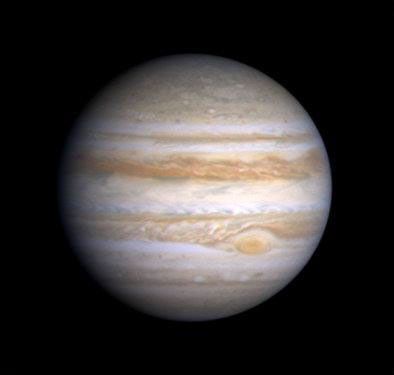
Cassini took this image of Jupiter in October of 2000, about two months before its closest approach. Credit: NASA/JPL/University of Arizona

Key Takeaways:
- On December 30, 2000, the Cassini spacecraft performed its closest Jupiter flyby, passing within approximately 6 million miles (9.7 million kilometers).
- During this encounter, Cassini captured approximately 26,000 images, enabling comprehensive mapping and the identification of a large, dynamic high-latitude storm distinct from the Great Red Spot.
- The mission also facilitated the analysis of Jupiter's temperature, atmospheric composition, and the radio "chirps" produced by its magnetic field interacting with the solar wind.
- The Jupiter flyby served as a crucial gravitational assist maneuver for Cassini's journey to Saturn and provided an important practice run for its instruments.
On Dec. 30, 2000, Cassini made its closest approach to Jupiter, passing by at only about 6 million miles (9.7 million kilometers) away. As it made its trip past the gas giant, Cassini captured about 26,000 images, allowing for thorough mapping and revealing a large storm, one at higher latitudes and more dynamic than the Great Red Spot. The planet’s temperature and atmospheric composition were also analyzed, and scientists were able to study the radio “chirps” emitted when Jupiter’s magnetic field deflects the solar wind.
Cassini would use Jupiter’s gravity to slingshot it on to Saturn, and the data-gathering and analysis at Jupiter provided a practice run for Cassini’s instruments before they had to perform at their ultimate destination.