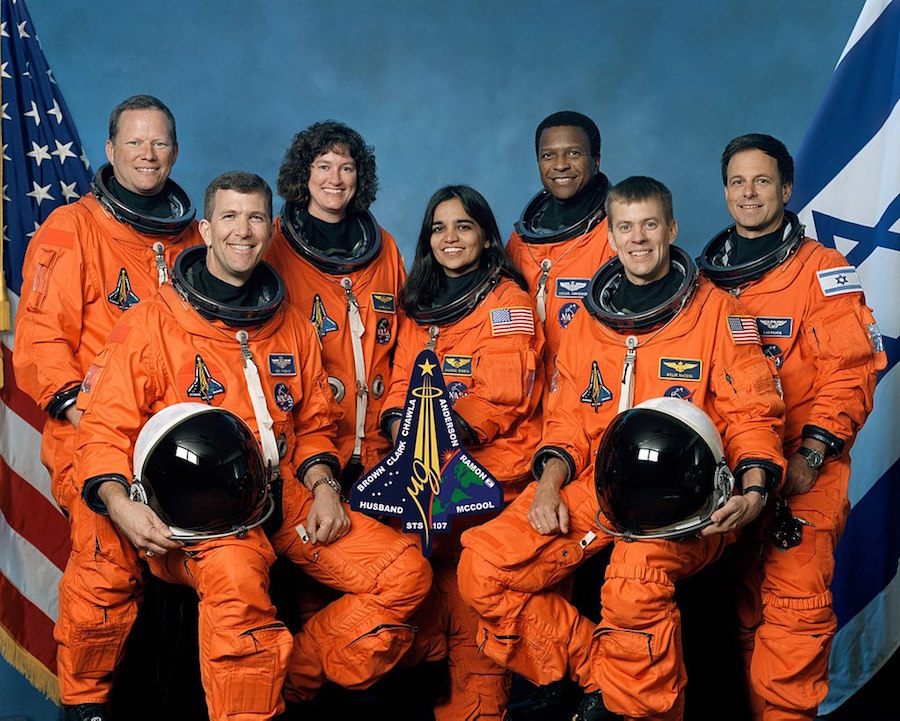
On Jan. 16, 2003, Space Shuttle Columbia launched on its 28th mission, STS-107. NASA had five additional space shuttle missions planned for 2003, but STS-107 was the only one focused on scientific research; the others were focused on continuing expansion of the International Space Station. The astronauts – Americans Rick Husband, Willie McCool, Michael Anderson, David Brown, Laurel Clark, and Kalpana Chawla, and Ilan Ramon of Israel – completed an ambitious and productive mission. The team conducted nearly 80 experiments, ranging from combustion in microgravity to improving the efficiency of anticancer drugs, during their 16 days in orbit.
However, while they were in orbit, NASA’s post-launch analysis revealed that a piece of foam insulation had broken off the external tank during liftoff, impacting the insulating tiles on the underside of Columbia’s left wing. It was unclear the amount of damage it had caused, and similar “foam-shedding” events had occurred during other space shuttle launches. NASA management concluded the strike posed no real danger – or, if it did, there would be nothing the astronauts could do to remedy it while in space.
As the shuttle reentered the atmosphere on Feb. 1, the hole the impact had caused allowed superheated air to breach the wing, melting its aluminum structure and ultimately destroying it. The rest of Columbia disintegrated, breaking apart at an altitude of 39 miles (63 kilometers) over northeast Texas. All seven astronauts were killed in the disaster. NASA’s accident investigation board report analyzed not only the physical faults, but the organizational causes rooted in the history and culture of the space shuttle program – including constraints on resources, lax safety practices, poor communication, and fluctuating priorities. The following year, President George W. Bush announced that the space shuttle program would be retired by 2010.