
Sky This Week is brought to you in part by Celestron.
Friday, December 5
Saturn’s far-wandering moon Iapetus reaches superior conjunction tomorrow, December 6. Observers in the U.S. will be able to spot this moon just over 1′ due south of the ringed world tonight.
First-magnitude Saturn stands high in the south about two hours after sunset. It’s easy to locate as the brightest light in this part of the sky, about 45° high by 6:30 P.M. local time. Zoom in on the planet with a telescope and you’ll likely notice a plethora of moons nearby. The brightest is Titan, which sits some 2.7’ east of the planet’s center, shining around magnitude 8.5. Tenth-magnitude Dione, Rhea, and Tethys are closer to Saturn, but their positions change quickly with time. By 6:30 P.M. CST, Dione is just east of the planet, while Tethys and Rhea are to the west (with the former closer to Saturn than the latter). Over the next few hours, Tethys continues moving west as Rhea moves east, toward Saturn. The two pass and appear to merge around 9 P.M. CST; they then pull away from each other, with Rhea moving closer to Saturn and Tethys moving away, now farther from the planet.
Fainter Iapetus appears alone, 1.2’ south of the planet, shining at 11th magnitude. It is moving so slowly that it should stay in this position all evening until Saturn sets around 12:40 A.M. local time.
Sunrise: 7:07 A.M.
Sunset: 4:34 P.M.
Moonrise: 5:05 P.M.
Moonset: 8:14 A.M.
Moon Phase: Waning gibbous (98%)
*Times for sunrise, sunset, moonrise, and moonset are given in local time from 40° N 90° W. The Moon’s illumination is given at 10 P.M. local time from the same location.
Saturday, December 6
This evening brings a transit of Europa and its shadow across Jupiter, beginning late and lasting overnight.
Jupiter is located in eastern Gemini; the giant planet rises around 7:30 P.M. local time, not long after the waxing Moon (now in western Gemini). At magnitude –2.6, Jupiter should still stand out well to the naked eye, despite the bright Moon nearby.
East Coast observers and even some skywatchers in the eastern Midwest may catch Io and its shadow both on the jovian disk as it rises. You’ll need a telescope to spot the pair (and Europa’s transit later on). At 8:30 P.M. EST, Io is roughly midway across the disk, following its shadow, which appears closer to the western limb. The shadow reaches the limb and disappears shortly after 9 P.M. EST, leaving Io alone on the disk, also heading for the western limb. Io’s transit ends around 9:50 P.M. EST, leaving Jupiter’s disk clear — for now.
For a while, Io is alone to Jupiter’s west. Europa is closing in from the east, with Callisto and Ganymede much farther west (the former is closer to the planet than the latter). Late in the evening, before Europa has reached the limb, its shadow appears at 11:54 P.M. EST. Its transit takes nearly three hours to complete as it moves from east to west.
Europa itself finally reaches the planet and begins its transit at 1:31 A.M. EST (Now the 7th for the eastern U.S.). Observers can watch the moon’s progress for several hours, until Europa finally leaves the disk just minutes after 4:20 A.M. EST on the 7th.
Sunrise: 7:08 A.M.
Sunset: 4:34 P.M.
Moonrise: 6:18 P.M.
Moonset: 9:19 A.M.
Moon Phase: Waning gibbous (93%)
Sunday, December 7
The Moon passes 4° north of Jupiter in Gemini at 11 A.M. EST, after both have set. However, you can catch the pair in the evening sky; they rise a few hours after sunset, with Jupiter now leading the way above the horizon first. The Moon is in Cancer, some 7.5° east of Jupiter this evening.
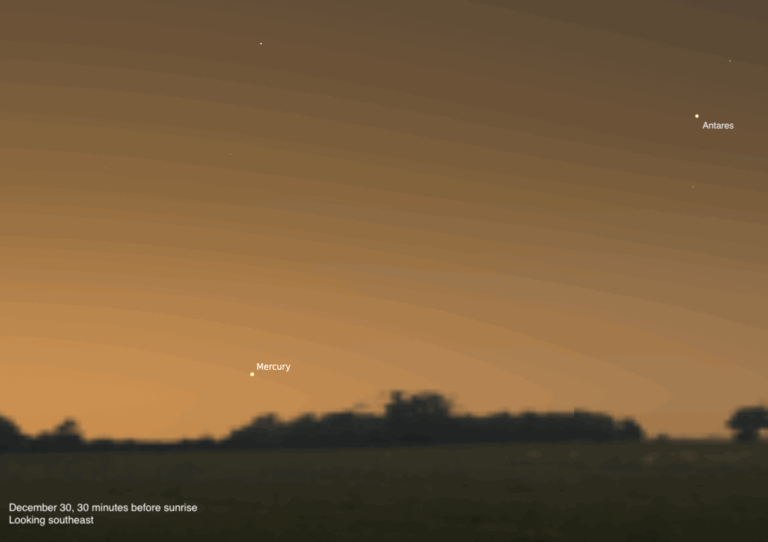
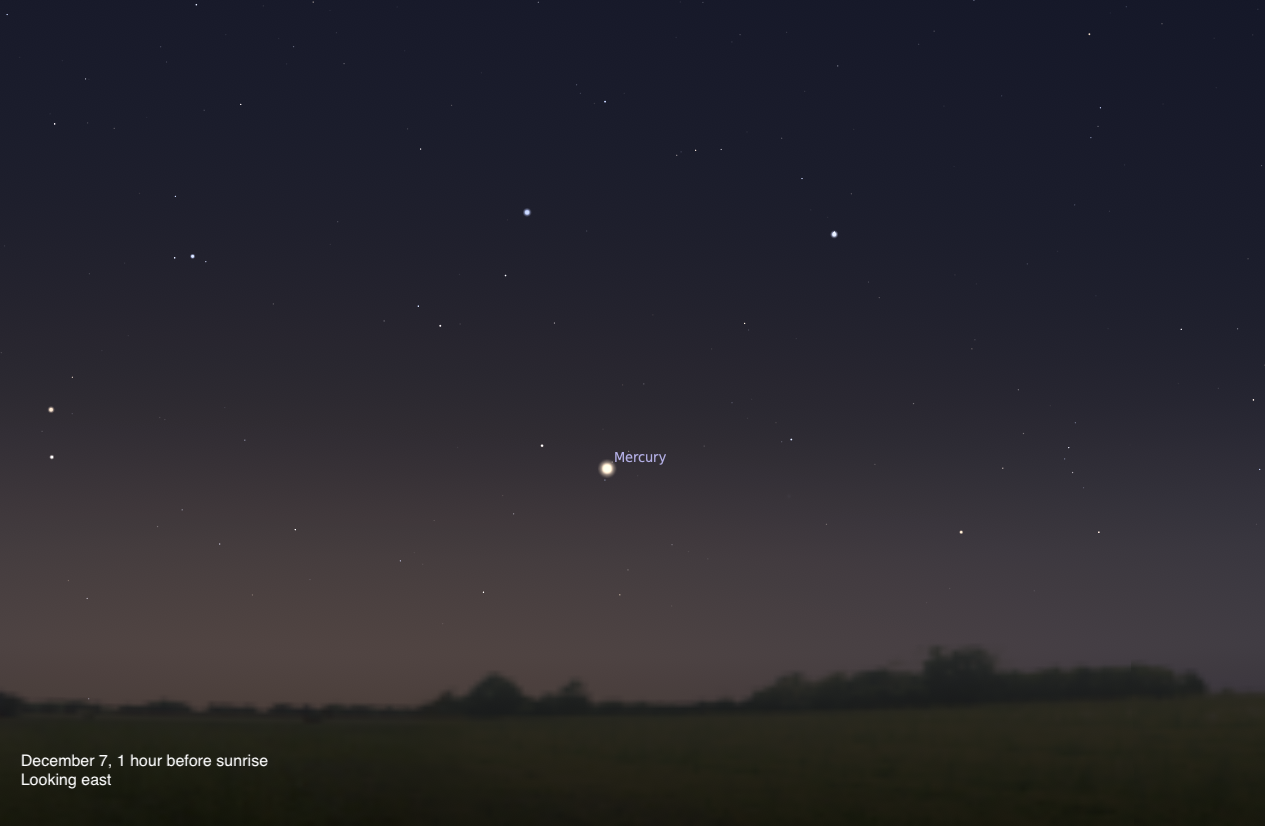
Early-morning observers can catch Mercury just hours before it reaches greatest western elongation from the Sun at 4 P.M. EST. The solar system’s smallest planet now stands 21° west of our star, rising nearly two hours before the Sun.
By 6 A.M. local time, Mercury is about 6° high in the east, amid the stars of Libra. Shining at magnitude –0.4, it should be easy to spot in the still-dark sky, close to the fainter, 4th-magnitude star Gamma (γ) Librae. Through a telescope, Mercury shows off a disk that is 7” wide and 61 percent lit. Pay particular attention to the orientation of the lighting — Mercury appears illuminated from below as it rises, indicating the direction of the Sun as it follows Mercury into the sky.
As always, make sure to put away any optics at least several minutes before sunrise from your location. That time may differ from the one given below.
Asteroid 16 Psyche reaches opposition at 9 P.M. EST tonight in Taurus the Bull. If you’d like to find it, wait until the constellation is well above the eastern horizon and center the bright orange star Aldebaran in your telescope. From there, scan slowly east-northeast; Psyche tonight lies just over 6° from Aldebaran in this direction, glowing at magnitude 9.7.
Sunrise: 7:09 A.M.
Sunset: 4:34 P.M.
Moonrise: 7:35 P.M.
Moonset: 10:10 A.M.
Moon Phase: Waning gibbous (86%)
Monday, December 8
Titan crosses Saturn early this evening, an event best observed from Europe as the transit begins around 17:40 UT (12:40 P.M. EST). The large moon takes several hours to pass in front of the ringed planet, however, and U.S. East Coast observers might be able to catch the tail end of the event, as there are roughly two hours left in the transit around sunset along the Eastern Seaboard. Try swinging your telescope over to Saturn, high in the south, as soon as the sky starts to grow dark. It may take some effort early on to make out the moon in front of the bright disk, as contrast will be lower, but as the evening grows darker, you may spot Titan closing in on Saturn’s western limb, north of the rings.
The transit ends around 6:40 P.M. EST, as darkness is now falling across the Midwest. After this time, Titan will still appear near Saturn, moving farther west of the ringed world with time. Also visible west of Saturn later this evening will be 10th-magnitude Rhea, while similarly bright Tethys and Dione are east of the planet. Take note of their locations — tomorrow we’ll be back to observe these two moons make a close pass, but they’ll be on the other side of the planet.
This is the second-to-last transit of Titan for the year; the other occurs on Christmas Eve, although it begins about an hour earlier and will again be best observed from Europe.
Sunrise: 7:10 A.M.
Sunset: 4:34 P.M.
Moonrise: 8:50 P.M.
Moonset: 10:49 A.M.
Moon Phase: Waning gibbous (77%)
Tuesday, December 9
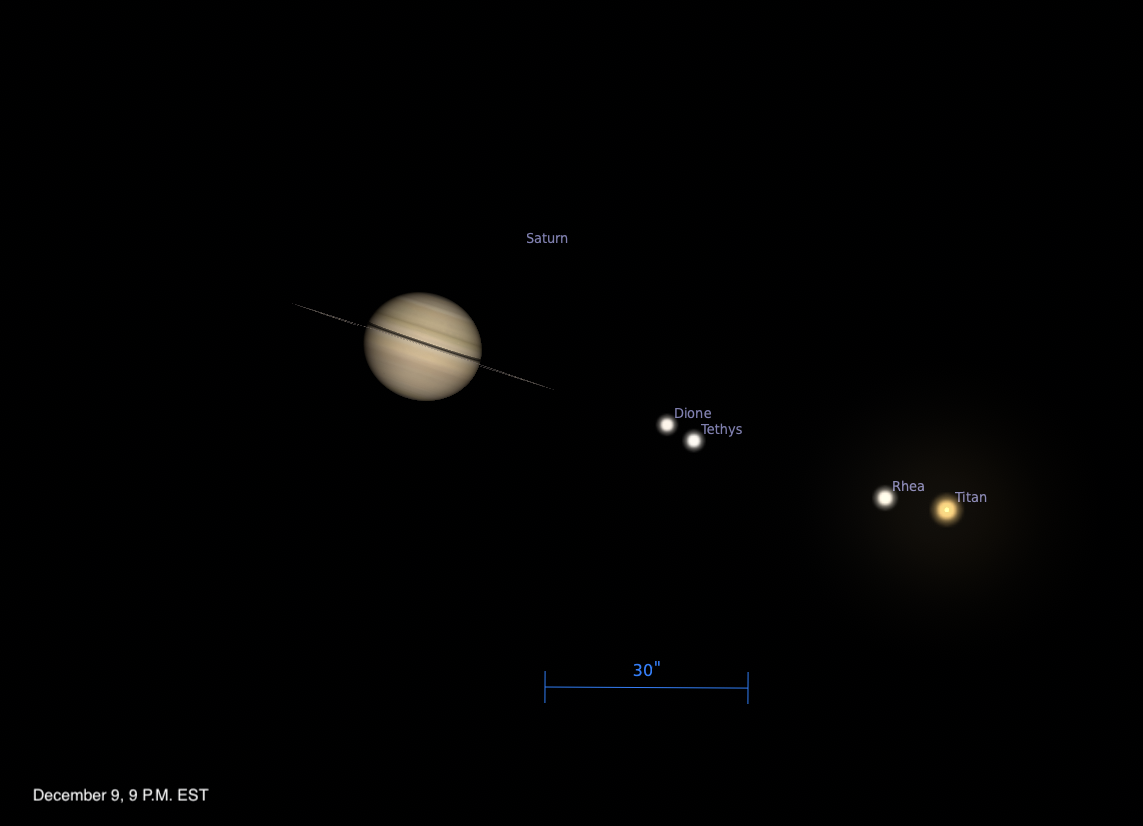
We’re back at Saturn again tonight to watch as two of its 10th-magnitude moons, Dione and Tethys, show off their relative motions as they orbit the ringed world.
Look for Saturn in the south after dark, easy to spot at 1st magnitude. Train your telescope on the ringed world and early in the evening, you’ll see a gaggle of moons located just to the planet’s west. Closest is Dione, followed by Tethys, then Rhea, and capped by brighter Titan.
But keep watching. Both Dione and Tethys are moving west, but Dione appears to be moving faster, slowly catching up to Tethys. Between 10 and 11 P.M. EST, Dione finally catches up. The two moons will likely appear to merge for a time as Dione skims just 1″ north of Tethys, then pulls away to the west. It’s a fascinating event to watch unfold, showing clearly orbital dynamics in motion.
Sunrise: 7:10 A.M.
Sunset: 4:34 P.M.
Moonrise: 10:02 P.M.
Moonset: 11:20 A.M.
Moon Phase: Waning gibbous (67%)
Wednesday, December 10
The Moon passes 0.7° north of Regulus at 2 A.M. EST. Observers in Greenland and northern Canada will see our satellite occult this star, while others will simply see it pass close by without blocking its light. Rising before midnight, you can watch the Moon’s progress as Leo climbs in the eastern sky. For some observers along the West Coast, the Moon will pass the star while both are quite low in the sky.
Mercury has now brightened slightly in the early-morning sky, shining at magnitude –0.5 and rising around 5:30 A.M. local time. It is some 7° high an hour before sunrise. Through a telescope, its phase has increased from earlier in the week, and the planet is now 70 percent lit.
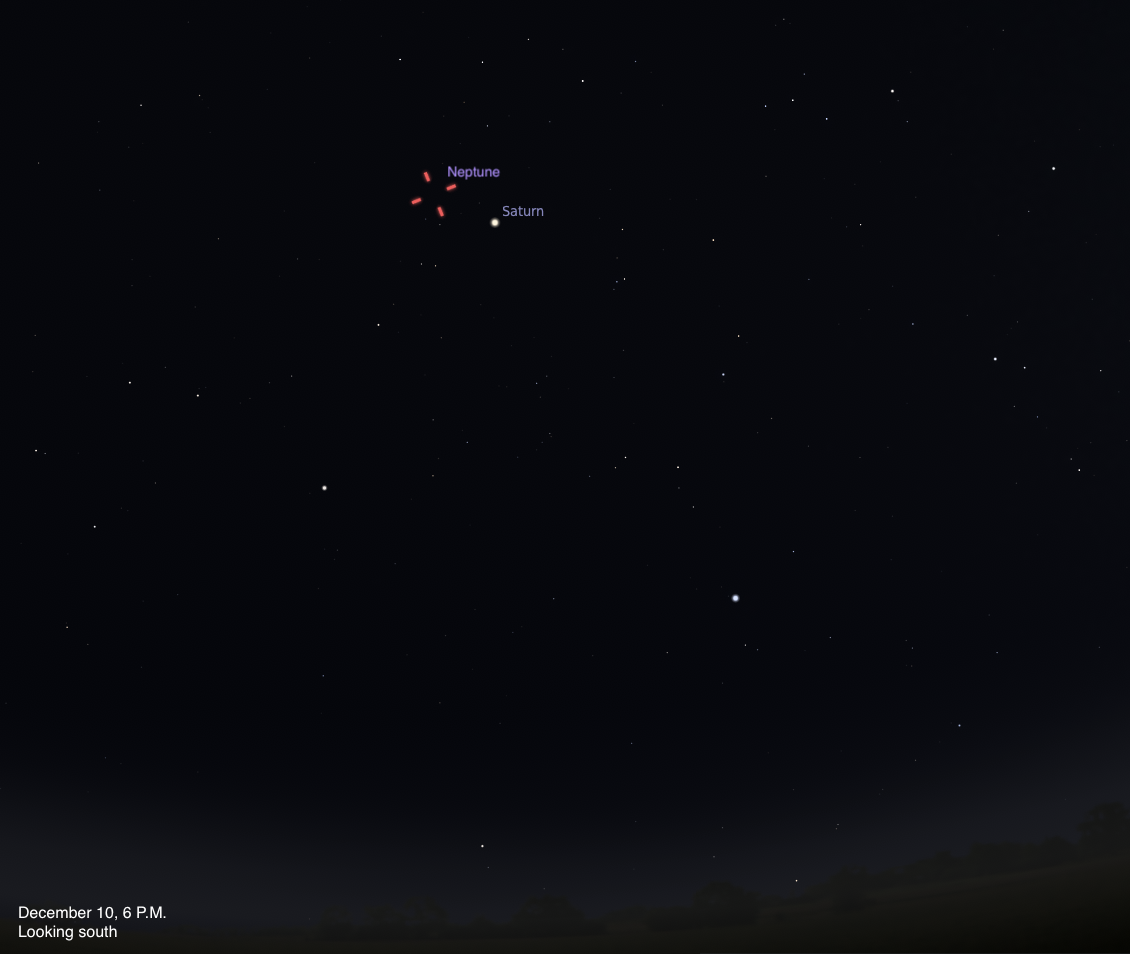
Neptune is stationary at 7 P.M. EST, ending its retrograde motion. The ice giant is located near Saturn in the evening sky, making it particularly easy to find despite its dim magnitude of 7.7. The pair hangs near the Circlet of Pisces as the region slowly sets. Around 7 P.M. local time, Neptune is still nearly 50° high in the south, offering plenty of time to find it for easy viewing.
First locate Saturn, likely familiar by now as the brightest point of light in this part of the sky, just to the lower left of Pisces’ Circlet. Neptune is 4.2° northeast of Saturn, within the same binocular field or three or so telescope fields from the brighter planet, depending on your field of view. The distant planet’s disk spans just 2” on the sky, and may appear as a dim, “flat” star to the eye; you may notice it has a faint bluish-gray hue.
After today, the planet will begin tracking eastward on the sky, though its motion is subtle because of its vast distance from Earth.
Sunrise: 7:11 A.M.
Sunset: 4:34 P.M.
Moonrise: 11:09 P.M.
Moonset: 11:46 A.M.
Moon Phase: Waning gibbous (52%)
Thursday, December 11
Last Quarter Moon occurs at 3:52 P.M. EST. With no Moon in the evening sky, let’s visit a favorite gem that’s now well above the horizon in the few hours leading up to midnight: the Orion Nebula (M42).
Hanging below the easily recognized belt of Orion, M42 is often envisioned as part of the Hunter’s sword. It is so large and bright — some 85’ by 60’ and magnitude 4.0 — that it is visible to the naked eye as a faint, fuzzy patch below the leftmost star in the belt as Orion stands nearly upright in the southeastern sky around 10:30 P.M. local time.
This nearby massive star-forming region is lovely through any optics. Try progressing from your eyes to binoculars to a telescope to see how the view changes. A telescope is best for picking out detail, and the larger the better, as always. Look toward the center of the nebula for four tightly packed bright stars — this is the Trapezium Cluster, cataloged as Theta1 (θ1) Orionis. It’s a group of hot, young stars that you may notice is surrounded by less intensely glowing gas. That’s because their radiation and winds are so powerful that they’re essentially blowing away the nearby gas and dust, carving out a region of the nebula as they shine.
Take your time with the nebula, enjoying its swirls of gas and darkness with your eye — or with a camera. Astrophotographers love to image this region, and it’s a great easy object for beginners.
Want some more tips on how to observe this region’s rich detail? Check out Astronomy contributor Stephen James O’Meara’s guide to observing the “dark side” of this famous nebula.
Sunrise: 7:12 A.M.
Sunset: 4:35 P.M.
Moonrise: —
Moonset: 12:07 P.M.
Moon Phase: Waning crescent (47%)
Friday, December 12
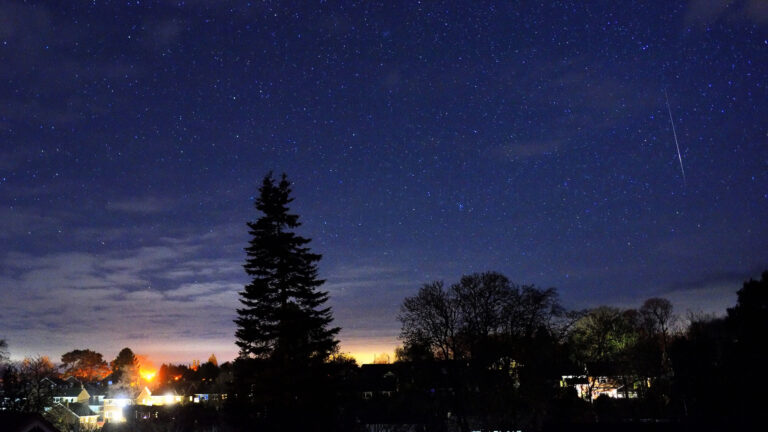
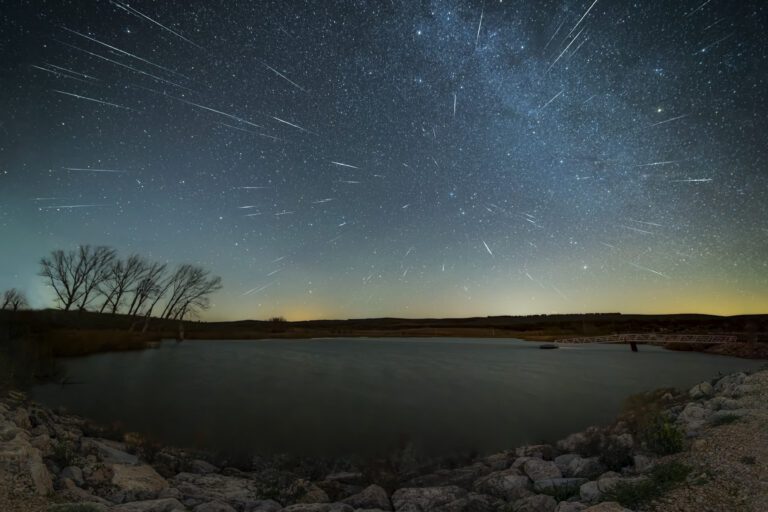
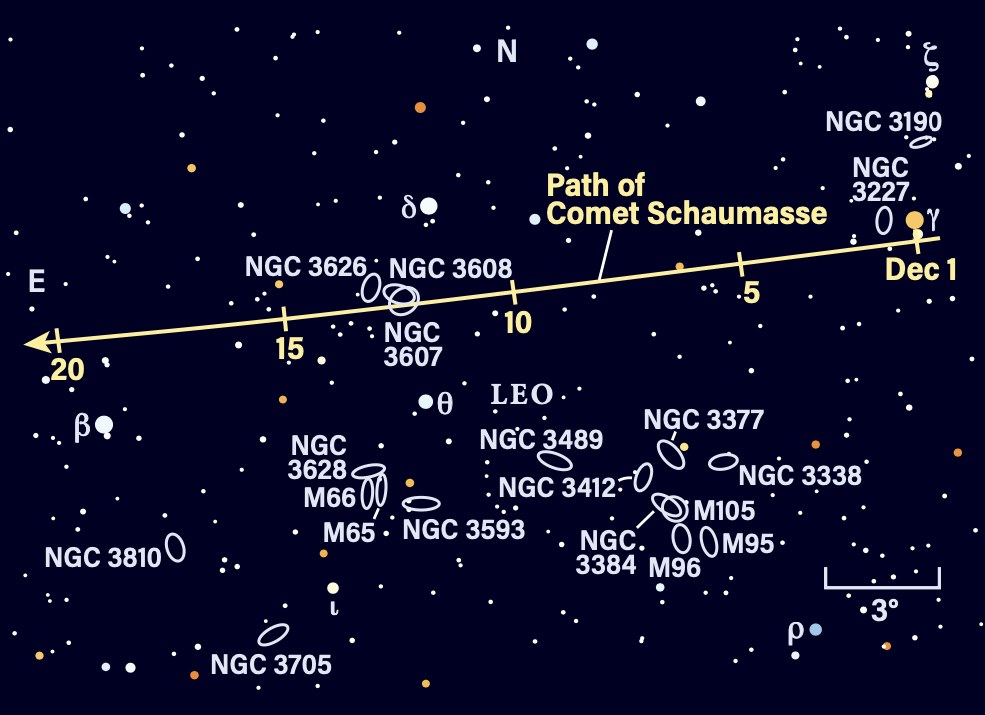
The Geminids are coming! Peaking on the 14th, this annual shower is likely already causing an increase over the random rate of meteors we see all year round, so keep an eye on the skies this morning as you wait for Comet 24P/Schaumasse to rise out of the horizon haze, located near the hindquarters of Leo the Lion.
By 3 A.M. local time, this region is nearly 50° high in the east — look for Denebola, the bright star marking Leo’s tail, then scan about 8.8° west-northwest for your target. Now glowing around 12th magnitude, Comet Schaumasse today lies near two slightly brighter background galaxies: 10th-magnitude spiral NGC 3607 and 11th-magnitude elliptical NGC 3608. Schaumasse is just 2.5° north of magnitude 3.3 Chertan (Theta Leonis), and about ¼° southwest of the two galaxies, which themselves are only about 6’ apart. Our chart should help guide the way.
The Moon is admittedly nearby, though its waning phase means its light isn’t as much of a hindrance as it could be. You can also try again tomorrow morning, when the Moon rises later and the comet will be roughly the same distance southeast of the galaxies instead. The Geminids may have further bumped up the sporadic meteor rate by Saturday morning as well.
Sunrise: 7:13 A.M.
Sunset: 4:35 P.M.
Moonrise: 12:12 A.M.
Moonset: 12:28 P.M.
Moon Phase: Waning crescent (37%)