
Sky This Week is brought to you in part by Celestron.
Friday, December 26
The Moon passes 4° north of Saturn at 11 P.M. EST, right as the pair is setting along the U.S. East Coast. It’s better to observe them earlier in the evening — they are more than 40° high in the southwest around 7 P.M. local time.
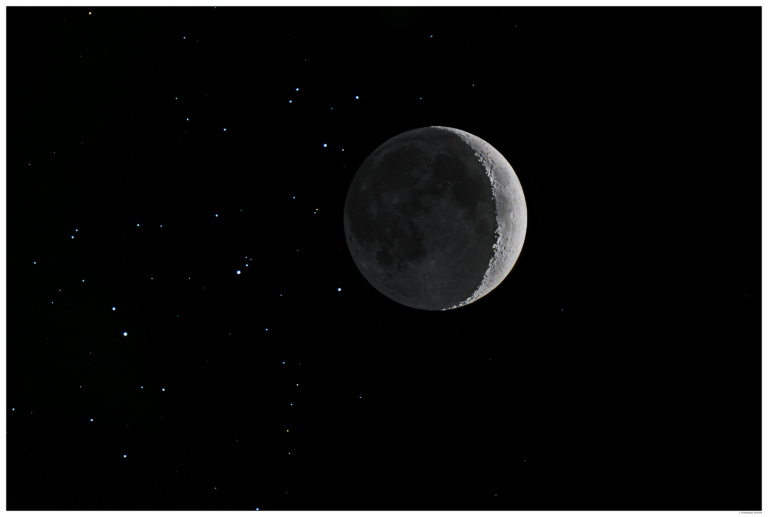
The waxing Moon lies to the upper right of Saturn, sandwiched between the giant planet and the Circlet of Pisces. While the Moon itself is in the constellation Pisces, Saturn is just over the border in Aquarius.
Saturn glows at 1st magnitude and should still be an easy naked-eye object even with the Moon so close by. To spot the planet’s stunning rings, however, you’ll want to home in on it with a telescope to magnify the view. Early in the evening, the three 10th-magnitude moons Rhea, Tethys, and Dione, line up in that order from east to west, all on the western side of Saturn. Titan lies far beyond them, also to the west, a much brighter point of light at magnitude 8.4. Iapetus, far to Saturn’s east and at its faintest (12th magnitude ), will likely be invisible in the bright background light cast by the Moon.
But keep your eyes on the trio of 10th-magnitude moons. As the hours pass, Dione, Tethys, and Rhea appear to converge. Dione and Tethys meet first, merging visually into one around 9:40 P.M. CST, as Saturn is very low for East Coast observers. Rhea joins the party around 10 P.M. CST, with Saturn starting to get low in the Midwest but still well clear of horizon haze farther west. By 9:40 P.M. MST the moons have started moving apart again, now with Dione closest to Saturn, Tethys in the middle, and Rhea farthest west.
Sunrise: 7:21 A.M.
Sunset: 4:41 P.M.
Moonrise: 11:15 A.M.
Moonset: 11:31 P.M.
Moon Phase: Waxing crescent (43%)
*Times for sunrise, sunset, moonrise, and moonset are given in local time from 40° N 90° W. The Moon’s illumination is given at 10 P.M. local time from the same location.
Saturday, December 27
The Moon passes 3° north of Neptune at 4 A.M. EST, about 10 hours before First Quarter Moon occurs at 2:10 P.M. EST. Rising around noon, the Moon will lie in southern Pisces by sunset, now some 11° east of Neptune and Saturn.
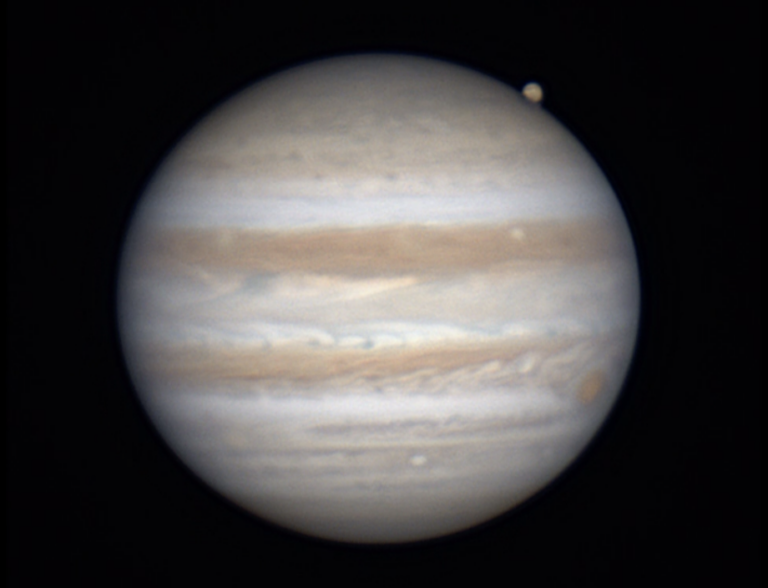
Io and its shadow cross Jupiter overnight tonight with only 20 minutes between them. Finding Jupiter is likely familiar by now, as the gas giant shines brightly in Gemini near the heads of the Twins. For most of the evening, there are three moons east of Jupiter’s disk: Io is closest, then Europa, with Ganymede farthest out. Callisto is alone west of the planet.
Io approaches the eastern limb as the hours pass, and its shadow appears first on the cloud tops at 12:28 A.M. EST (early on the 28th in EST only, late on the 27th in all time zones farther west). Io follows 20 minutes later, at 12:48 A.M. EST. The pair lies centrally on the disk around 1:45 A.M. EST, now the 28th in the Eastern and Central time zones.
The shadow maintains its lead and slips off the western limb of Jupiter around 2:45 A.M. EST on the 28th, with Io following by 3:05 A.M. EST. After that, there are two moons on either side of Jupiter, now that Io lies to the west with Callisto.
Sunrise: 7:21 A.M.
Sunset: 4:42 P.M.
Moonrise: 11:38 A.M.
Moonset: —
Moon Phase: Waxing gibbous (54%)
Sunday, December 28
Let’s keep the holiday joy going with a smile among the stars — tonight we’re tracking down the so-called Happy Face asterism in Auriga the Charioteer.
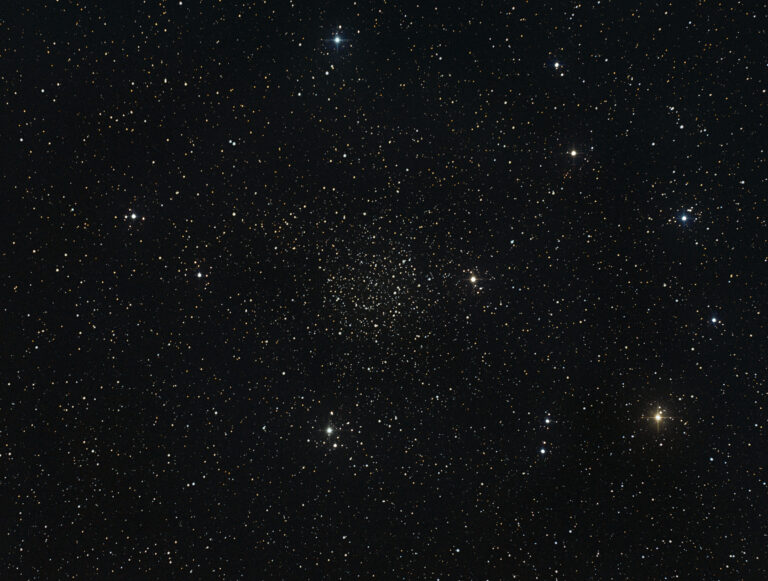
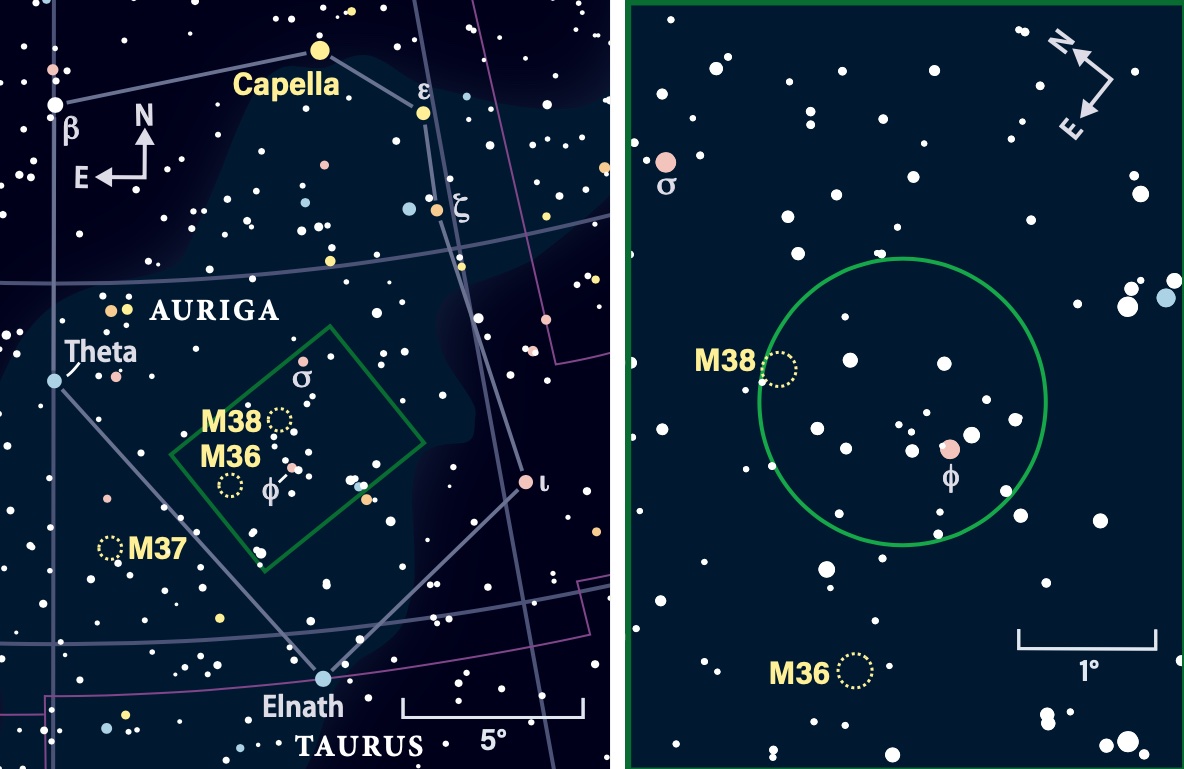
Already high in the east a few hours after sunset, the large, circular figure of Auriga lies above Gemini the Twins, the latter of which currently hosts bright Jupiter. Auriga’s brightest star is magnitude 0.1 Capella, and we’ll start our journey here. From Capella, drop about 8.7° south-southeast to 5th-magnitude Sigma (σ) Aurigae. From there, it’s just a short hop 1.7° southeast to the open cluster M38. One of three Messier clusters in Auriga, M38 shines at magnitude 7.4 and appears easily in binoculars or a telescope. It spans some 20’ and its brighter stars appear to many observers to form the shape of the Greek letter pi (π). M38 also serves as a “dimple” in the Happy Face asterism, a random pattern of stars that forms two eyes, a small nose, and a broad smile just southwest of M38. The magnitude 5.1 star Phi (φ) Aur is part of the mouth. Check out the star chart above to help you visualize the face, and see whether you can visualize it through your optics!
Just under 2° southeast of the Happy Face is another of Auriga’s Messier clusters, M36. Don’t forget to stop over for a look at this magnitude 6.3 grouping of young stars, which contains a few dozen confirmed members.
Sunrise: 7:21 A.M.
Sunset: 4:42 P.M.
Moonrise: 12:02 P.M.
Moonset: 12:40 A.M.
Moon Phase: Waxing gibbous (65%)
Monday, December 29
If you’re looking for some pops of color in your nighttime sky, then open cluster M41 is for you. Located in Canis Major within the Big Dog’s body, this bright gaggle of stars is highest around local midnight, when it stands 30° above the southern horizon and hangs just below the brightest star in the northern sky, Sirius.
Finding blazing Sirius in binoculars or a telescope should be a snap. From there, simply drop 4° south to land on your target. M41 shines at magnitude 4.5, making it a bright, easy target for any observer and great to view under any magnification. It may even pop out to your naked eyes as a misty glow.
M41 spans a little more than half a degree on the sky and is home to some 100 young suns about 240 million years old. Even under low magnification (7x) you should see nearly two dozen stars, with that number increasing as you bump up the power (though your field of view will also shrink). At magnifications of 14x or more, you’ll start to notice the contrasting colors of the stars, with some appearing blue-white while others glow golden yellow, orange, or red. At the center of the cluster is a bright red star, with more reddish suns spreading outward from it almost like the arms of a starfish.
Sunrise: 7:22 A.M.
Sunset: 4:43 P.M.
Moonrise: 12:30 P.M.
Moonset: 1:53 A.M.
Moon Phase: Waxing gibbous (76%)
Tuesday, December 30
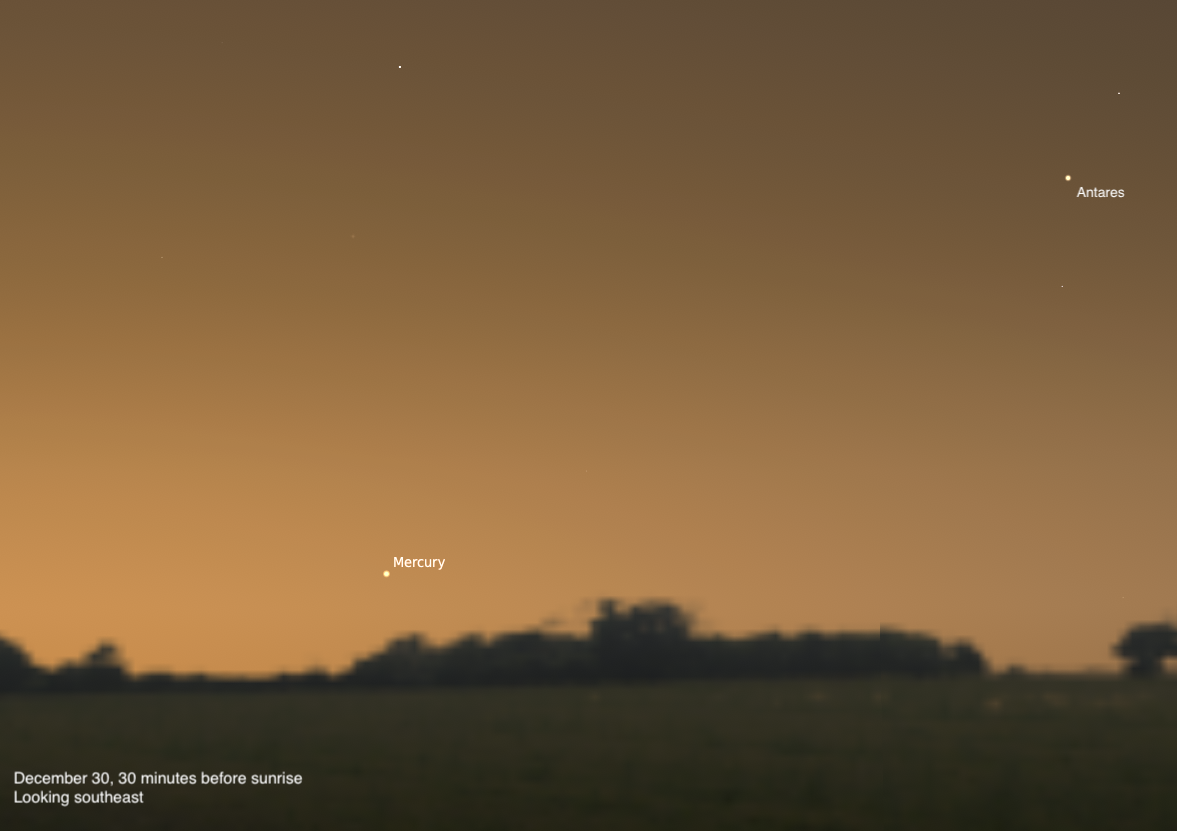
Mercury may be a bright magnitude –0.6, but it is sinking quickly toward the horizon. The small planet will only be visible in the predawn sky for a few more days at most, so try to grab your chance to spot it now. It is heading toward superior conjunction in late January, a configuration that places the planet behind the Sun from our point of view. Some 94 percent of Mercury’s face is now lit by the Sun, helping to keep the planet bright in the early-morning sky.
See if you can find Mercury in the growing twilight some 30 minutes before sunrise, when it is just 3° high in the southeast. Your best bet is to sweep the southeastern horizon with binoculars, moving slowly back and forth to look for the planet’s reflected light. A bit earlier you might spot Antares — the ruby-hued heart of Scorpius the Scorpion — above the horizon as well. Mercury lies to this star’s far lower left. Antares, at magnitude 1.1, will disappear first in the oncoming dawn.
The observing window is very short, and you should make sure to stop your search and put away your instruments at least several minutes before sunrise from your specific location, which may differ from the time given below.
Sunrise: 7:22 A.M.
Sunset: 4:44 P.M.
Moonrise: 1:04 P.M.
Moonset: 3:09 A.M.
Moon Phase: Waxing gibbous (85%)

Wednesday, December 31
The Moon passes 5° north of Uranus in Taurus at 7 A.M. EST. By evening the Moon has moved to a position some 7.5° east of the Pleiades, while Uranus remains about 4.5° south of the bright open cluster.
But our attention this evening is on Jupiter, as the year comes to a close with a transit of the icy moon Europa across the cloud tops, trailing behind its dark shadow. Jupiter is approaching opposition, with the time between shadow and moon transits dwindling quickly over the next week and a half.
By 8 P.M. local time, Jupiter is nearly 30° high in the east, dominating the constellation Gemini at its opposition magnitude of –2.7. Europa’s shadow kicks things off at 9:01 P.M. EST as it slips onto the southeastern limb. Europa is alone to Jupiter’s east, while Io, Callisto, and Ganymede lie west of Jupiter, in that order from closest to farthest.
Europa follows its shadow onto the disk 28 minutes later, and both are visible together crossing in front of the gas giant for more than two hours. Europa’s shadow disappears just minutes before midnight EST, while Europa slides away from the southwestern limb nearly half an hour later, as the Central time zone is getting ready to ring in 2026.
Sunrise: 7:22 A.M.
Sunset: 4:45 P.M.
Moonrise: 1:47 P.M.
Moonset: 4:28 A.M.
Moon Phase: Waxing gibbous (92%)
Thursday, January 1
The Moon reaches perigee, the closest point to Earth in its orbit, at 4:44 P.M. EST. At that time, our satellite will stand 223,910 miles (360,348 kilometers) away. Full Moon is just two days away, making the first Full Moon of 2026 a Super Moon as well.
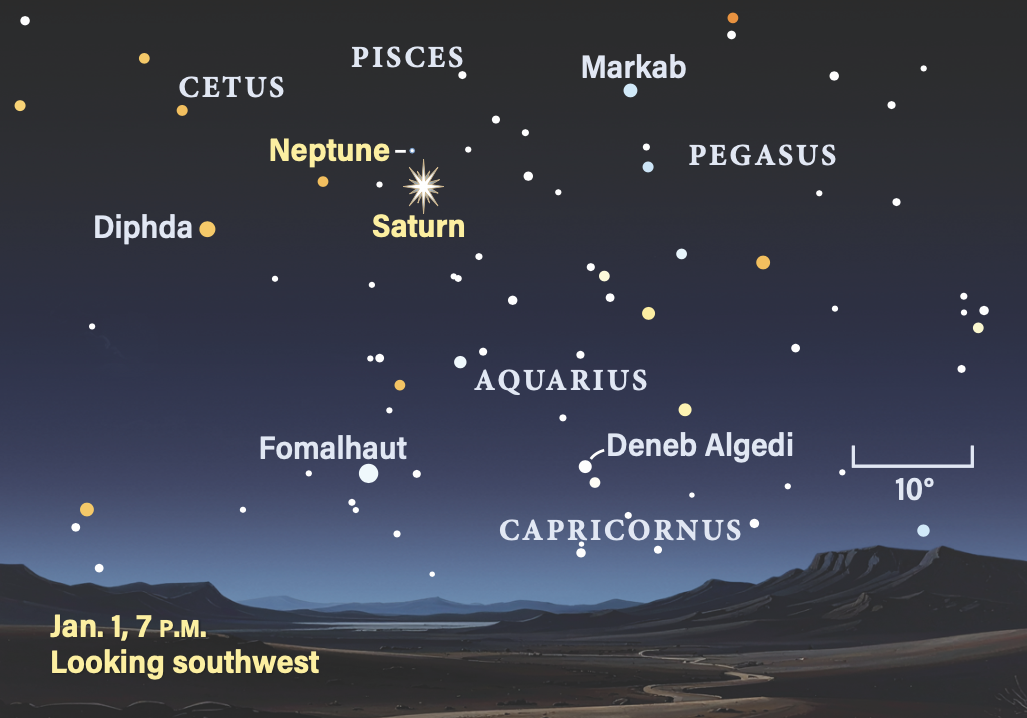
Saturn points the way to Neptune all through the month of January, offering an easy way to spot the solar system’s most distant planet. The best time to view these distant worlds is early in the evening, before they sink too close to the horizon and set by local midnight. First-magnitude Saturn continues to dominate the sky near the Circlet of Pisces, an easy naked-eye object in the southwest a few hours after sunset. Center the ringed planet in binoculars or a telescope, then slowly scan 3.5° to the northeast. That will land you right on Neptune, which shines at magnitude 7.8 and shows off a tiny, 2”-wide disk. Compared to the background stars, the planet may look like a “dull” star with a slight bluish hue.
This is the farthest the two planets will be all month; over time, Saturn will move closer to Neptune and end January just 1.7° from Neptune.
While you’ve got your optics out, make sure to take some time to enjoy Saturn as well. Its disk is 17” across, with rings stretching 39” from end to end and appearing quite thin, nearly edge-on. The planet’s brightest moon, mid-8th-magnitude Titan, lies nearby tonight, located just southeast of the disk.
Sunrise: 7:22 A.M.
Sunset: 4:45 P.M.
Moonrise: 2:42 P.M.
Moonset: 5:47 A.M.
Moon Phase: Waxing gibbous (98%)
Friday, January 2
Mercury is now a mere 1° above the southeastern horizon half an hour before sunrise. This morning is probably the last chance to catch the planet before it disappears from view.
Still at magnitude –0.6, Mercury will be low on the southeastern horizon some 30 minutes before sunrise. As earlier this week, try scanning for it with binoculars. Once more, you won’t have long to search, and put away any optics well before sunrise from your location.
Asteroid 40 Harmonia reaches opposition at 10 A.M. EST. You can catch the 9th-magnitude main-belt world in binoculars or a telescope this evening in Gemini, where it lies just under 2.5° southeast of 3rd-magnitude Mebsuta (Epsilon [ε] Geminorum) and above bright Jupiter as the constellation rises in the evening sky. Note that the bright, nearly Full Moon is nearby in Taurus, which may hinder the view. However, Harmonia will remain in roughly the same part of the sky for a while, moving slowly against the background stars — so you can come back and search for it again after the Moon has begun to wane and rises later in the evening, providing some darkness after sunset.
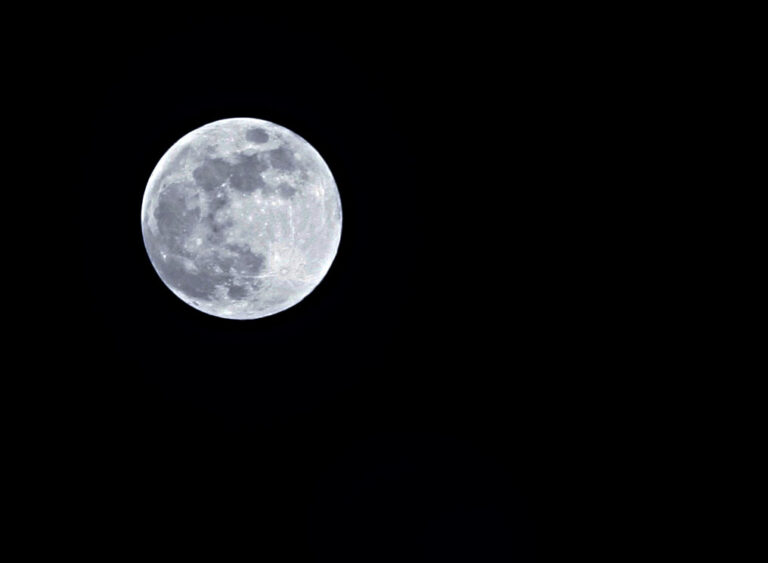
Although the Moon does not officially reach Full phase until early tomorrow morning, our satellite will appear essentially Full (more than 99 percent lit) to the naked eye by late this evening. It may also appear slightly bigger and brighter than average, as it is still close to perigee and this month’s Full Moon is considered a Super Moon.
Sunrise: 7:22 A.M.
Sunset: 4:46 P.M.
Moonrise: 3:50 P.M.
Moonset: 6:57 A.M.
Moon Phase: Full