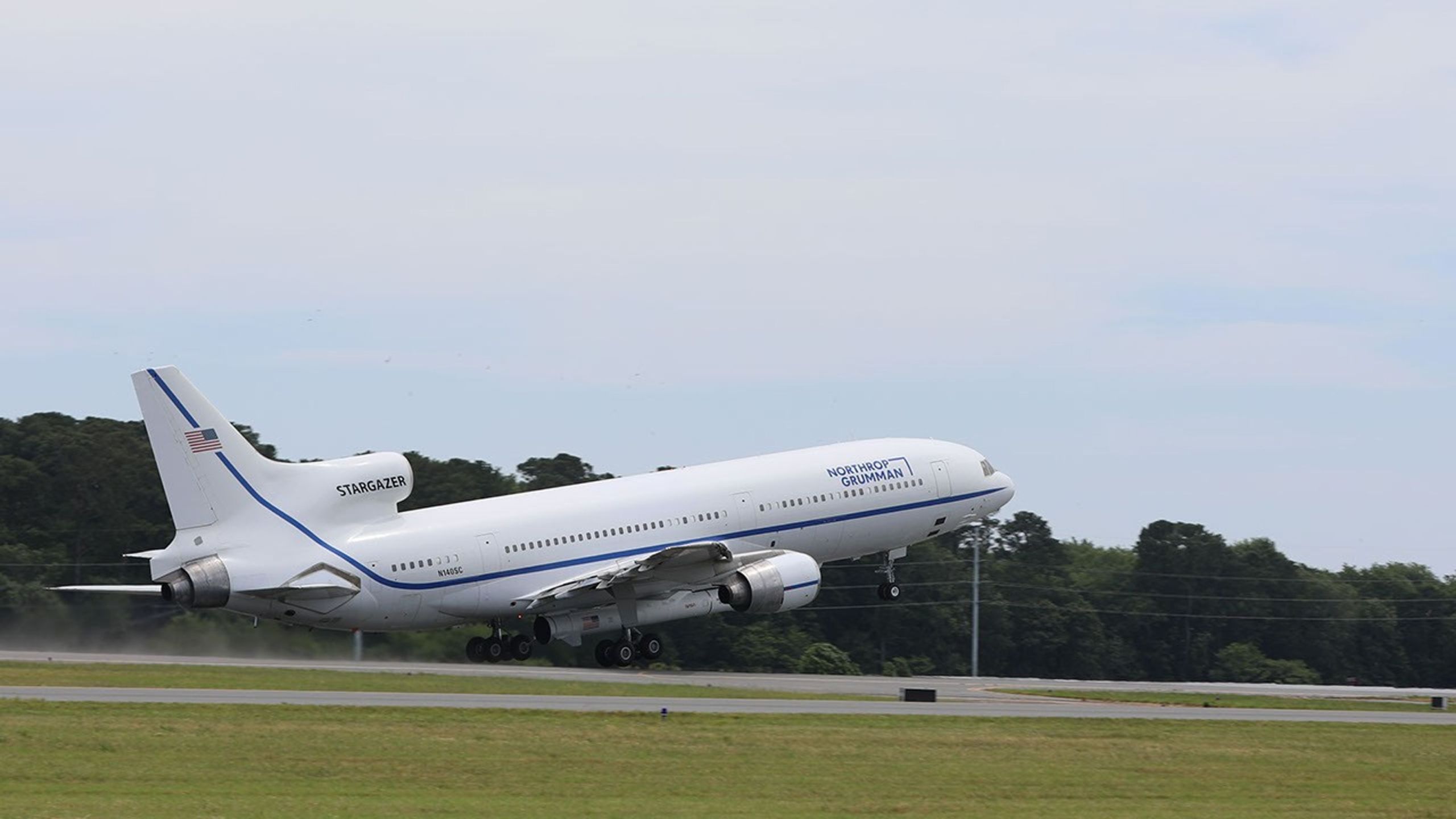
UPDATE July 2, 2026: On Thursday, July 2, NASA attempted to launch Katalyst’s LINK servicing spacecraft, but the launch was scrubbed. The Swift Boost mission’s target date had already slipped from June 30 to July 1 and then to July 2. The L-1011 carrier aircraft took off Thursday morning with the Pegasus XL rocket slung beneath it, but a problem with the launch vehicle kept the rocket from deploying. LINK, bound for a boost of NASA’s Neil Gehrels Swift Observatory, will have to wait — engineers are reviewing data from the attempt before setting a new date.
UPDATE June 29, 2026: NASA has updated the launch target for the Swift Boost mission to no earlier than Tuesday, June 30, 6:23 a.m. EDT. This story has been updated to reflect the revised schedule.
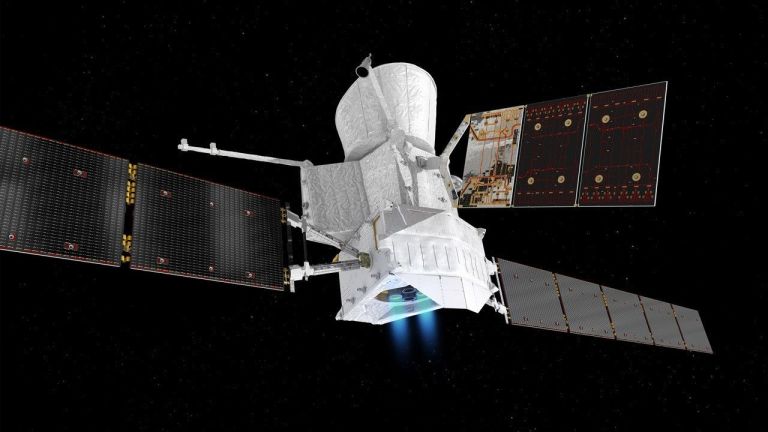
An airplane began its journey across the Pacific on Thursday, June 18, with a rocket strapped to its belly. Inside that rocket was a rescue mission — a small robotic spacecraft that, later this month, will dock with an operating space telescope and hopefully boost its orbit.
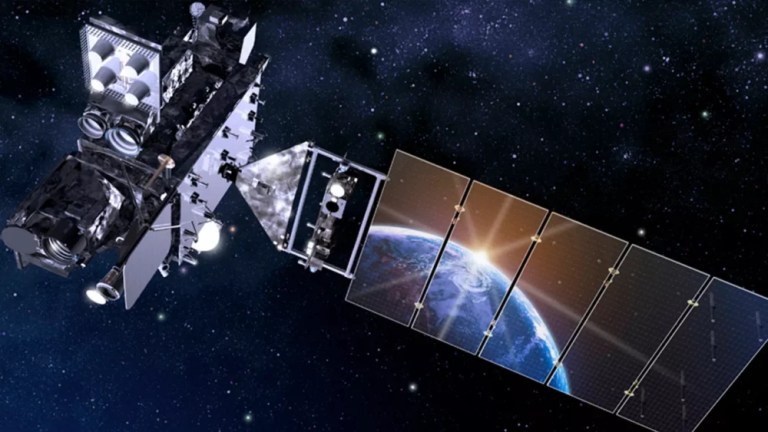
The target is NASA’s Neil Gehrels Swift Observatory, a gamma-ray burst (GRB) telescope that has been losing altitude more quickly than anticipated, thanks to increased solar activity that has intensified drag on the craft as it skims our outer atmosphere. In September 2025, NASA awarded Katalyst Space Technologies of Flagstaff, Arizona, a $30 million contract to build the rescuer — a robotic spacecraft called LINK — and get it to Swift in under a year. Swift Boost, as the mission is known, is currently scheduled to launch no earlier than June 30 from Kwajalein Atoll in the Marshall Islands. If it succeeds, it will be the first time an autonomous robotic spacecraft has captured and boosted a satellite not originally designed for servicing.
“The Swift Boost mission is designed to extend the life of an existing spacecraft, one not designed for servicing, quickly and cost effectively,” said Katalyst Space CEO Ghonhee Lee in a NASA press release.
A telescope in trouble
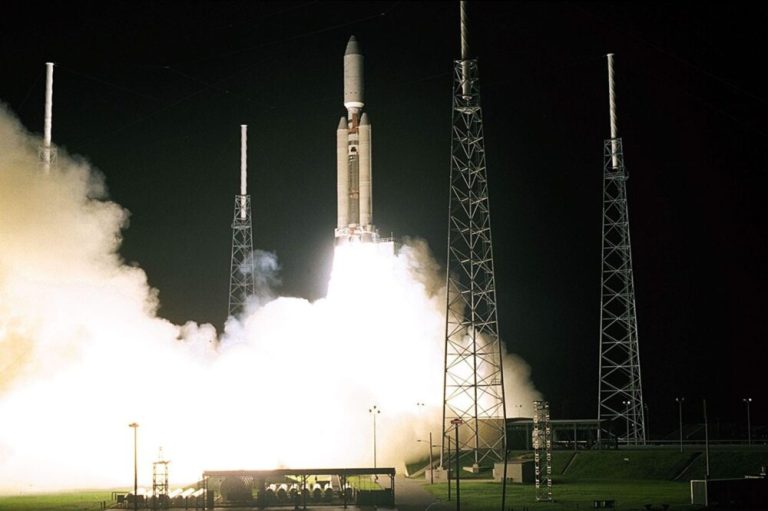
Swift launched in November 2004 on a Delta 7320 rocket to study GRBs, extreme flashes of gamma radiation now understood to result from the collisions of massive, compact objects as well as the birth of black holes. The explosions occur around once a day, come from every direction, and last from milliseconds to a few hundred seconds. Swift’s instruments were designed to capture GRBs and alert other telescopes worldwide.
The observatory has delivered well beyond its original mission. Swift imaged its first GRB shortly after launch, in January 2005. By May 2005 it had accomplished what no mission had managed before: pinpointing the location of a short GRB — bursts that peak in under two seconds — precisely enough to observe its afterglow. That detection, called GRB 050509B, lasted just 0.03 second, and confirmed models that proposed short GRBs come from neutron star collisions. In the two decades since, Swift has logged more than a thousand GRBs, detected the brightest burst ever recorded, and branched into studies of tidal disruption events (as black holes rip apart stars), magnetars (highly magnetic neutron stars), supernovae, and even comets in our own solar system.
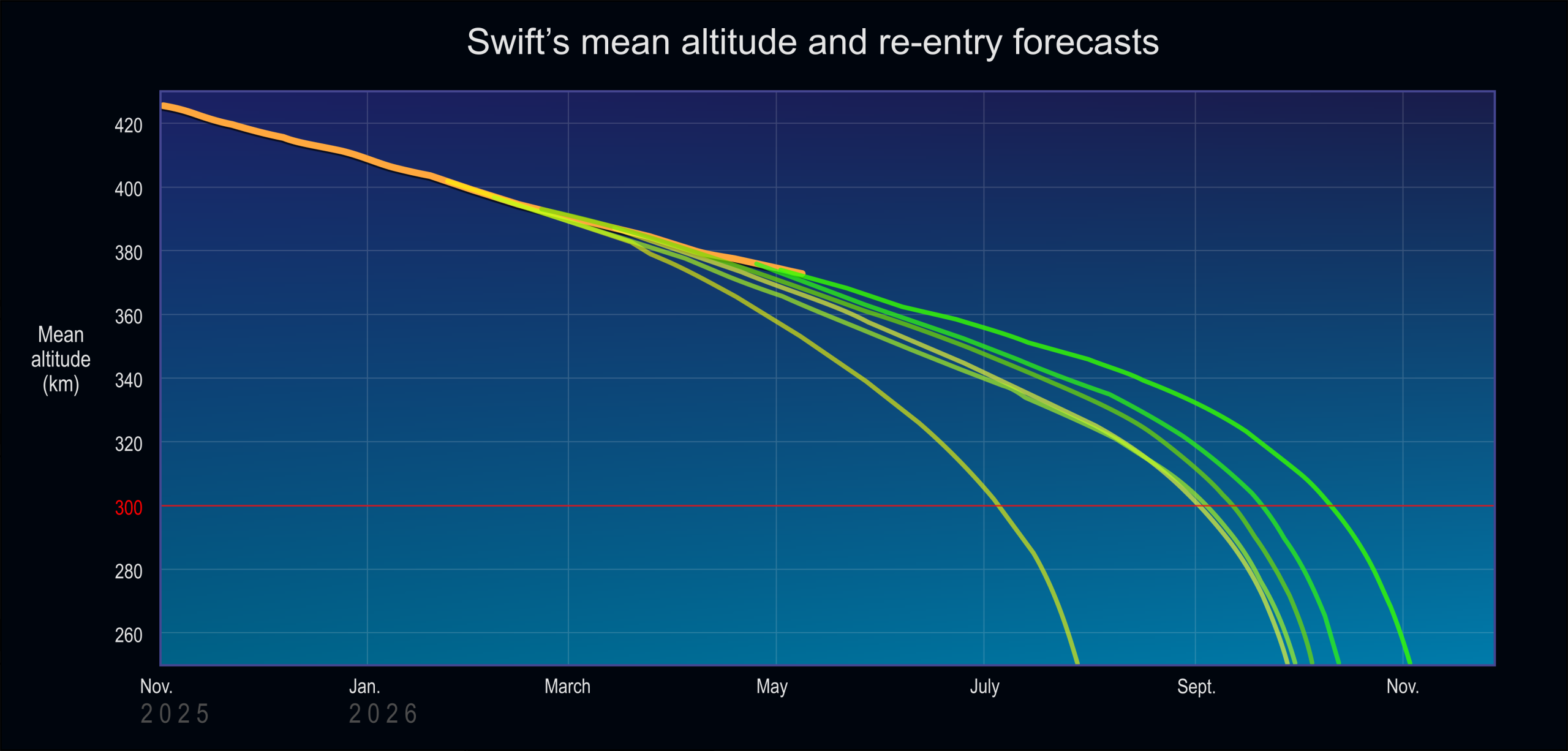
Unfortunately, Swift has no propulsion system. Any spacecraft in low Earth orbit loses altitude over time, pulled down by atmospheric drag. And when the Sun is more active, the atmosphere expands and the drag intensifies. Swift launched at an altitude of 373 miles (600 kilometers). It has now sunk to around 249 miles (400 km). The Sun reached solar maximum in 2024, sending out increased bursts of charged particles and accelerating Swift’s decline. Predictions made by NASA in 2025 showed a 50% chance of the telescope reentering the atmosphere midway through 2026 and a 90% chance of reentry by the end of the year.
RELATED: Solar activity determines how fast space junk falls to Earth
The Swift operations team at NASA’s Goddard Space Flight Center in Greenbelt, Maryland, has been buying time. In February, the team suspended observations to put the spacecraft in an orientation that minimizes drag. The goal is to keep Swift above 185 miles (300 km) — the minimum altitude at which a reboost attempt is viable. The latest predictions suggest it will hold above that threshold into early fall, hopefully long enough for the rescue attempt to succeed.
Katalyst for change
Katalyst Space Technologies is a small Flagstaff, Arizona-based company that builds autonomous robotic spacecraft designed to service, repair, and extend the lives of satellites already in orbit.
Once awarded the contract for boosting Swift, the company had less than a year to design, build, test, and launch LINK. “Six months ago, this [mission] was a PowerPoint and it looked nothing like this,” said Kieran Wilson, LINK lead at Katalyst, in a NASA video released June 17. “In under a year, we’re going from identification of a problem, proposal, contract award to launch.”
The challenge of boosting Swift is compounded by the fact that the observatory was never built with docking hardware in mind — no external grapple fixtures, no docking ports. “Nobody took a picture of the backside of Swift before it launched,” Lee told Aerospace America. To overcome this, Katalyst designed a custom robotic capture mechanism consisting of three arms guided by LiDAR (Light Detection and Ranging) to attach to a feature on Swift’s primary structure without disturbing its instruments.
The road to launch
By November, Katalyst had selected Northrop Grumman’s Pegasus XL as its launch vehicle. It was chosen in part because Swift sits at a low angle relative to the equator that most rockets launching from the U.S. can’t easily reach. Pegasus, dropped from an airplane while at 40,000 feet (12,190 meters), can launch from nearly anywhere on Earth, making it an easy choice for hitting Swift’s orbit on the compressed timeline. “It’s the only launch vehicle that can meet the orbit, the schedule, and the cost to achieve something unprecedented with emerging technology,” Lee said in a November Katalyst press release.
LINK completed environmental testing at NASA Goddard on May 4, where engineers put it through vibration tests to simulate the extreme conditions of a Pegasus launch and ran thermal vacuum tests inside the same chamber used for Swift and the upcoming Nancy Grace Roman Space Telescope. During those tests, LINK fired its xenon-powered ion thrusters and deployed one of its three LiDAR-equipped robotic arms. After testing, the spacecraft made a final stop at Katalyst’s facility in Broomfield, Colorado, for last pre-launch preparations before shipping east.
On June 5, LINK arrived at NASA’s Wallops Flight Facility in Virginia, where Northrop Grumman engineers loaded it into the rocket. Integration was complete by June 9. Three days later, on June 12, the rocket was coupled with Stargazer, Northrop Grumman’s modified L-1011 aircraft, and the combination was ready for departure.
Stargazer left Wallops on June 18, making stops in California and Hawaii en route to Kwajalein Atoll in the Republic of the Marshall Islands. When the launch window opens on Tuesday, June 30, the aircraft will climb to roughly 40,000 feet (12,190 m) and release Pegasus XL. After a few seconds of free fall, the rocket will ignite, and reach orbit in about 10 minutes.
Once in orbit, the rocket will deploy LINK. Then, the Katalyst team will spend several weeks checking LINK’s systems and surveying Swift to determine potential attachment points before attempting capture. When LINK has secured the telescope, it will fire its thrusters and begin the months-long process of raising Swift’s orbit.
The future of on-orbit servicing
Orbit-boosting is not new — space shuttle crews raised Hubble’s orbit multiple times over several missions. But those were crewed missions to a telescope purpose-built for servicing. Swift Boost is something different: a commercial, autonomous operation on a compressed timeline, targeting a spacecraft nobody planned to service.
“The Swift boost attempt is a fast, high-risk, high-reward mission. Swift will likely reenter the atmosphere sometime later this year if we don’t attempt to lift it to a higher altitude. Katalyst has gotten to this point in just eight months, and we’re glad they were able to use NASA’s facilities to test LINK and draw on our expertise,” said John Van Eepoel, Swift’s mission director at NASA Goddard.
Beyond the science, Katalyst says it is working with the U.S. Department of Defense to use Swift Boost to demonstrate quick-turnaround satellite servicing capabilities, which the Pentagon considers critical as China is advancing its own similar capabilities. The company also has a mission called NEXUS planned for 2027 that would extend servicing capabilities to geostationary orbit, roughly 22,000 miles above Earth, where many of the weather and communications satellites that underpin modern infrastructure reside.
If LINK succeeds, the implications extend beyond Swift. Rapid-response satellite servicing could open an entirely new sector of the orbital economy — one where satellites are repaired and repositioned rather than discarded — while reducing the debris burden in an increasingly crowded low Earth orbit.