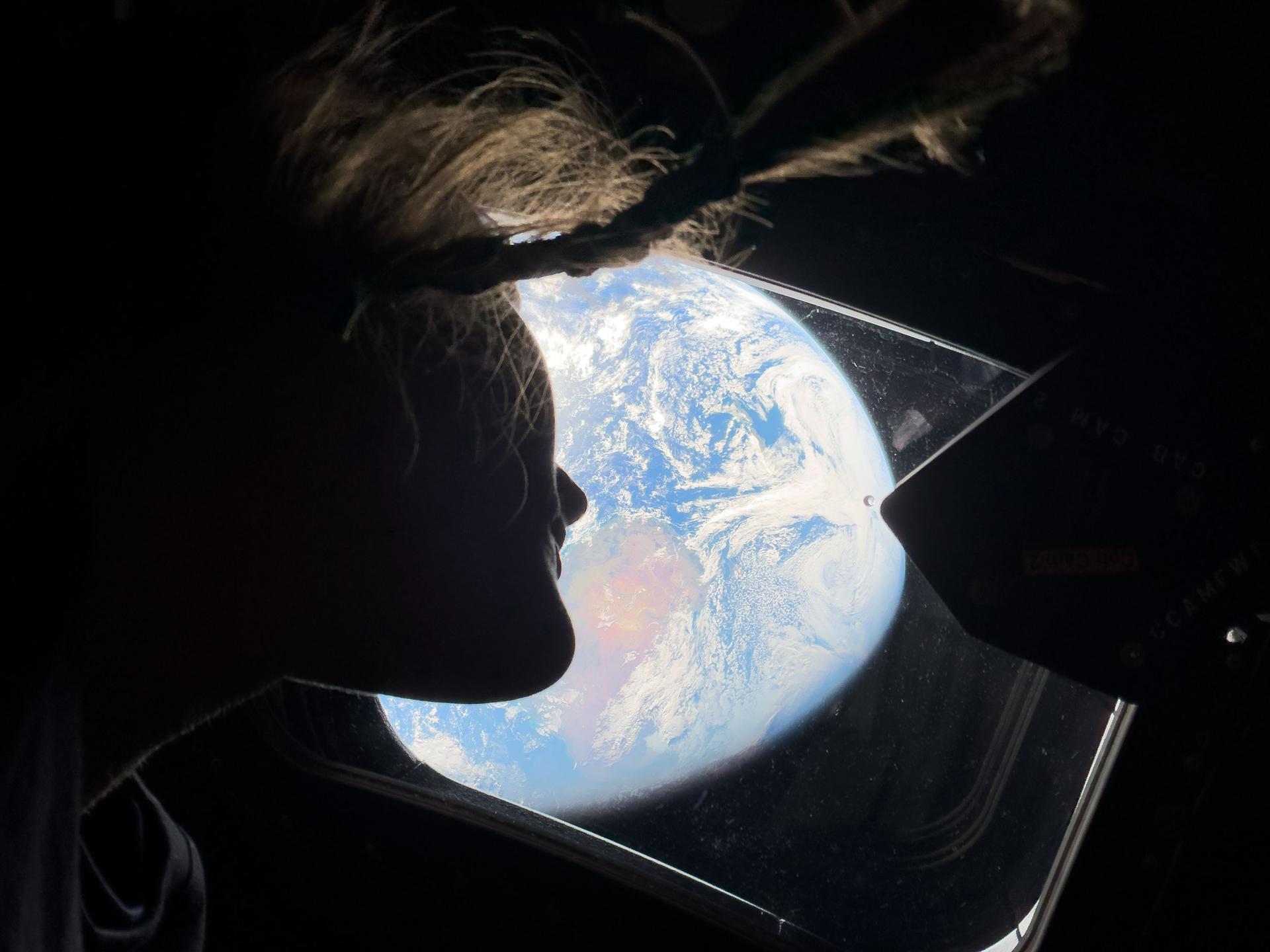
On Saturday, April 4, on the eve of Easter, as the Artemis 2 crew traversed cislunar space 180,000 miles (290,000 kilometers) from Earth, the pilot of Integrity, Victor Glover, was asked in a video interview whether the crew had “a message you’d like to share from space about Easter Sunday.”
His response quickly found into social feeds and group chats the world over, shared and praised for its grace and poignancy:
Glover: You know, I don’t have anything prepared. I am glad you brought that up, though. I think these observances are important and as we are so far from Earth and looking back at, you know, the beauty of creation, I think for me, one of the really important personal perspectives that I have up here is I can really see Earth as one thing.
And you know, when I read the Bible and I look at all of the amazing things that were done for us who were created, it’s — you have this amazing place, this spaceship. You guys are talking to us because we’re in a spaceship really far from Earth, but you’re on a spaceship called Earth that was created to give us a place to live in the universe, in the cosmos.
Maybe the distance we are from you makes you think what we’re doing is special. But we’re the same distance from you, and I’m trying to tell you, just trust me, you are special. In all of this emptiness, this is a whole bunch of nothing, this thing we call the universe. You have this oasis, this beautiful place that we get to exist — together.
I think as we go into Easter Sunday thinking about, you know, all the cultures all around the world, whether you celebrate it or not, whether you believe in God or not, this is an opportunity for us to remember where we are, who we are, and that we are the same thing and that we’ve got to get through this together.
Glover’s off-the-cuff soliloquy had the added resonance of being a callback to one of the most famous moments of the Apollo program: when, to close out the first ever live network broadcast from lunar orbit, the crew of Apollo 8 read the first 10 verses of the book of Genesis.
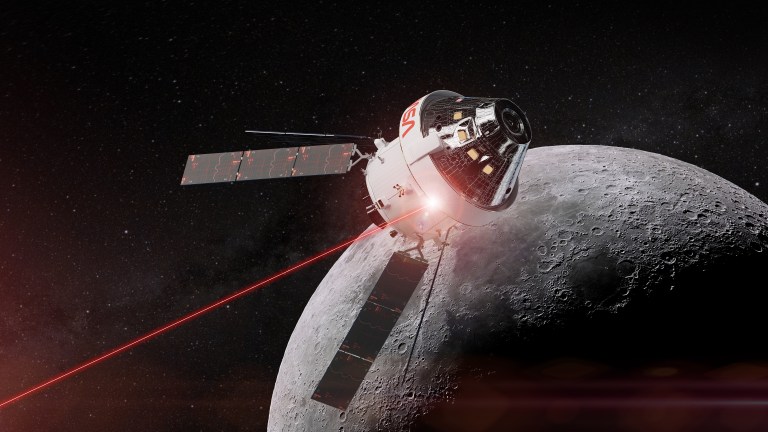
There are plenty of parallels between the two missions. In broad strokes, the objective of Artemis 2 is similar to Apollo 8 — the first mission of its program to send humans around the Moon. And CBS correspondent Mark Strassman prefaced his question to Glover by noting the coincidence of timing: While Artemis 2 will enter the Moon’s gravitational sphere of influence late on Easter Sunday (early Monday morning EDT), Apollo 8’s reading came on Christmas Eve of 1968.

Glover’s descriptive language of space as a “whole bunch of nothing” and Earth as an “oasis” also echoed that of Apollo 8:
As Allyson Gross and Jenell Johnson wrote in our December 2023 issue:
In addition to naming the bumps, craters, and mountains crossing the screen, the men also described their emotional impressions of the alien surface. For Borman, the Moon was a “vast, lonely, forbidding-type existence or expanse of nothing.” For Lovell, it made Earth look like a “grand oasis in the big vastness of space.” Anders commented on the lunar sunrises and sunsets, the “long shadows” and “stark terrain.”
That’s not to that say Glover was intentionally referencing Apollo 8 in this respect — after all, it’s hard not to reach for words like them when discussing Earth and its place in the universe. Those turns of phrase and strains of language have long since entered into the lexicon. But it’s worth remembering that Apollo 8 helped put them there in the first place, marking the moment when humans saw the scale of that “emptiness” and “oasis” for themselves.
There’s another, graver resonance. While neither Strassman nor Glover remarked on it explicitly, Glover’s message of global community against a backdrop of geopolitical conflict is another point of connection to 1968.
As a year of political upheaval, 1968 is remembered primarily for unrest both domestic and international. In 1968, more U.S. soldiers died in Vietnam than in any year before or after; on U.S. soil, the assassinations of Rev. Martin Luther King Jr. and Robert F. Kennedy further destabilized an already fractured homefront.
But in a year plagued by violence, Apollo 8 went to the Moon in peace. Its success was proof, in the words of Anders’ wife, Valerie, “that we could do something besides go to war; we could do something positive with our technology.” For their efforts, the crew were named Time magazine’s Men of the Year. “For all its upheavals and frustrations,” Time proclaimed, “the year would be remembered to the end of time for the dazzling skills and Promethean daring that sent mortals around the moon.”
Of course, 2026 is not the same as 1968. Even 1968 was not necessarily the same as the 1968 of U.S. collective memory. Added Gross and Johnson: “In hindsight, the idea that a lunar flyby might dull the sting of nearly 17,000 U.S. soldiers dead in Vietnam might be a reach” — not to mention the estimated hundreds of thousands of Vietnamese soldiers and civilians killed in one of the conflict’s deadliest years. “Claims that Apollo 8 ‘saved’ the year from ruin are subjective,” wrote Gross and Johnson. “But there is no question that the mission did unite people around the globe.”

Many, like Ars Technica‘s Eric Berger, have pointed out that Artemis 2 is unlikely to land as a cultural milestone to the same extent as Apollo 8 — how could it? On its own, it is no more likely to end conflicts or ease tensions than Apollo 8 was. And just like Apollo during the Cold War, the technical feats of Artemis come hand in hand with geopolitical implications: In practice, countries looking to partner with NASA on its lunar program are expected to sign the nonbonding Artemis Accords, aligning themselves with the U.S.-led framework for exploring and mining the Moon. In a post-launch press conference, NASA Administrator Jared Isaacman invoked geopolitical competition as one of the main reasons that the U.S. is going back to the Moon in the first place.
And yet, Apollo 8’s descriptions and imagery of Earth as a tiny oasis in the vastness of space that we all share have endured and inspired. In the decades since, legions of astronauts have spoken about the “overview effect” that comes from seeing Earth from space, and how glimpsing our world’s beauty and fragility has changed their perspective. Artemis 2 offers today’s generations the chance to see that perspective through the eyes of a new group of astronaut ambassadors. NASA officials are aware of the opportunity, telling reporters at a press conference that they and the crew have been planning how to capture their own version of Apollo 8’s famous “Earthrise” photo. So, even as the crew explores an alien world, they will also be looking back at our own.