July 2026 digital issue Now available!
Learn more
Skip to content
Astronomy Magazine logo
  • Login / Register
  • Logout
  • Shop
  • Subscribe

  • News
  • Science
    • Solar System
    • Exoplanets
    • Stars
    • Milky Way
    • Galaxies
    • Exotic Objects
    • Cosmology
  • Observing
    • In The Sky
    • Upcoming Events
    • The Sun
    • The Moon
    • Planets
    • Comets
    • Deep-Sky Objects
    • Observing Basics
    • Telescopes and Equipment
    • Astrophotography
    • Gear Guide
    • This Week in Astronomy
  • Space Exploration
    • What’s Launching This Week
    • Human Spaceflight
    • Robotic Spaceflight
  • The Magazine
  • Ask Astro
  • Star Products
  • News
  • Science
    • Solar System
    • Exoplanets
    • Stars
    • Milky Way
    • Galaxies
    • Exotic Objects
    • Cosmology
  • Observing
    • In The Sky
    • Upcoming Events
    • The Sun
    • The Moon
    • Planets
    • Comets
    • Deep-Sky Objects
    • Observing Basics
    • Telescopes and Equipment
    • Astrophotography
    • Gear Guide
    • This Week in Astronomy
  • Space Exploration
    • What’s Launching This Week
    • Human Spaceflight
    • Robotic Spaceflight
  • The Magazine
  • Ask Astro
  • Star Products
  • Login / Register
  • Logout
  • Shop
  • Subscribe
From the June 2008 issue

Thirty-five years of stories

Read a sampling of stories from Astronomy since its beginning.
By Astronomy Staff | Published: June 23, 2008 | Last updated on May 18, 2023

Up Next

  • An oval-shaped all-sky map fills the frame in muted blues and purples, with a bright, dense white and yellow band stretching horizontally across the middle. Small yellow dots are scattered across the upper and lower portions of the oval, with two red dots standing out among them, one on each side of center.
    Galaxies

    Euclid spots the oldest known quasars

  • A James Webb Space Telescope image of a dense galaxy cluster filled with hundreds of galaxies of varying shapes, sizes, and colors against a black background. Three small white squares labeled A, B, and C mark gravitationally lensed images of a background quasar near the cluster center. At right, three zoomed-in inset panels labeled QSO1A, QSO1B, and QSO1C show each lensed quasar image as a small red point source.
    Exotic Objects

    Did this black hole grow up before its galaxy?

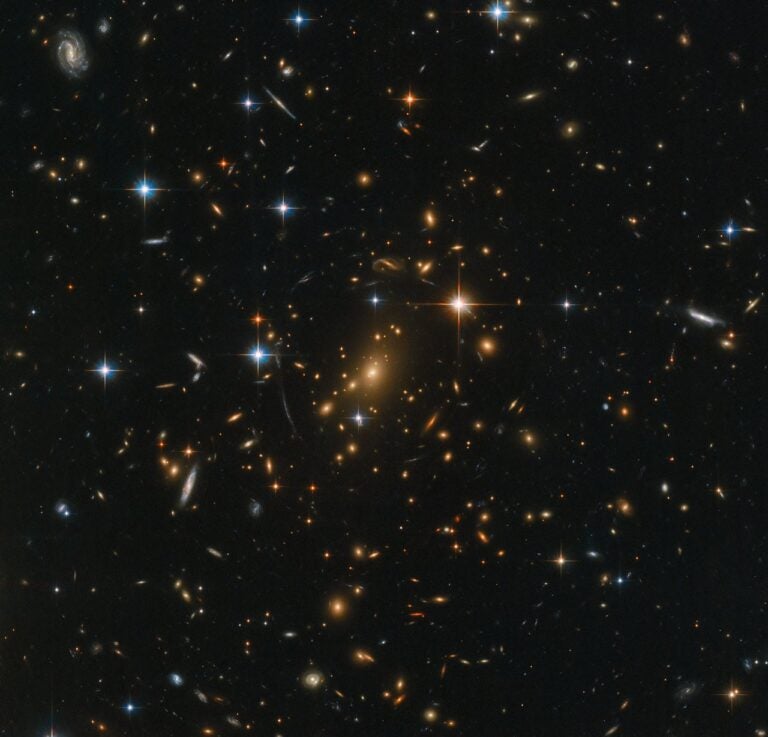
  • A James Webb Space Telescope deep field image showing hundreds of distant galaxies scattered across a black background in a range of shapes — spirals, ellipticals, and elongated streaks — in colors from white and blue to orange and red. A large, detailed barred spiral galaxy with a bright white core and faint blue spiral arms dominates the center-left of the frame. Several foreground stars display the distinctive six-pointed diffraction spikes characteristic of JWST imagery.
    Cosmology, Stars

    JWST studies a supernova near the dawn of time

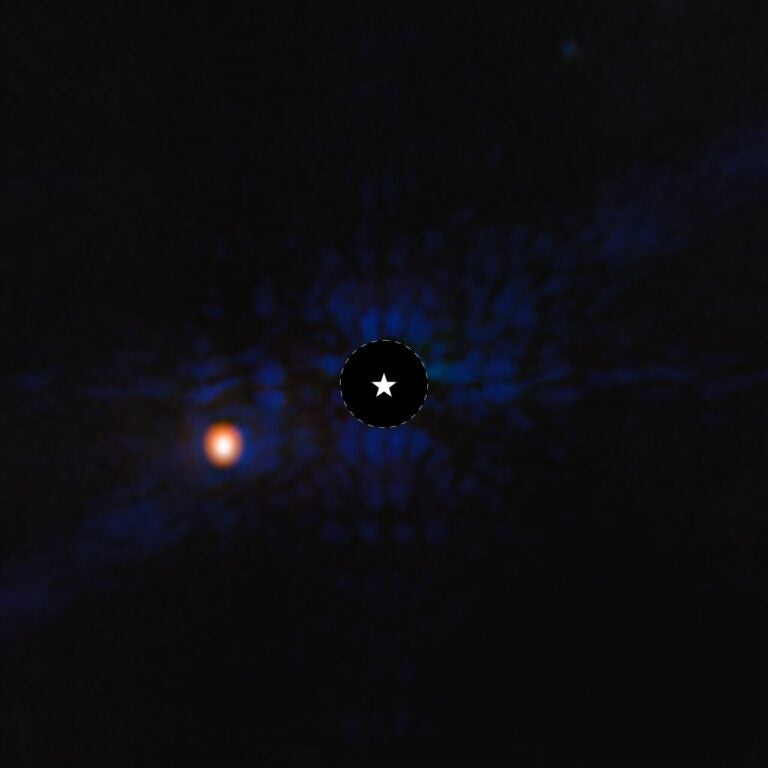
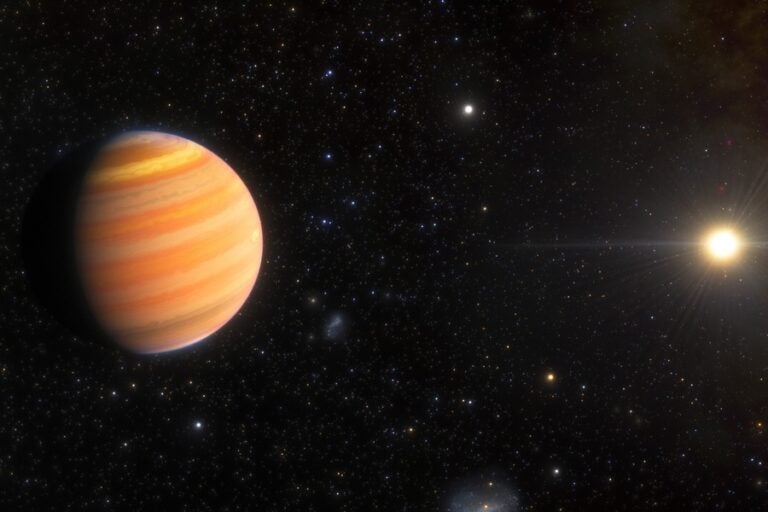
  • A large planet occupies the upper right of the frame, its surface swirling with bright orange, yellow, and deep red clouds on its sunlit side, fading to dark blue-black on its shadowed edge. Below and to the left, a bright white glow from a nearby star washes out part of the lower frame, set against a dark brown sky scattered with faint stars.
    Exoplanets

    JWST reveals Roasted Planet’s extreme heat

  • A size comparison illustration showing Earth and the Moon side by side against a black background. Earth appears on the left, showing the Americas, swirling cloud cover, and blue oceans, while the gray, crater-marked Moon is shown to the right at roughly one-quarter of Earth's diameter, accurately reflecting their relative sizes.
    Solar System

    How is the Moon 1% of Earth’s mass, but its gravity is 17% of Earth’s?

  • Science

    No place like home

  • Science

    Vera C. Rubin Observatory begins its Legacy Survey of Space and Time

  • A highly pixelated, black-and-white image features a single blurry object floating against a pitch-black background. The subject appears to have two connected sections: a larger, brighter rounded shape on the left and a smaller, dimmer lobe extending to the right. The contrast is sharp between the solid black void and the glowing, blocky white patches of the central object.
    Solar System, Today in the History of Astronomy

    June 28, 2011: Kerberos is discovered

  • Features, Science

    Our planet’s electronic vulnerability

Astronomy Newsletter

Get newsletters, updates and special offers via email from Astronomy.com!

Please enter a valid email address.

Astronomy magazine: 50 years and counting

Astronomy leads the astronomy hobby as the most popular magazine of its kind in the world. Get information about subscriptions, digital editions, renewals, advertising and much, much more.

Count me in

FREE DOWNLOAD

All About the Apollo Mission

Get it now
Astronomy Magazine logo
  • Facebook
  • LinkedIn
  • YouTube
  • Instagram
  • Twitter
  • About Us
  • Contact Us
  • Subscribe
  • Customer Service
  • Advertising
  • Terms of Use
  • Privacy Policy
  • Do Not Sell

@ 2025 Firecrown Media. All Rights Reserved.

More Sites from Firecrown Media Publisher logo
Scroll to Top

Sign In

New User? Create an Account

Why Sign In? Subscribers can access their digital magazine issues, and registered users can participate in our Community forums and galleries.

Please enter your email.
Please enter your password.

Lost your password?

Manage My AccountCustomer Support