When you have been an amateur astronomer as long as I have (the sky caught my interest in 1956), you have seen a lot of celestial history. I like to think of it as having lived during the most amazing period in human history. During this period spanning from the birth of the Space Age to the present, humanity has traveled to another world, learned how to live off this Earth, and truly found its place in the universe.
It saddens me to realize that unless a person is at least 60 years old, they likely have no personal memory of the stunning moment half a century ago when a modest man from Ohio stepped onto the surface of the Moon. Indeed, the majority of Earth’s population was not even born when Neil Armstrong stood on another world and uttered the words “…that’s one small step for a man, one giant leap for mankind…” What a grand time it was for humanity as the culmination of scientific and technical genius put a man on the Moon!
But I also remember an earlier time when the far side of the Moon was still uncharted territory and astronomers had only recently deduced that the universe extends far beyond our own Milky Way. Astronomy was a slow-paced science back then. The academic community had barely begun to digest the significance of Hubble’s discovery of the expansion of the universe. Quasars and neutron stars were still unknown, and black holes were pure science fiction. The amateur astronomy community still clung to the belief of a desert-like Lowellian Mars where life exited. Similarly, amateur telescopes of the early 1960s were for the most part quaint throwbacks little removed from the instruments used by Galileo and Newton. But still, the sky beckoned us with an irresistible siren song of mystery and intrigue. Something wonderful was out there waiting to be discovered!
What a difference a lifetime makes. We find that we unwittingly allowed short-sighted politicians to usurp our ability to send brave heroes to another word. But at the same time, astronomy has accelerated at warp speed. We have charted the finite boundaries of the universe and are on the cusp of finding Earthlike habitable planets around distant stars. It has been an amazing journey for someone like me who has lived through the stunning times when astronomy exploded from a mysterious academic pursuit to a fascinating science where anyone with a modest telescope can see for themselves what a marvelous universe we live in!
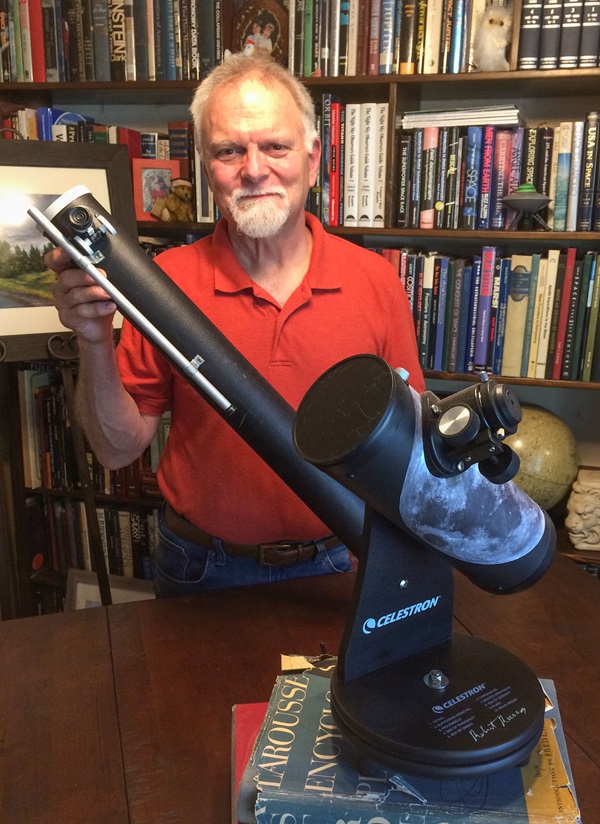
My first telescope was little more than a toy; a wobbly 3-inch Gilbert reflector that appeared under the Christmas tree in 1958. The device was a telescope in function only; it succeeded in magnifying the view. The real challenge was simply pointing it at what I wanted to see. By some miracle, the little cantankerous beast didn’t kill my joy. It was my personal Mount Palomar, and back then Palomar was the holy grail of observatories. And I began a lifelong fascination with the Moon!
Two Christmases later, another telescope came into my life, a 4-inch Criterion K2B reflector on a German equatorial mount. As we say in the south, now I was in tall cotton! This was a real telescope with a good finder and mount. I could actually explore the sky and took satisfying photos of the Moon through it.
My fascination with astronomy continued to grow, but bigger telescopes remained on hold as I completed my education and military service. In an era when a 6-inch reflector was considered a “big” telescope, I vowed my next instrument was going to be really big! The vogue of the times were large reflectors, 10- to 12-inches, made by the venerable masters at companies like Cave Optical and the Optical Craftsman. Though I lusted after these astronomical beasts, their sheer size and the difficulty in transporting them held me back.
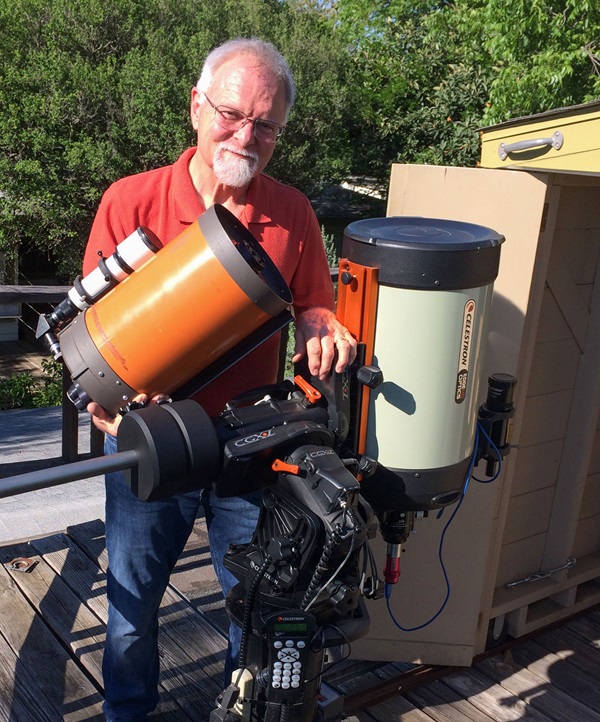
Then I saw my dream ‘scope…. the newly introduced fork-mounted Celestron 8 Schmidt-Cassegrain! Here was a compact, large aperture, portable telescope that was designed for both visual observing and astrophotography. I marveled at the leap in amateur telescope technology in the 12 years since I gazed in awe through the shaky Copernicus 3-inch Gilbert. The revolutionary Celestron 8 offered the amateur astronomer a truly professional class instrument. I wanted that Celestron 8!
The early 1970s were a difficult economic time. The Nixon administration even imposed a wage and price freeze in a desperate attempt to control a damaged economy. Thus, my coveted Celestron 8 had to wait until early 1975 when an improved economy allowed purchasing my dream scope, then sold directly by Celestron in Torrance, California.
The scope arrived a few weeks before the May, 1975 total lunar eclipse. Now I had the chance to use the telescope for the prime reason I bought it: astrophotography. I attached my Nikon F camera and burned through several rolls of Kodak’s Plus-X film. Success! The eclipse photos were beautiful.
Over subsequent decades, that vintage orange tube Celestron 8 has been aimed at the Moon hundreds of times, and each time I encountered a serious photographic limitation—the film! The art of planetary imaging changed little in the one and a half centuries since the first daguerreotype of the Moon was taken in 1840. Faster, finer grained films were perfected, but nature of film photography dictated that a single exposure, lasting significant fractions of a second, be used to record lunar detail. The unsteady atmosphere did much to smear and blur that single exposure. Then, in the early 21
st century, we entered the era of digital photography. Overnight, hundreds of film images of the Moon were obsolete!
The application of webcam style solid state video cameras to astrophotography changed everything! The technique of planetary photography leapfrogged to a point where amateurs with modest instruments were exceeding the results attained by the best professional observatories using film. I was so impressed with the telescopic results achieved with a simple Philips ToUcam that I wrote my third astrophotography book about it, Introduction to Webcam Astrophotography, a book that I like to think helped launch today’s planetary camera industry.
In the three decades of film photography through my beloved Celestron 8, telescope technology continued to improve. The classic orange tube Celestron 8 remained in production for over 10 years and was joined by 5- and 14-inch versions. The Super C-8 made its appearance, featuring an optional black tube, high-transmission StarBright optical coatings, and a Byers worm gear drive.
By the early 1980’s, the Schmidt-Cassegrain revolution began to claim victims. The large tube reflectors produced by Cave Optical and the huge Unitron refractors we drooled over in full page ads in magazines were fading from the astronomy scene. Cave Optical shuttered its doors, but large tube reflectors continued production when Crown Optics hired the Cave production staff. Crown soon evolved into Meade Instruments. Meade then joined the Schmidt-Cassegrain revolution, producing their Meade 2080 telescope in competition with the now universally popular Celestron 8.
Not to be outdone, Celestron quickly released the “SP-C8” or Super Polaris C8, the first SCT on a German equatorial mount, which eliminated the problem of cameras and instruments not fitting within the original fork mount.
The Celestron line further evolved with the development of the Compustar, the first computer-controlled GoTo Celestron, and the internal battery-operated PowerStar that liberated the observer from extension cords or the need for large batteries and power inverters. Celestron’s innovative Fastar photographic system allowed quickly converting an f/10 optical system into an ultra-fast astrograph. The mid-sized Celestron 11 also joined the telescope lineup.
Entering the 21st century, electronics, computer control, and full GoTo capability became the standard across all the hotly competing Celestron and Meade telescope lines. Today, any computerized Celestron mount, from entry level to advanced research grade, can be fully controlled from a smartphone, tablet, or laptop/PC.
Over the past half century, not only has the optical quality, mount stability, and tracking accuracy improved, the base price of a Celestron 8 has dramatically come down! In 1975, my Celestron 8, with tripod and wedge, was considered a bargain at $1000, or well over an average month’s pay at that time. Adjusted for inflation, that original C8 cost $4,750 in 2018 dollars. In contrast, Celestron’s Advanced VX 8-inch Schmidt-Cassegrain telescope, superior in all respects to the original C8, now costs $1739, or over two and one half times less than the original C8.
Thanks to the vision of Celestron founder Tom Johnson to integrate photography directly into the design of his Schmidt-Cassegrain telescope in the 1960s, the ranks of outstanding astrophotographers has grown exponentially. When I began my celestial photography in the early 1960s, the number of good amateur astrophotographers could be counted on the fingers of both hands. Today, there are thousands of amateurs producing extraordinary astrophotos.
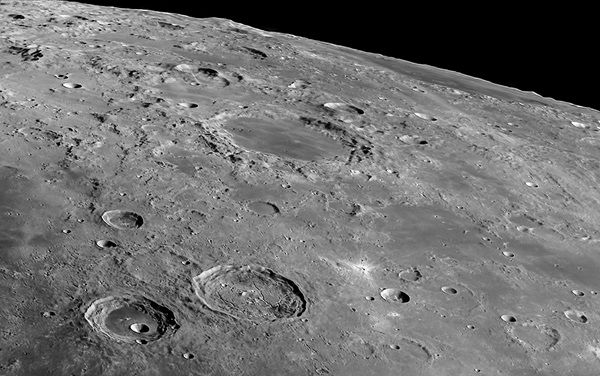
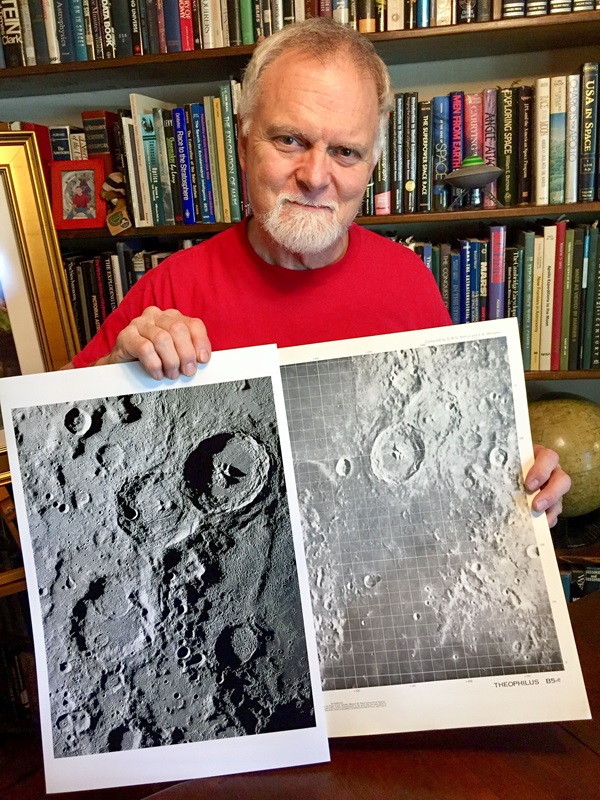
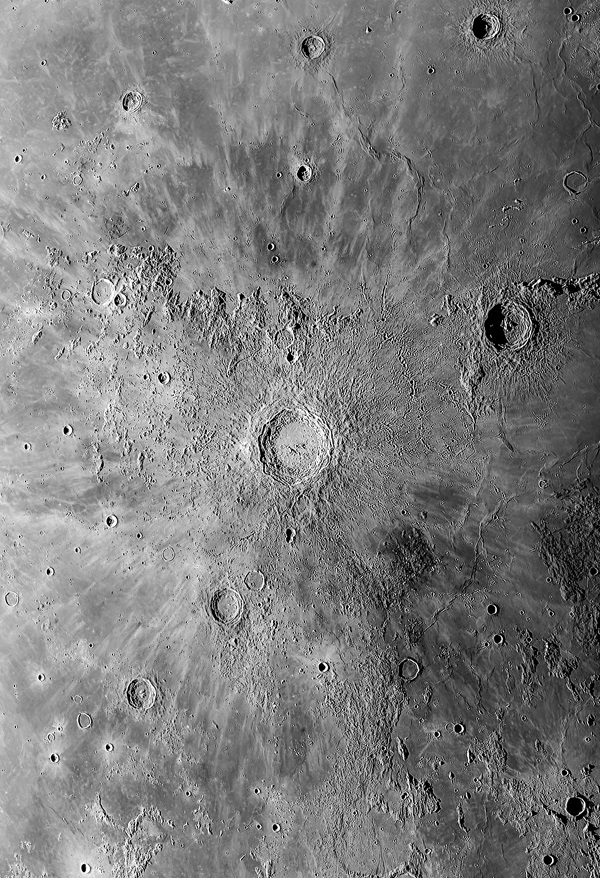
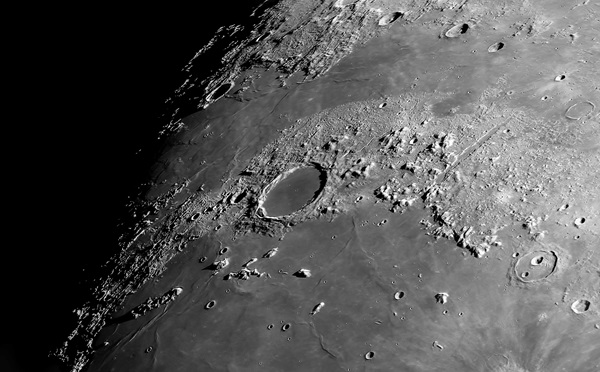
It is delightful to look back at the half century since Apollo 11 and see how much amateur astronomy, and the telescopes we routinely use today, have evolved. When I received my Celestron 8 in 1975, I felt I was at the pinnacle of telescopic astronomy. The Celestron 8 is still optically marvelous, but now I look in awe at my Celestron 11 EdgeHD mounted on the fantastic CGX-L mount. In the winter cold or during summer mosquitoes, I can remotely control this equipment from my home office using Celestron’s CPWI software. It is a joy to image the Moon, from my backyard, and routinely achieve kilometer resolution. It is very satisfying to compare my modern electronic lunar images to the best Earth-based film images taken during the Apollo era. There is no comparison! The amateur astronomer today routinely exceeds the image quality of such research landmarks as the Consolidated Lunar Atlas produced by the University of Arizona in 1967.
It is indeed a golden era for amateur astronomy. Though this field is considered a hobby, we now have superior affordable telescopes, innovative accessories and digital cameras, and a basic knowledge of the universe that would astonish the professional astronomer back when I was young. And I predict we haven’t seen anything yet! The next generation will see humans return to the Moon. And that next generation will enjoy the sky using telescopes that we would find incredible.
Such is the nature of science, always moving forward and forever exploring the unknown. It has been a joy to see how far we have come since Apollo claimed the Moon for mankind, and it is inspiring to know the future will be nothing less than stunning!