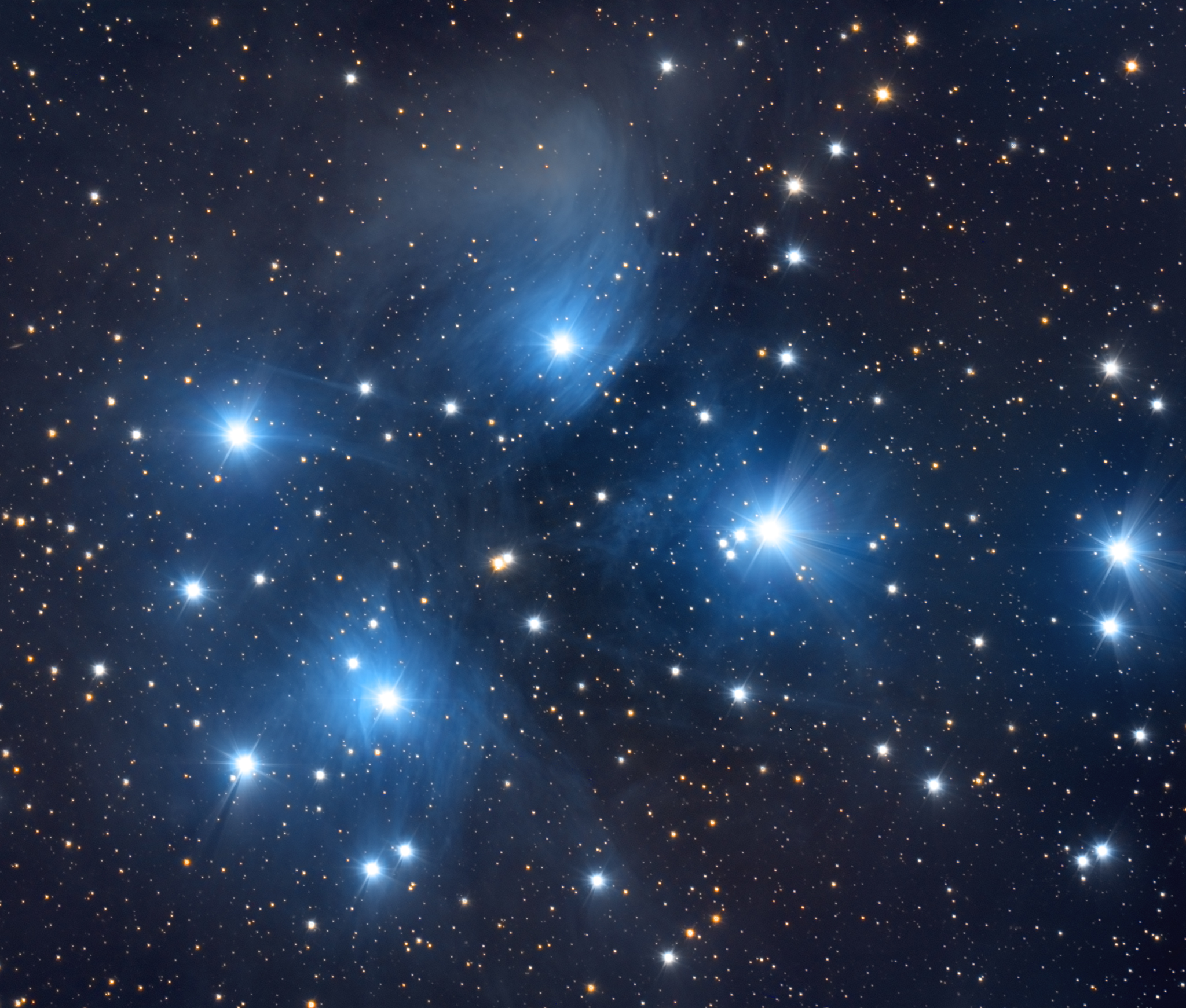
From the Old Testament to the starry logo on your Subaru, the Pleiades (M45) are a cultural touchstone, springing up throughout human history. This star cluster has been mythologized across the globe, in cultures ranging from Aboriginal Australia to the Ancient Greeks, who envisioned them as the Seven Sisters of myth. Some scientists think similar stories are 100,000 years old, dating to before humans left Africa.
For most of modern human history, however, astronomers have known the Pleiades as a tight-knit family containing a few hundred to a thousand stars. A new study reveals we’ve only been looking at the tip of the celestial iceberg.
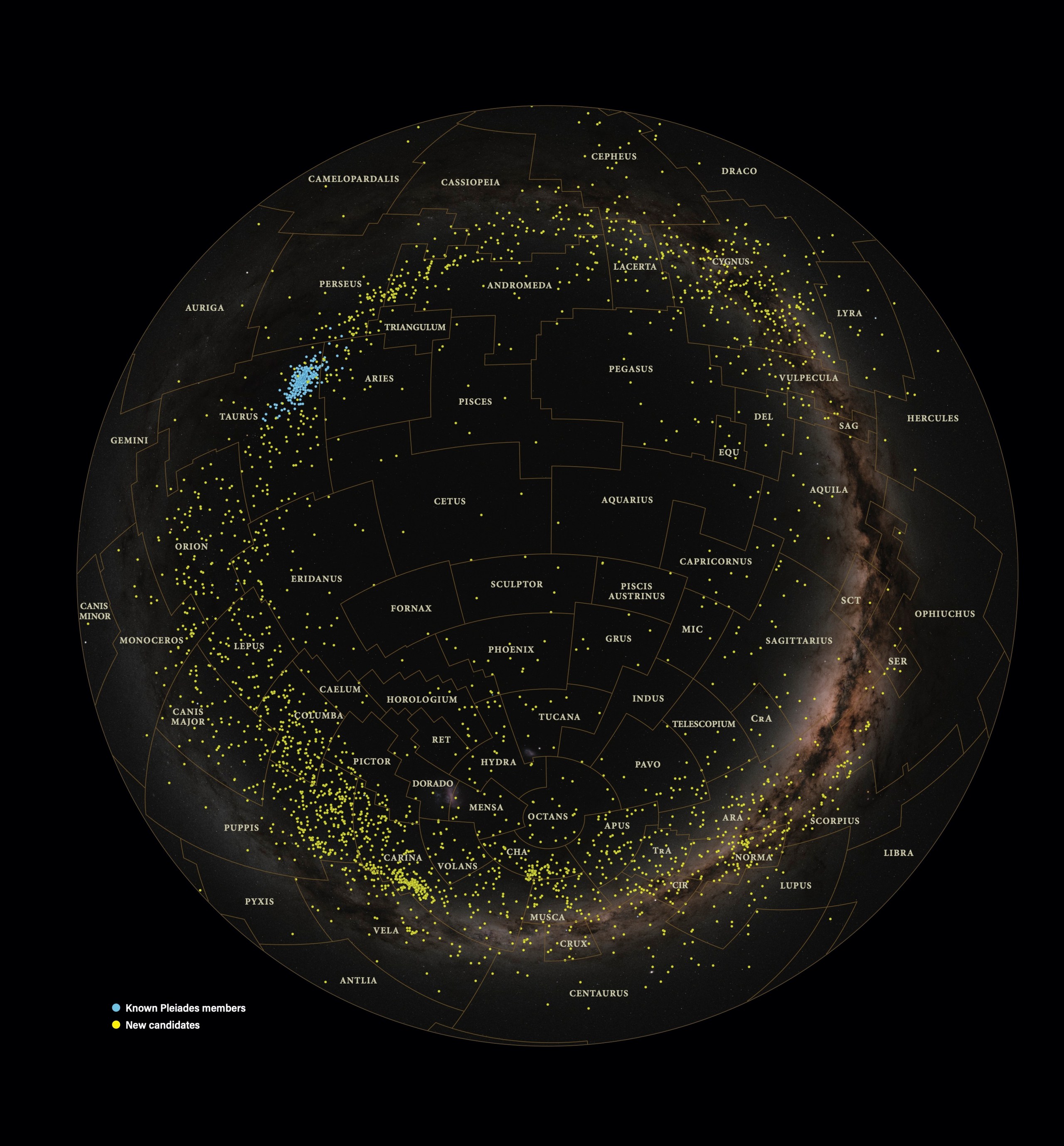
Astronomers at the University of North Carolina at Chapel Hill have discovered that the familiar Pleiades cluster is the bright core of a much larger association of stars they have named the Greater Pleiades Complex. In a study published Nov. 12 in The Astrophysical Journal, the team reveals this stellar family is between three and 20 times larger than previously thought, containing 3,091 member stars and spanning more than 1,950 light-years. The findings also demonstrate the merits of a new method for studying stellar evolution.
“This study changes how we see the Pleiades — not just seven bright stars, but thousands of long-lost siblings scattered across the whole sky,” said lead author Andrew Boyle, a graduate student at UNC-Chapel Hill, in a press release.
Putting the family back together
The team’s discovery combined data from two powerful space telescopes — NASA’s Transiting Exoplanet Survey Satellite (TESS) and the European Space Agency’s Gaia — as well as ground-based data from two major spectroscopic surveys, the Large Sky Area Multi-Object Fiber Spectroscopic Telescope (LAMOST) and the Sloan Digital Sky Survey (SDSS).
Most stars, including our Sun, aren’t born in isolation. They form in massive clouds of gas and dust, emerging in groups called open clusters. These stellar siblings are bound by gravity at first. But over millions of years, they drift apart and the cluster dissolves, making a given star’s family tree difficult to trace. The stars that comprise the Pleiades cluster as we know it were born together some 100 million years ago and have mostly stuck together. But Boyle and his team wanted to know whether the known cluster might have even more siblings lost to time.
To find the rest of the Pleiades’ family, the researchers developed a new method for tracking down an open cluster’s members. First, they looked for stars traveling on the same orbit through the Milky Way as the stars in the Pleiades. Data from the Gaia satellite, which provides precise 3D positions and motions for billions of stars, allowed them to identify around 10,000 stars moving the same direction as the Pleiades’ core. Since these stars were moving on the same path, it’s possible that they were all drifting away from the same point of origin: the dusty nursery that birthed M45.
To further constrain their results, the team determined the ages of the 10,000 candidate stars using data from TESS as a cosmic clock. TESS was designed to hunt for exoplanets by searching for stellar dimming as transiting worlds pass in front of their stars. To that end, it has collected data on the brightness of millions of stars across more than 90 percent of the sky. The team used this data to look for patterns in the variability of the candidate stars’ brightness. From them, they could determine the stars’ rotation rates. Young stars — like those in the 100-
million-year-old Pleiades — spin rapidly, while older stars have slowed down. The team identified the stars that shared a spin rate, and thus likely birth date, with the stars of the Pleiades cluster. This step whittled the list of 10,000 candidates down to a family of 3,091 related stars — the Greater Pleiades Complex.
“By measuring how stars spin, we can identify stellar groups too scattered to detect with traditional methods — opening a new window into the hidden architecture of our galaxy,” Boyle said.
Verifying the results
The team performed a few final tests to verify their results. Stars born from the same giant cloud of gas and dust not only share the same orbit and spin rate, but also the same chemical recipe, determined by the blend of elements that made up the cloud itself. To confirm whether the stars had matching makeups, the researchers turned to spectroscopy, a technique that splits starlight into its component colors to measure the precise abundances of elements. They analyzed data from LAMOST and SDSS to see whether a selection of the candidate stars were made of the same stuff as the Pleiades. The comparisons showed that the makeup of the candidate stars closely aligned with the makeup of the stars in the Pleiades cluster across several elements, meaning they were likely related.
Finally, they confirmed the origins of the Greater Pleiades Complex’s 3,091 stars by analyzing their so-called traceback histories. Using the Gaia motion data — the same data used to find the initial candidates — the team ran computer simulations to rewind the stars’ orbital paths. They showed that, based on their known motion, the entire collection of stars converged at the same location roughly 100 million years ago.
A new tool for stellar evolution
The study’s “cosmic clock” method of measuring stellar spin now gives astronomers a powerful new tool. “We’re realizing that many stars near the Sun are part of massive extended stellar families with complex structures,” said co-author Andrew Mann, an associate professor of physics and astronomy also at UNC-Chapel Hill. This technique can be used to map the hidden architecture of our galaxy, with the team planning to apply it to other associations as part of the TESS All-Sky Rotation Survey. Just as this study reunited the Seven Sisters with their lost kin, the hope is that this method could one day help astronomers find the Sun’s own lost siblings.
Brooks Mendenhall is a staff writer for Astronomy magazine and is based in Chattanooga, Tennessee.