For the first time, a probable source of ultra-high-energy cosmic rays (UHECRs) has been identified in the sky, says the astrophysicist who reported the discovery at the San Diego meeting of the American Astronomical Society in January. The researcher, Glennys Farrar of New York University, says the identification came following a statistical analysis of data from two cosmic-ray observatories, one in Japan and the other in Utah.
The observatories — Japan’s Akeno Giant Air Shower Array (AGASA) and the National Science Foundation’s High Resolution Fly’s Eye Air Fluorescence Detector (HiRes) in Utah — produced cosmic-ray data that differ in observational method and sensitivity. In addition, each observatory’s set of data, taken singly, was insufficient to indicate a source location. However, Farrar and her HiRes collaborators found a way to analyze both observatories’ records in combination.
Data cluster
They found a group of four ultra-high-energy cosmic-ray events coming from a single direction in the sky. Each event was detected either as a minute streak of light left in the atmosphere or a splat of particles detected on the ground. The chances of these four being coincidentally aligned, they say, are less than 1 in 100. With a source location tentatively pinpointed, Farrar returned to the data, checking lower energies — and found a fifth event detected by HiRes in the same area of sky.
These five UHECRs arrived over a 10-year span. Their locations fit within a circle about three Full Moons wide, centered on 11h17m right ascension and 57° north declination. This lies near the 2nd-magnitude star Merak (Beta Ursae Majoris) in the bowl of the Big Dipper.
The ultra-high-energy cosmic rays, Farrar says, have much higher energies than ordinary cosmic rays. They are mostly protons, but moving at nearly the speed of light. Each tiny bit of matter packs the kinetic energy of a fast-moving bowling ball. Ultra-high-energy cosmic rays are extremely rare, however, with one hitting a square kilometer (0.4 square mile) on Earth every century on average. Only about 100 such events have ever been detected in the Northern Hemisphere.
Big disturbances
What kicks the cosmic rays to such high speeds is an astrophysical puzzle because few processes can accelerate particles so much. The most likely candidates include the collapse of a massive star into a black hole, gamma-ray bursts, and active galactic nuclei (quasars).
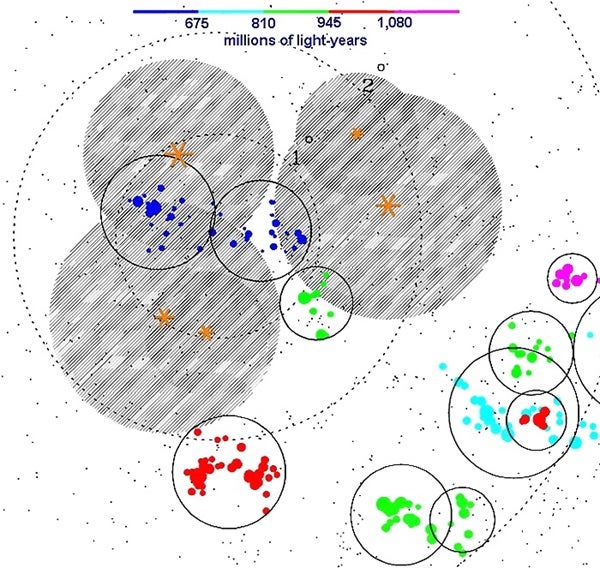
But there’s a catch, says Farrar. “Because the particles are charged, they tend to get spread out in transit due to magnetic fields they pass through.” The fact that these four or five cosmic rays kept their alignment suggests they either had not come very far — or the space they traveled through was unusually free of magnetic fields. To see what objects might be the source of the UHECRs, Farrar turned to an extensive study of thousands of galaxies, the Sloan Digital Sky Survey (SDSS).
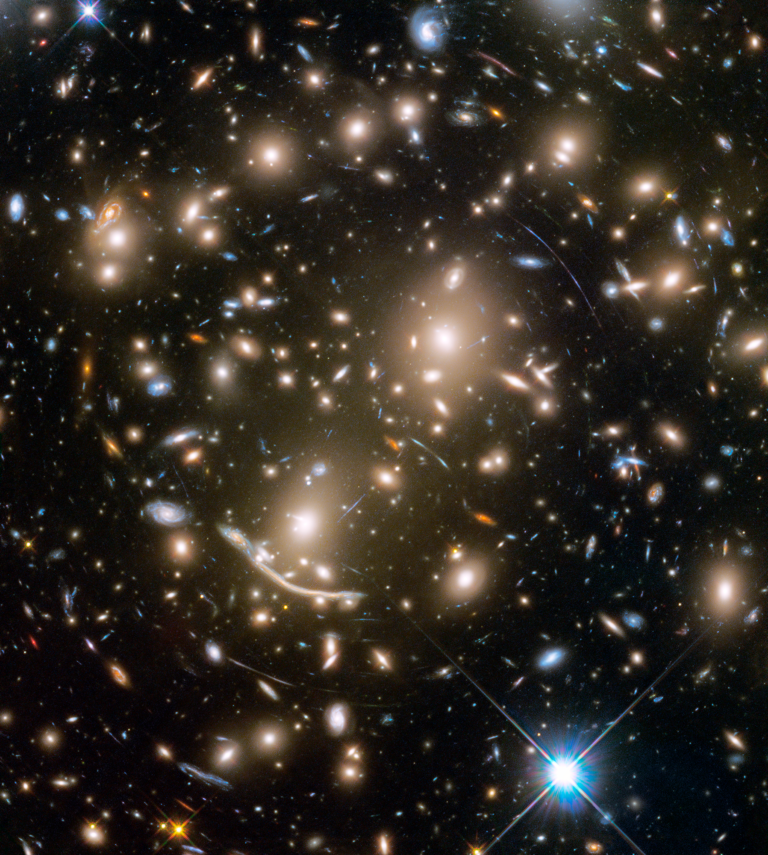
“Luckily, these sources turn out to lie within a Sloan field,” says Farrar. “This also lets us understand why the cosmic-ray particles are not all spread out.” The SDSS data suggest the apparent source is two rich clusters of galaxies in the process of merging about 550 million light-years away. The Sloan data also reveal that no other galaxies lie closer to Earth in this direction. Says Farrar, “In those clusters, there could be obscured active galactic nuclei, there are hints of X-ray sources, and certainly gamma-ray bursts remain possible candidates.”
Hole in the clouds
Further observations in years to come should help Farrar and others studying UHECRs tell more about the processes that fire them up to high energies. Cosmic rays generated in bursts, such as from a single powerful event like the creation of a black hole, result in a different spectrum of energies than a more drawn-out process, such as matter falling into a black hole.
Says Farrar, “Nature has been very kind in presenting us with this opportunity to unravel one of the real mysteries of physics. The discovery of this bundle of cosmic rays tells us there’s one direction where the magnetic fields do not disperse the particles — it’s like seeing a patch of blue sky through a break in the clouds.”