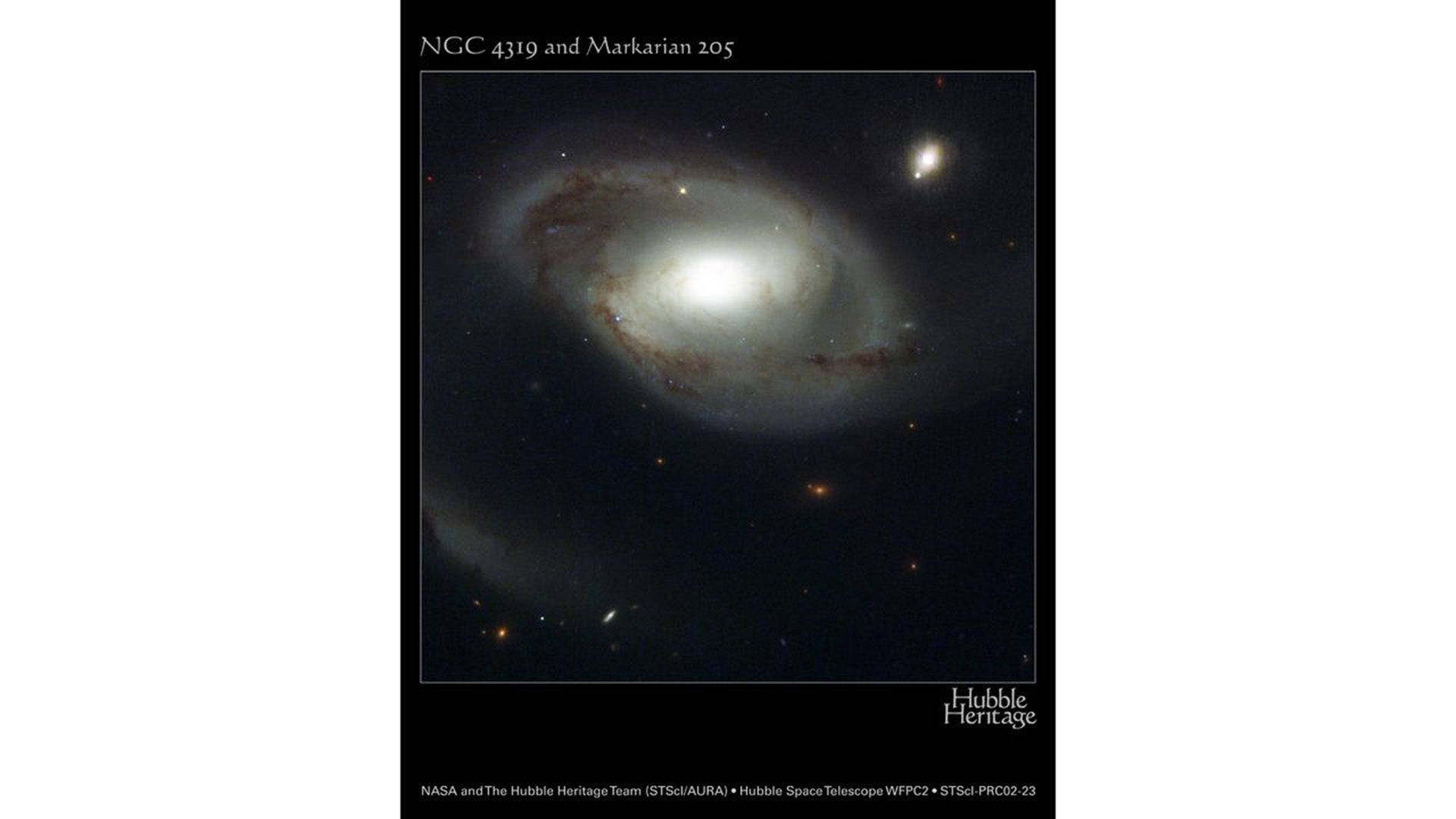
Located in the constellation Draco, NGC 4319 is a barred spiral galaxy seen nearly face-on from Earth. It is characterized by an inner ring structure and moderately tight spiral arms. What is perhaps most unusual about NGC 4319 is how close it appears to quasar Markarian 205.
After studying the pair in 1971, American astronomer Halton Arp concluded that the quasar was not a distant background object at all. He believed it may have been blasted away from the nucleus of NGC 4319 as sort of a cosmic cannonball.
Arp’s strange idea derived from his skepticism of both the Big Bang theory and the notion that the universe was expanding. He thought that quasars were caused by other events. To support his theory, he pointed to what looked like a luminous stream of material bridging the gap between NGC 4319 and Mrk 205. Arp’s claim created a furor that lasted for more than two decades.
To resolve the matter, astronomers used two methods to find the distances to these objects. First, they examined the objects’ spectra to determine their redshifts caused by the expansion of the universe — the greater the redshift, the greater the object’s distance. This revealed that the quasar’s redshift far exceeds the galaxy’s redshift.
Next, they measured how much of Mrk 205’s ultraviolet energy dimmed as it passed through NGC 4319’s outer halo of interstellar gas. Each technique gave the same answer: NGC 4319 is 80 million light-years from Earth, whereas Mrk 205 is 1 billion light-years away, separated by both space and time.