
Key Takeaways:
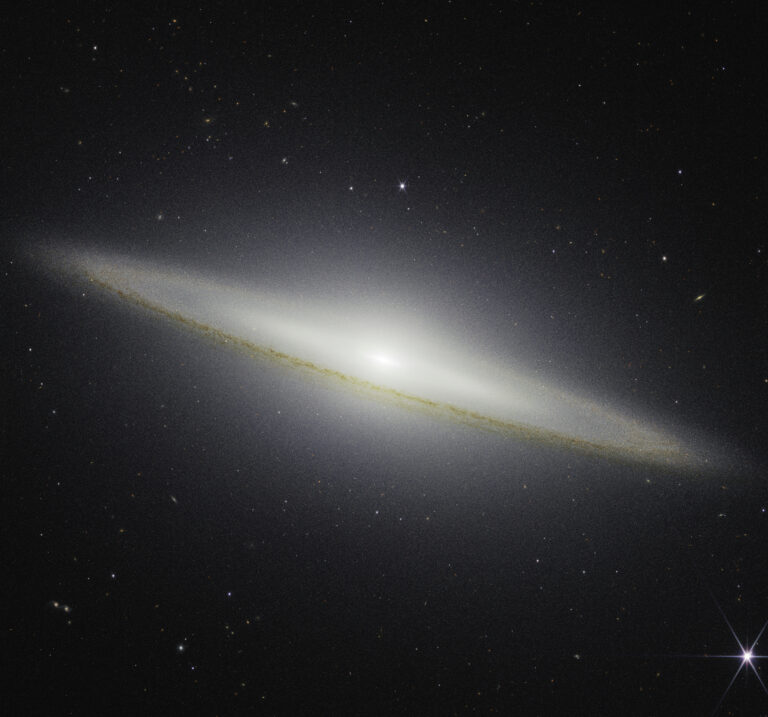
- NGC 1023, the largest member of a small Perseus galaxy group, is classified as a barred lenticular (SB0) galaxy, characterized by a central bulge, tapering edges, and the absence of spiral arms.
- What was initially identified as a lopsided spiral arm (Arp 135) on NGC 1023's eastern side was later determined through improved imaging to be a small, irregular, and likely tidally locked companion galaxy, now designated NGC 1023A.
- Hubble Space Telescope observations revealed a supermassive black hole residing at the core of NGC 1023, possessing a mass estimated to be between 40 million and 60 million times that of the Sun.
- Stars in the immediate vicinity of this supermassive black hole orbit within a small, flattened disk, achieving speeds up to 2.1 million km/h while remaining under its powerful gravitational influence.
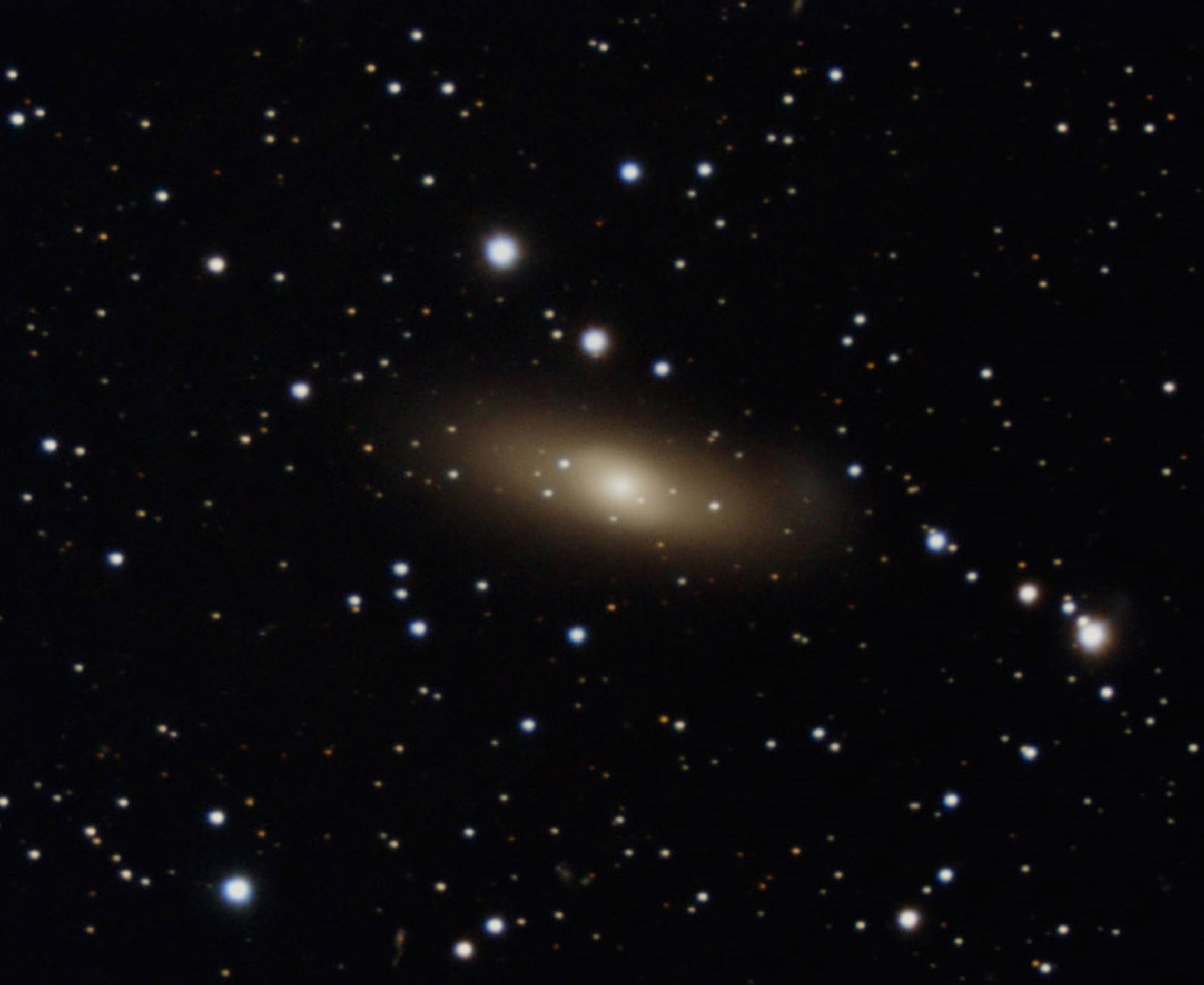
NGC 1023 is the largest member of a small group of galaxies in Perseus. After extensive study, NGC 1023 has been classified as a barred lenticular galaxy, which have protruding central bulges that taper toward their edges. In many ways, they look like elliptical galaxies, but also share some common traits of spiral galaxies — except for one: They do not have spiral arms. In the case of NGC 1023, the disk shows no discernible structure, but there is a hint of a central bar, leading to the SB0 classification.
Detailed images of NGC 1023 show a lump on the eastern side of the galaxy, which was thought to be a lopsided spiral arm and led Halton Arp to add it to his atlas as Arp 135. As imaging improved, it became clear that the lump was actually a small irregular galaxy that is likely tidally locked to the larger NGC 1023. That companion galaxy is now referred to as NGC 1023A.
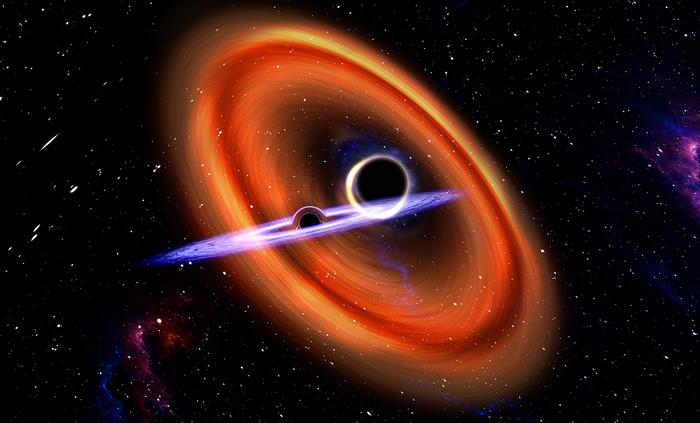
Hubble Space Telescope studies unveiled a supermassive black hole at the center of NGC 1023. Its mass is between 40 million and 60 million times greater than our Sun’s. Hubble also shows that many stars closest to the black hole orbit in a small, flattened disk rather than at random angles as other stars in the central bulge do. And even though some are orbiting as fast as 1.3 million mph (2.1 million km/h), they still cannot break the powerful grip of the black hole.