Targets for June 2–9, 2016
Naked eyes: Mizar and Alcor
Small telescope: The Sombrero Galaxy (M104)
Large telescope: Elliptical galaxy M60
This week’s naked-eye object is an optical double star in Ursa Major. At the bend of the Big Dipper’s handle, you’ll find magnitude 2.4 Mizar (Zeta [ζ] Ursae Majoris) and magnitude 4.0 Alcor (80 Ursae Majoris).
The two stars are separated by 12′, an easy split for most observers just using their naked eyes. In fact, 2,000 years ago, spotting two stars at this location was the test for vision in the Roman legion. If a prospective soldier didn’t see two stars, he didn’t get in.
Mizar and Alcor are an optical double star. That means the two stars are not physically related. They just lie in the same direction from our point of view. I like to think of an optical double as a type of optical illusion.
When you’ve enjoyed the two stars without optical aid, point a telescope at them and you’ll see more. Telescopically, Mizar splits into two components separated by 14″. Mizar’s companion shines at magnitude 4.0. This was the first star astronomers telescopically identified as a double. Italian astronomer Giovanni Battista Riccioli made this discovery at Bologna in 1650.
Originally, Mizar carried the name “Merak,” which repeated the common name for the star Beta [β] Ursae Majoris. Merak means “the loin.” French scholar Joseph Justus Scalinger erroneously changed the name to Mizar in the second half of the 16th century, and that name stuck.
Hats off to this galaxy
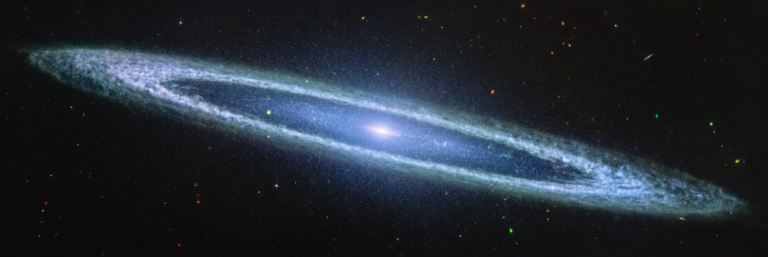
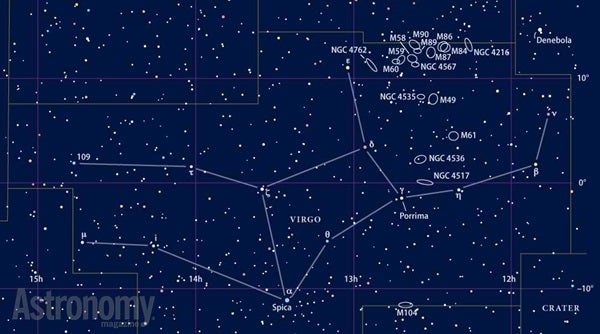
This week’s small-telescope target is the Sombrero Galaxy (M104) in Virgo. Here’s a showpiece spiral galaxy guaranteed to delight amateur astronomers and the public alike. The Sombrero Galaxy is undoubtedly one of the finest objects you can see through a small telescope. It shines at magnitude 8.0 and measures 7.1′ by 4.4′. To find it, look 11° due west of magnitude 1.0 Spica (Alpha [α] Virginis).
M104 was the first galaxy astronomers detected a large redshift in. Redshift refers to the direction of motion away from us caused by the universe’s expansion. In 1912, American astronomer Vesto M. Slipher discovered that the Sombrero Galaxy is moving away from us at a speed of 2.2 million mph (3.6 million km/h).
The Sombrero Galaxy’s lens shape and the dark dust lane that splits it are easy to spot through a 4-inch telescope. The galaxy’s two sections have unequal brightnesses — the north outshines the south because M104 inclines 6° to our line of sight. The dust lane, therefore, appears to cross south of center.
Through a small scope, you might detect the dust lane only near the Sombrero’s center. The core is bright, and a large halo surrounds it, even extending above and below the sections of the spiral arms nearest the nucleus.
A nice double galaxy
This week’s large-telescope target is elliptical galaxy M60, which also lies in Virgo. This bright but under-observed galaxy lies 1.4° north-northeast of magnitude 4.9 Rho (ρ) Virginis. Through medium-sized telescopes, magnitude 8.8 M60 easily shows as a double galaxy. Its companion, NGC 4647, glows 3 magnitudes fainter, but it’s still well within the light grasp of a 6-inch scope.
Through an 11-inch instrument, M60 itself appears just slightly out of round. It measures 7.1′ by 6.1′. The galaxy features a wide, concentrated central region and a faint halo visible at high magnifications. The magnitude 9.7 elliptical galaxy M59 lies 0.4° west of M60. A low-power telescope/eyepiece combination will show them both.
In the 1844 two-volume observing epic Cycle of Celestial Objects, William Henry Smyth describes a contemporary’s view of this type of object, and he gives a reason for astronomers to observe it: “The hypothesis of Sir John Herschel, upon double nebulae, is new and attracting. They may be stellar systems each revolving round the other: each a universe, according to ancient notions. … Meantime our clear duty is, so industriously to collect facts, that much of what is now unintelligible, may become plain to our successors, and a portion of the grand mechanism now beyond our comprehension, revealed.”
Expand your observing at Astronomy.com
The Sky this Week
Get a daily digest of celestial events coming soon to a sky near you.
Observing Basics
Find more guidance from Senior Editor Michael E. Bakich with his Observing Basics video series.