Key Takeaways:
- The Titius-Bode law, a numerical progression discovered by Titius in 1766 and published by Bode in 1772, initially matched the orbital distances of known planets (Mercury through Saturn) and gained wide acceptance after Uranus's discovery in 1781.
- The "law" was subsequently discredited with the discovery of Neptune in 1846, which did not fit the progression, leading to its current classification as a mere coincidence.
- The observed spacing of major planets in our solar system is likely an outcome of chaotic formation processes involving collisional accumulation of orbiting bodies, with limited planetary migration due to the relatively short lifespan of the protoplanetary disk.
- The Titius-Bode progression does not apply to extrasolar planetary systems, where diverse orbital configurations, including "hot Jupiters," are explained by gravitational interactions and planetary migration within their respective dusty disks.
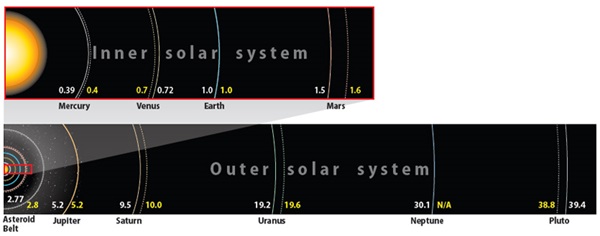
In 1766, Johann Daniel Titius of Wittenberg discovered a numerical progression that roughly matched the orbital distances of the known planets — Mercury through Saturn. In 1772, Johann Elert Bode of Berlin published the progression. When William Herschel discovered Uranus in 1781, the planet fit in the number series. This addition provided further evidence for the Titius-Bode law, which was widely accepted in the astronomical community until Neptune’s discovery in 1846. Neptune broke the “law.” So, yes, it’s just a coincidence that most of the planets fall within the Titius-Bode law distances.
Titius discovered the relation after playing with number sequences and finding one that worked. Yet, scientists have long sought deeper explanations for the Titius-Bode progression. In fact, so many ideas have been advanced that Icarus, a leading journal of planetary science, no longer accepts papers that allege to explain the series.
In our solar system, the major planets’ spacing is likely an outcome of the chaotic processes involved in forming planets through the collisional accumulation of progressively larger orbiting bodies. Also, our planets seem to have stayed close to the orbits in which they formed. The gas and dust disk that produced our solar system had a relatively short life span, which didn’t allow enough time for planets to migrate elsewhere. This is different from many of the extrasolar planetary systems known.
The progression also doesn’t apply to extrasolar planetary systems, discovered in the past decade. Scientists suspect gravitational interactions between forming planets and the dusty disk explain how some gas-giant planets become “hot Jupiters,” orbiting a star well inside the distance of Mercury’s orbit. This observed planetary migration limits the applicability of simple numerical progressions to extrasolar systems. — ALAN BOSS, CARNEGIE INSTITUTION OF WASHINGTON