Just as the Moon can eclipse the Sun as seen from Earth, Earth can eclipse the Sun as seen from the Moon. These eclipses may be partial or total.
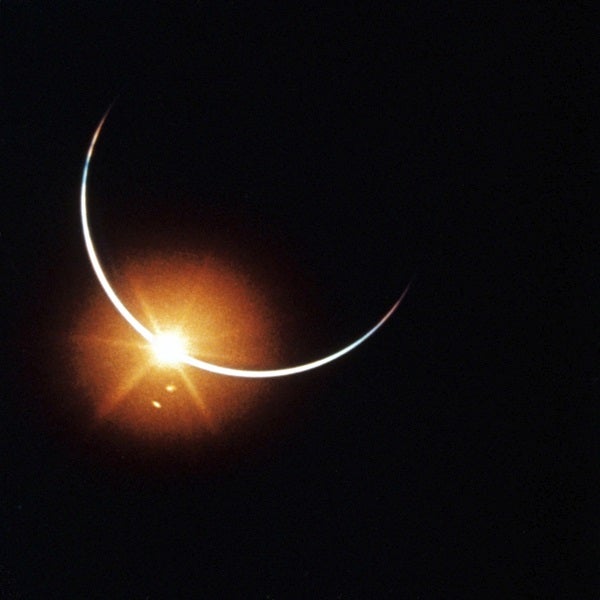
During the lead-up to a solar eclipse from the Moon, a viewer on the Moon would see the Sun approach the dark disk of Earth, with the planet’s nightside facing the Moon. Earth’s atmosphere would be lit from behind, creating a reddish ring around the planet that would glow brighter as the eclipse proceeded. Astronaut Alan Bean, who experienced such an eclipse while returning home on Apollo 12, said in interviews that the light filtering through Earth’s atmosphere shifted from red into the full spectrum of colors during maximum eclipse. On the Moon, the landscape would also grow darker and redder, as the sunlight of every sunrise and sunset on Earth filtered through the atmosphere and reached the Moon. We see this reddish color from Earth during total lunar eclipses.
During a partial eclipse, some bright portion of the Sun would remain uncovered by Earth. For near-total eclipses, this would create a diamond ring effect with the tiny part of the Sun’s disk as the diamond and Earth’s atmosphere acting as the ring. During a total eclipse, the entire Sun would vanish, and the outer regions of the Sun’s corona would become visible, just as it is during a total solar eclipse on Earth.