Key Takeaways:
- The visually prominent "Pillars of Creation" in the Eagle Nebula, despite their apparently solid structure, are composed of gas significantly less dense than Earth's atmospheric air.
- These monumental structures are characterized by vast dimensions, with the largest pillar measuring approximately 3 light-years in length and possessing a thickness of about half a light-year.
- The perceived sharp edges and dense appearance are not due to high intrinsic material density but rather to the extensive amount of material observed along the line of sight, analogous to dense terrestrial fog.
- Quantitatively, the gas within the pillars has a density of approximately 4,000 particles per cubic centimeter, which is orders of magnitude less dense than Earth's sea-level atmosphere and even lower than the most extreme terrestrial vacuums.
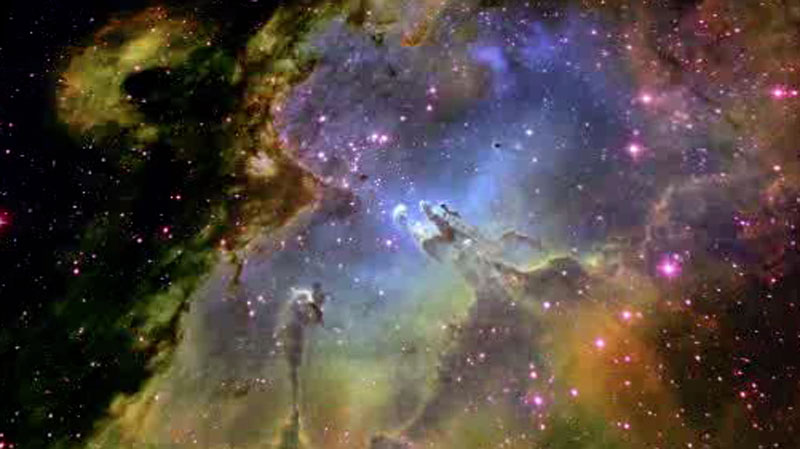
The terrestrial analog is looking into a fog bank. What we call “dense fog” is not actually denser; it is just a larger cloud of material — more water droplets suspended in the air along our line of sight obscure our view. And so it is with these types of nebulae. Because we’re looking a half light-year through the pillars, we can see sharp edges and apparently dense structures — even though the material is quite tenuous.
In the Eagle Nebula, the density of material within the columns is about 4,000 particles per cubic centimeter. Air density at sea level has more than 1019 particles per cubic centimeter — that’s a factor of 10 million billion times more dense than in the pillars. The 4,000 particles per cubic centimeter density is far lower than that of the best vacuum we can achieve on Earth. So, it is the vast scales of these nebulae that give them the appearance of solid structures. — Paul Scowen, Arizona State University, Tempe