Key Takeaways:
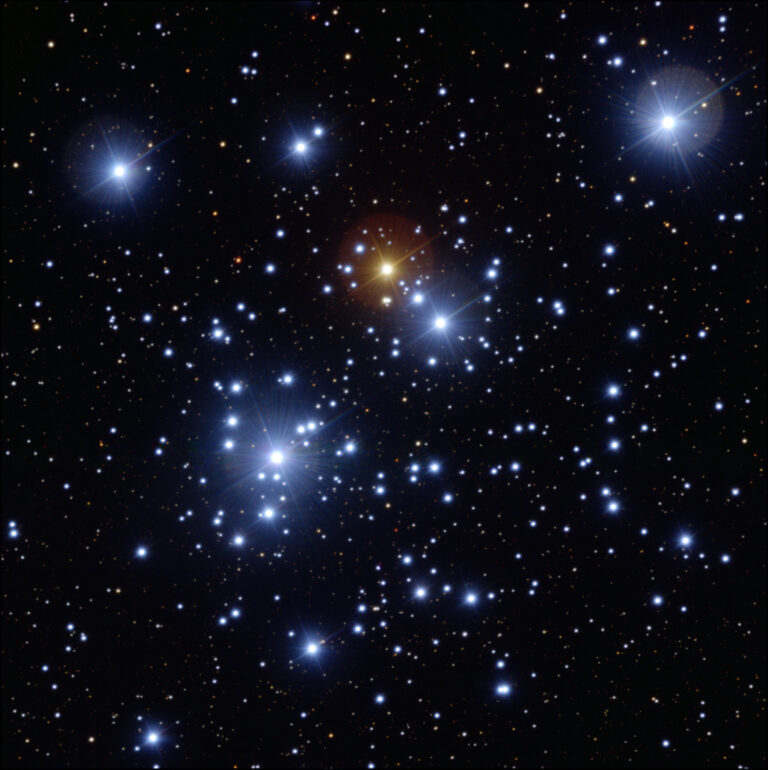
- Star clusters are fundamentally defined as gravitationally bound families of co-eval stars that traverse the galaxy together.
- Identifying cluster membership relies on measuring shared stellar properties, which enhances the confidence in distinguishing members from unrelated field stars.
- A practical application of this method involves plotting stars around a globular cluster, such as NGC 6397, and filtering by proper motions akin to the cluster's to reveal clear distinctions.
- This technique effectively differentiates stars physically associated with a cluster from those merely projected into the same observational region.
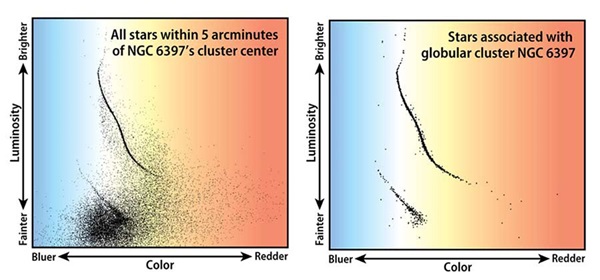
All the stars in a tiny region around the Southern Hemisphere globular cluster NGC 6397 are shown at left. Astronomers then plotted just those stars with proper motions similar to the globular cluster stars, shown at right. Using such a method shows a clear difference between the stars associated with a cluster and those that happen to lie in the same region. Astronomy: Roen Kelly, after Harvey B. Richer, et al.
Star clusters are families of stars of the same age bound by gravity and traveling together through the galaxy. The more of these shared properties we can measure for a star, the more confidently we can state it is (or is not) a cluster member.