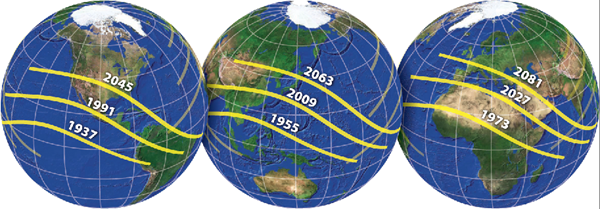
111/3 days, but over a different location on Earth. The paths of nine eclipses of Saros cycle 136 are shown here.
This article originally appeared in Astronomy‘s March 2012 issue.
Total eclipses follow a period known as the saros, which is 18 years and 111/3 days long. If there is a long totality (like the one on July 22, 2009, which was almost seven minutes), there will be another long totality 18 years and 11 1/3 days later (with minor adjustments of the date for leap years) — August 2, 2027. The third of a day gives Earth time to rotate a third of the way around, so the peak in Africa on June 30, 1973, corresponded to a peak in Mexico on July 11, 1991, and a peak in the Pacific Ocean off the coast of China in 2009. The 2027 eclipse will peak in Africa again.
The Saros cycle arises from a natural synchronization among three of the Moon’s periods: synodical (the time from New Moon to New Moon), anomalistic (the time from the closest Earth-Moon distance to the next), and draconic (the interval between the Moon’s orbit crossing Earth’s — this point is called a node). Two eclipses of the same saros occur at the same node when the Moon is at nearly the same distance from Earth and at the same time of year. A saros is equal to 223 synodical months, which is also the same as 239 anomalistic months and 242 draconic months to within a few hours.
The July 1, 2011, partial solar eclipse was brief and visible only from the ocean off Antarctica. Over the next 1,000 years, every 18 years and 11 1/3 days, this eclipse will move northward on Earth and will grow longer and become central (total or annular), before it declines, turns partial again, and moves off the North Pole.
— Jay M. Pasachoff, Hopkins Observatory of Williams College, Williamstown, Massachusetts