Skiffle, stars, and 3-D
A postwar baby, Brian May was born July 19, 1947. In his boyhood home on Walsham Road in Feltham on London’s western side, he was an only child, the offspring of Harold, an electronics engineer and senior draftsman at the Ministry of Aviation, and Ruth. (Harold had served as a radio operator during World War II.)
The seeds for all of May’s enduring interests came early. At age 6, Brian learned a few chords on the ukulele from his father, a music enthusiast. A year later, he awoke one morning to find a Spanish guitar “hanging off the end of my bed.” At age 7, he began piano lessons and started playing guitar with enthusiasm. His father’s engineering genius came in handy for repairing and fixing up equipment, as the family was of modest means. “We were very, very poor,” says May.
As he explored music, Brian also developed scientific interests. “In the school library there was this little book called The Earth,” he says. “It was written by the man who is now Sir Patrick Moore, who has become a good friend in recent times. It had a picture of Earth on the cover and gave a history of Earth from its formation all the way through the beginnings of life, and I was just enthralled. I read it from cover to cover again and again.”
The discovery of Moore, England’s famous astronomy television presenter, led to Brian staying up late to watch Moore’s show, The Sky at Night, on the BBC. “I begged my parents to stay up far enough into the night,” he says, “and I just became captivated by the whole story of the universe. It’s been a lifelong passion, something that’s never left me. There’s always a part of me who just likes to go out and gaze up at the heavens if I’m fortunate enough to have a clear sky.”

May excelled in school, and he readily says, “I had a lot of application, and I liked achieving.” His was an intellect that was mathematical, ordered, and also quite creative. Astronomy and music each found a comfortable home here. He entertained his parents by writing a monologue about the stars and speaking it over a playing of “Saturn, the Bringer of Old Age” from Gustav Holst’s The Planets. A collector, he acquired toys, comics, matchboxes, and before long a camera and telescope, the latter home-built. The scope, which he still has, is a 4-inch reflector.
“It was just a kit we bought at Tottenham Court Road,” he says, “which was famous for bits of recycled stuff, ex-government lenses, and electrical bits and pieces. Me and my dad used to go down there and find things, and we located a kit for making a telescope that must have cost 10 pounds, I don’t know, and we made it together. It’s a small scope, but it still gives me pleasure because even though I have a bigger telescope now, the 4-incher can be wheeled out in 10 seconds flat if there’s something interesting in the sky.”
Another interest emerged to coexist with astronomy and music. All May had to do to acquire this fixation was to sit down as a kid to breakfast. Weetabix, compressed wheat in the form of a biscuit, is served with milk at many an English table. “It was a big thing when I was a kid,” says May, “and when you got your packet of Weetabix in those days you would get a free card inside. An incentive for kids to badger their mums to buy it!”
The card inside was a photographic stereo card. Stereoscopy (stereoscopic, or 3-D, imaging) was invented by Sir Charles Wheatstone in England in 1838. The technique employs two nearly identical images made from a slightly different angle that, when combined by viewing through a special device, appear to merge together to produce a three-dimensional scene. The process was huge in the United States during and after the Civil War era, and was still a novelty of sorts in the Great Depression era, when kids could drop a penny in the grocery-store stereoscope to see the wonders of the world in 3-D.
Enter the Red Special
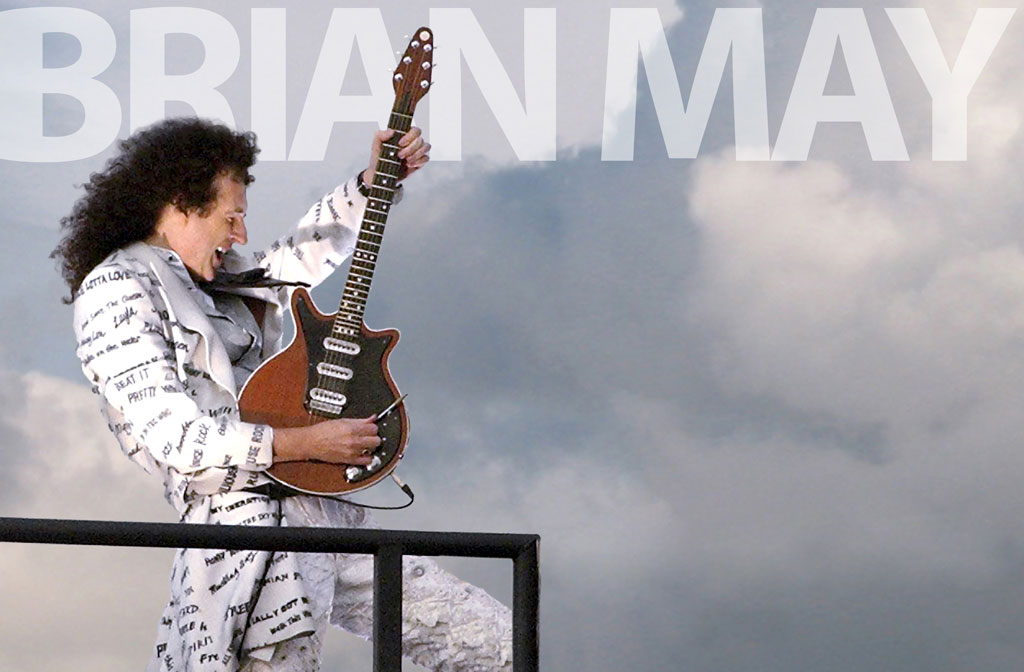
As May began his teenage years, he continued to play guitar, borrowing one here and there, a friend’s Fender Telecaster, say, or a Gibson SG. His talent was expanding by leaps and bounds, and he had no instrument of his own, unable to afford one. By the spring of 1963, when May was 15, he and his father decided to build their own guitar. Designing and building an electric guitar from scratch was no easy undertaking, although Harold’s engineering background and Brian’s methodical, mathematical mind helped the process along. The project took 18 months, and produced one of the most famous guitars in rock ’n’ roll history.
Nothing else like this instrument existed, and it conspired to give May a unique tone in playing pop music. The guitar’s body was made from oak, the neck from an 18th-century mahogany fireplace mantle, and the fret markers from mother-of-pearl buttons taken from Ruth May’s sewing box. Oh, and the valve springs used to balance the string tension were salvaged from a 1928 motorcycle.
The pickups and fret wire used for the strings created one-of-a-kind qualities. In the end, the Mays produced a carefully considered instrument with 24 frets and special placement of pickups that produced a unique tone. When the finished product was varnished in deep red mahogany, the guitar took on the name “Red Special.”
“Basically, we had no money,” May remembers. “I couldn’t afford to buy a guitar, so I said, ‘By God, we’ll make one, and we’ll make it better than anything that’s ever been seen or heard.’ ”
Early influences also helped to inspire the guitar’s unique properties. “I’d grown up with the beginnings of rock, right down from Elvis records to Little Richard,” May says. “People like James Burton had somehow made the guitar speak instead of just support, and I was captivated by that. I wanted my guitar to be my voice, with sustain, articulation, variations of intensity.”
The guitar’s clean tone also came from the Vox AC30 amplifier, and Irish rocker Rory Gallagher showed May how to set it up and drive it to achieve that tone. Another part of the equation was a treble booster, which, as May says, “drives the amp into smooth distortion as it gets rid of a little of the low end.” Couple that with Burns pickups that May installed in the Red Special, and you came out with a unique sound in rock ’n’ roll.
Another part of May’s approach was the unusual habit of using a British sixpence coin as a pick. When he was first experimenting with playing guitar, May didn’t want to buy picks because, “you know, it would have been a waste of money,” he says. “So I’d use anything I could get my hands on, little pieces of plastic cut off a packet of my Dad’s flints, stuff like that. Coins presented themselves, too. I soon noticed that having minimal flexure gave me more control in my fingers. I discovered the old sixpence coin, which had a reeded edge and discovered that if I held it parallel to the strings it would produce a smooth, nice, warm sound. If I held it at an increasing angle, I’d get this rasp that mimicked the consonants from articulating a voice. That was another ingredient in making the guitar talk.”
With all these parts of the process working together, May produced a clear, tenor tone that is vividly sharp and distinct. It would come to be known very well in many solos in the years to come, and he has used this same guitar as his principal instrument for 48 years.
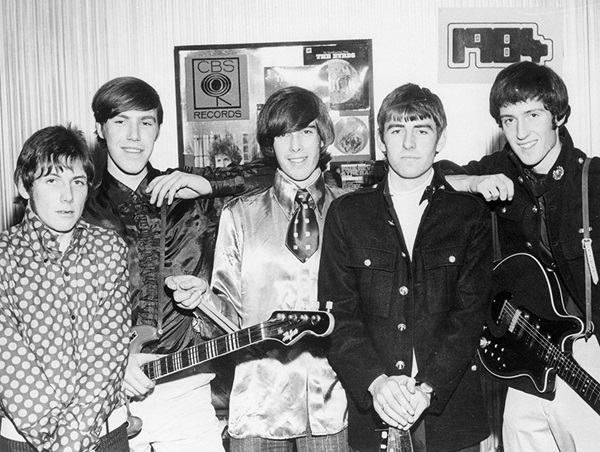
A fellow student, Dave Dilloway, also played guitar, and together with some other schoolmates, he and Brian formed an early band. Their repertoire included music from the Beatles, Manfred Mann, the Moody Blues, and other groups. By 1964, May was getting used to his new guitar and continued trying out new personnel, forming a band called 1984, the name taken from the George Orwell novel. His principal partner was vocalist and bassist Tim Staffell.
Music+astronomy
For May, the balance between school and music was a fine line that sometimes teetered one way or the other. Described at the time as “serious-minded” or even “sheltered,” May was expected to excel at his studies and then perhaps branch out and play and experience the world a bit by the time he was about 20. But many teenage musical groups were moving away from their studies and following the Beatles’ path to glory, or so they thought. “I completed my studies, O-levels [high-school-level exams], and applied for various universities,” says May. Astronomy and space science had become increasingly attractive to him through his schoolwork.
Unlike most of his contemporaries, May did it all. In the music world, he saw Jimi Hendrix play in London, which transformed and inspired his idea of guitar playing and what it ought to be. 1984 was busy playing gigs, with May adorned in Hendrix-style clothes, sporting Beatle-like hair. On May 13, 1967, the band played at Imperial College in London on the same bill as The Jimi Hendrix Experience, the day after the latter released its first album, Are You Experienced? Just after the new year, however, May quit 1984. A new band that May and Staffell formed recruited a blond-haired drummer they had met in the bar at Imperial College, Roger Taylor, age 18, who hailed from Cornwall. They wanted a “high-energy” drummer in the mold of Mitch Mitchell or Ginger Baker, and Taylor would fit the bill admirably. The new band, which began in 1968, would be called Smile.
“Jimi Hendrix really opened up the heavens,” May says. “It‘s really hard to imagine the world without Jimi because he changed it so much. All of us thought we knew what guitar playing was. Jimi tore asunder all the limitations that none of us really knew were there.” The first time May heard Jimi’s track “Stone Free,” he thought much of the guitar part was studio trickery. “We went to see Jimi at Brian Epstein’s theater and my jaw just dropped to the floor. I had never seen anything like that. He only had a Marshall stack and I think one PA, but the sound was just colossal. It was just pure magic. I saw him a few times and Freddie did, too — sometimes we went together. And it was always the same; things would just be falling to bits around him but it was the sound of heaven coming from the stage. Absolutely, unreasonably colossal.”
Academics rolled forward, too. May attended Imperial College, studying mathematics and physics among other subjects, and was graduated with an upper second-class degree. The physics was clearly leading to astronomy. On October 24, 1968, May received his bachelor’s degree in physics from the Queen Mother at the Royal Albert Hall. Two days later, Smile picked up considerable steam by opening for Pink Floyd.

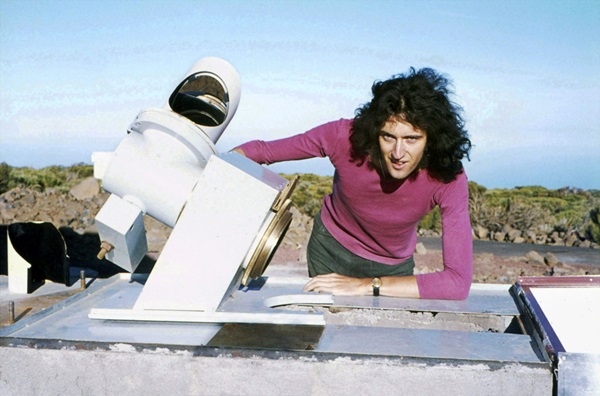
Instead, May accepted an offer to attend Imperial College, which would keep him in London, able to play music. May thought he was going to do infrared astronomy, which was really just beginning at the time. “The strange thing is that Professor Jim Ring, the department head, was involved in optical spectrometry at the time and looking to radial velocities,” says May. “And so I somehow got hooked into this whole program!” May thought he would be interested in working on radial velocities, but “was a little scared at the time because then spectrometry was a little arcane, or so I thought.”
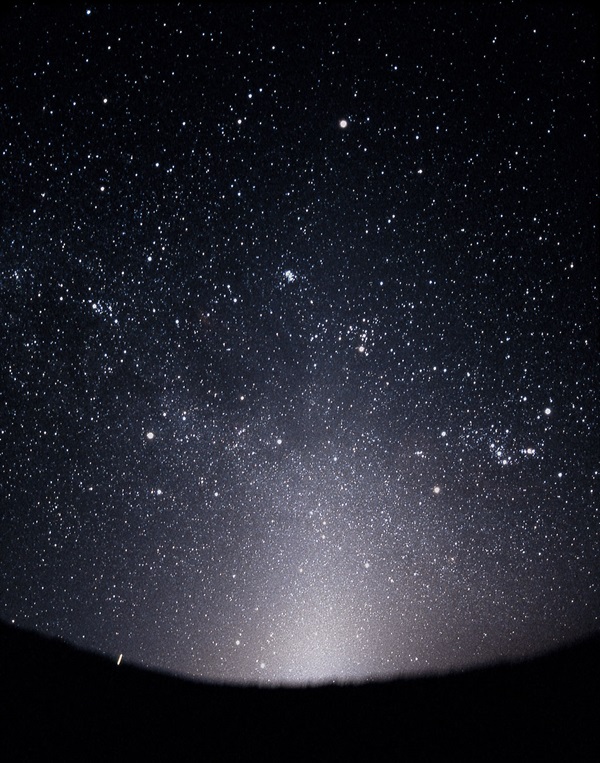
Ring and his colleagues were interested in a novel idea: looking at the radial velocities of particles in the zodiacal dust cloud and beginning to understand how dust in the plane of the solar system is moving. “This appealed to me,” May says, “so I said, ‘Yes, I’m your man — I’ll take this on as a project!’ ” The researchers were looking for “clean” spectral lines that would allow them to detect Doppler shifts, indicating motion, and they settled on magnesium I, which corresponds to the easiest transition line of the magnesium atom.
“We looked for it in the zodiacal light,” says May, “and, of course, the zodiacal light is not a very well-known phenomenon even to this day. But we were looking at this green line reflected in the dust and looking for a shift in the frequency of that line, which would then show us how the dust was moving.” May and his colleagues were able to make a velocity map of the dust as opposed to what everyone else was doing, simply making positional maps. It was somewhat revolutionary at the time.
And when he wasn’t working away on the dynamics of the zodiacal dust cloud, May kept hammering away with Smile. Throughout 1969, the band played gigs around London, and they picked up, from early on, an “ardent fan” who was “full of suggestions.” This fan desperately wanted to be in the band and was quite a promising singer. “No,” said May at the time. “Tim [Staffell] is the lead singer. He’d never wear it.” The kid kept hanging around and slowly, everyone began noticing him. He was very shy but “cloaked in a persona,” May recalls. The kid was Freddie Bulsara.
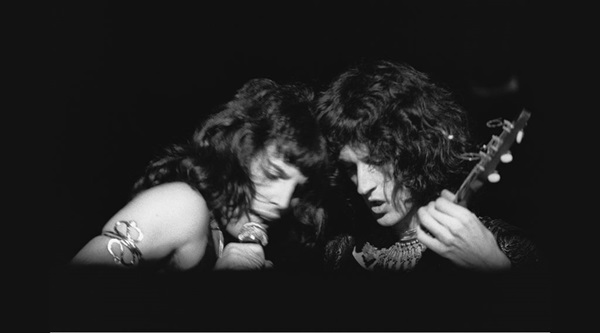
Freddie Bulsara spent the next few months looking for a band to sing with. He spent stints in Ibex and Sour Milk Sea, but by early 1970 spats and lineup changes left him looking for a band again. He and Roger Taylor each had a stand, selling clothes and gear, at London’s hippy-fashionable Kensington Market. May, although still involved with Smile, was away, studying astronomy in Tenerife in the Canary Islands. In his mountain residence there, he had a Spanish guitar he had recently purchased, and his professors, among them Jim Ring and Ken Reay, found his playing amusing. “I think Ken thought it was quite funny,” says May. “He had a sly little smile on his face that said, ‘Obviously, you’ll never get anywhere.’ ”
When May returned to London, he found that Tim Staffell wanted to move on, and after some coaxing, Freddie wound his way into a new band that consisted of May, Taylor, Bulsara, and, for some months to come, a rotation of bass players. Eventually, by mid-1971, the guys found a bassist who would stay in John Deacon, a 19-year-old electronics student from central England who had played with some other London groups.
Well before then, two big name changes had occurred. Freddie suggested the new band’s name, Queen, taken from the hippy world centered on Kensington Market, which prominently included gay culture — and Freddie would himself have gay relationships, although at this time he was still ensconced with his live-in lover Mary Austin. Secondly, Freddie had written a song he really liked called “My Fairy King,” which included the line “Oh Mother Mercury what have you done to me?” Freddie decided on a dramatic stage name change and the world was introduced, slowly at first, to Freddie Mercury. It seemed necessary from Fred’s point of view to complete the transformation from shy schoolboy to where he hoped he was going — full-fledged, stage-extrovert god.
The new band played a series of London-area gigs and secured some studio time to create a demo. This, of course, dragged May increasingly away from astronomy, which displeased his family. He continued to travel to Tenerife occasionally, which halted the band, as he worked on his Ph.D. And then he returned to England and the band started up with live gigs again. Queen came away from studio time in mid-1971 with some demos that were far from the polished band the world knew later. The tracks included a version of the later hit “Keep Yourself Alive.” But that is what the four were doing then — no semblance of big-time musical success had yet arrived.
Queen got a bite from its demo but turned it down, the money insufficient. “Arrogance is a very good thing to have when you’re starting out,” Freddie said later, “and that means saying to yourself you’re going to be the number one group, not number two.” They ended up using Trident Studios to make a full album they could shop around. This resulted in Queen, released in 1973 and including the tracks “Keep Yourself Alive” and a proto version of “Seven Seas of Rhye.” The moderate success of the first album led to a tour mostly in England in the last few months of the year.
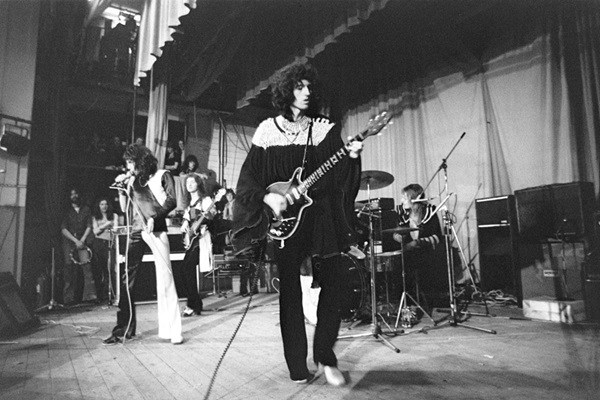
During the Queen years, astronomy remained a passion in May’s mind, but professional astronomy went dormant. “If I could ever maneuver my way into a place where there were clear skies at night, I would always do that on tour,” he says. “I kept in touch with the guys at Imperial College and read some of the literature, but I wasn’t really a student of astronomy during those years.”
And yet he became a tour guide, showing the sky to many other musicians. “Lots of people really like that, and, of course, it’s incredible how many people who live in cities rarely get to see the Milky Way, for instance,” May says. “There were so many times when people have said, ‘My God, I’ve never seen that!’ when seeing the planets, or star clusters, or M31. It’s nice to be able to share that with people who don’t know about it.”
And May points out that many musicians tend to be interested in astronomy. “I think the things tend to go together,” he says. “Maybe it’s a kind of a romantic spirit to making music that spills over into curiosity about the universe. I would say the majority of musicians I know have a bit of passion for the night sky.”
As with many bands of the era, despite successful album releases and touring, Queen’s individual members were slow to accumulate the benefits. This was partly due to the crazy system of record companies essentially fronting money to the bands that had to be paid back to the labels, and to the dealings of the band’s first manager, Norman Sheffield. The manager would be savagely remembered in Mercury’s delightfully nasty song “Death on Two Legs (Dedicated to … ),” from the 1975 album A Night at the Opera.
But the band was achieving success and becoming famous, so May abandoned his astronomy, for the time being, to get on with rock ’n’ roll. And Queen caught a big break when it toured with the established act Mott the Hoople.
A second album, Queen II, followed in 1974 and contained but one single, a full-out version of “Seven Seas of Rhye.” The band toured England, Germany, and other parts of Europe in support in 1974 and continued its moderate success. Queen also embarked on its first tour of the United States, Canada, and Japan, which was planned for the first half of the year. But, waking up in Boston one April morning, May found he was barely able to move. He gazed in the mirror and his face was yellow. Doctors diagnosed him with hepatitis, and the tour was halted. Queen flew back to England and May recuperated in bed. A late-1974 tour concentrated on Europe.
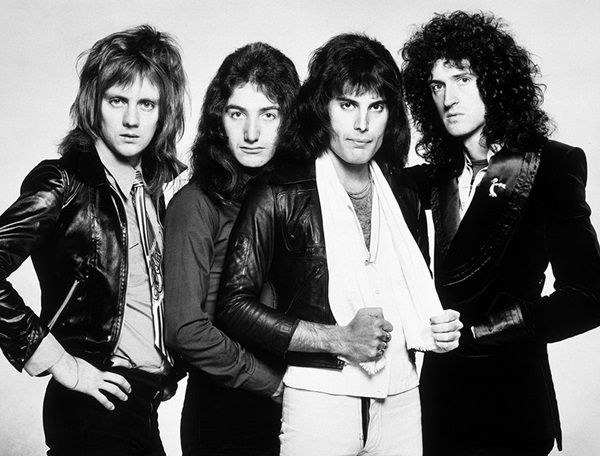
The next release, A Night at the Opera, made Queen’s members international superstars. Not only was the album full of memorable and electric hits, but one of them, Freddie’s “Bohemian Rhapsody,” exploded as a huge smash. It began years earlier in Freddie’s mind as “The Cowboy Song,” a simple ditty that commenced with, “Mama, just killed a man.” Inspired by the Beatles’ “A Day in the Life,” the song became a three-part “mock opera,” in Freddie’s words, whose middle operatic section married references to Galileo, the 17th-century Italian clown Scaramouche, the Italian composer Rossini, Mozart’s operatic character Figaro, the Arabic prayer expression “bismillah,” and the Spanish and Portuguese folk dance known as the fandango.
There was also Brian’s great sci-fi folk song “ ’39,” about interstellar travel; Roger’s rocked-out “I’m in Love with My Car”; and John’s sentimental “You’re My Best Friend.” Not to mention Freddie’s lasting “Love of My Life” and Brian’s working of “God Save the Queen,” which would be used again and again as a live concert coda. Now Queen had arrived with unrelenting momentum, careening success, big money, unbounded critical acclaim, and another major touring romp in 1975 through Great Britain. From then on, the mere first keystrokes of Freddie’s hammering out the intro to “Rhapsody” would produce screams and cheers in concert. The sky was now the limit.
The band spent much of 1975 touring the United States, Canada, Japan, and Great Britain. Inspired by huge success, its next move was to release A Day at the Races, the 1976 album that contained more huge hits. The boys were fans of the Marx Brothers, and this second consecutive album named for one of the brothers’ movies secured an invitation from Groucho for a visit and a plea not to name the next one Duck Soup. “He was very much like he was in the films,” says Brian of Groucho. “He was ancient by that time and they wheeled him out, but he was sharp as a razor. He sang this curious little song and then we all clapped and then he said, ‘Now you sing!’ It was that terrible moment when you think, ‘Oh, what are we going to do?’ I remember saying that we couldn’t sing without a guitar, and he had one brought out! And so I settled down to strum away ‘ ’39,’ I think it was. He enjoyed it, told us a few jokes, and went off to have his nap!”
Races contained one of Brian’s best straight-out rockers in “Tie Your Mother Down,” which became a live favorite. It also contained a spectacular vocal gospel anthem, inspired by Aretha Franklin and written by Freddie, in “Somebody to Love,” one of Freddie’s favorites. “Freddie certainly loved that song at the time,” says Brian. “It was all about Aretha Franklin for Freddie. She was a huge influence. I said to some people that I think sometimes Freddie wants to be Aretha in pretty clothes. So it was very much gospel construction and allowed him to sing in the way which he loved.”
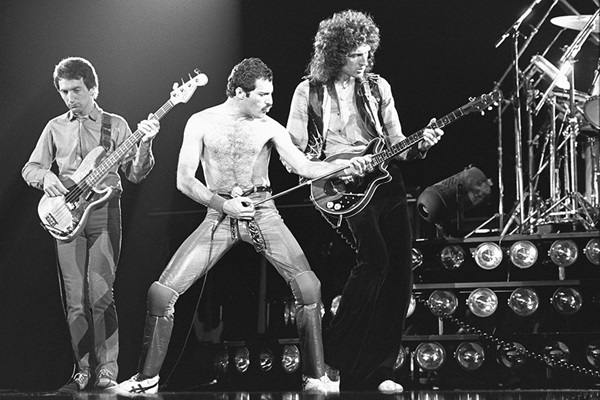
The band had a healthy relationship that, as with nearly all bands, became difficult at times in the studio. “We focused so much on the music and it was too close and too emotional to be dispassionate about,” says May. “So we got into fierce arguments. We’d leave the group for a day or so. I suppose making music is like a baby, really — when someone starts pulling it apart, you get very angry and defensive. But that kind of thing just goes with the territory.”
The band toured the United States, Japan, and Australia in early 1976. The following year saw an enormously long tour schedule around the world and the release of News of the World, a spectacularly successful album that contained two explosive hits. Having challenged each other to write “anthems” in which concertgoers could participate to the fullest, Brian composed “We Will Rock You,” which since has become one of the best-known arena rock songs of all time. Its recording with the double thump followed by single hand clap came about when May found a bunch of loose boards in a studio hallway and the guys experimented with stomping on them followed by a clap. Freddie produced the anthem “We Are the Champions,” a song so bold and outrageous in its ego that at first the other band members thought they simply couldn’t do it.
The next album, Jazz, was released in 1978 and again contained some high-powered hits. Just as “We Will Rock You” and “We Are the Champions” were linked, Brian and Freddie created a twosome of songs for this release. Brian’s tongue-in-cheek “Fat Bottomed Girls” was lyrically linked to Freddie’s curious and poetic “Bicycle Race.” The album also contained “Let Me Entertain You,” which became a live favorite, and Freddie’s “Don’t Stop Me Now,” which symbolized his increasingly rambunctious and reckless lifestyle in the gay community. When asked about his flamboyant and wild antics, Freddie simply retorted, “I sleep with men, women, cats, you name it.”
At this juncture, I was fortunate enough to see Queen live for the only time. It was in Cincinnati in November 1978 — I was 17, in high school, and working on my second year of producing Deep Sky Monthly — and (as a drummer myself) I remembered being thrilled with Roger’s dynamic drumming, and coming out just blown away by Brian’s amazing and extremely clear, tonally crisp lead playing. And I think anyone who saw Queen at any time would have been awestruck, as I was, at Freddie’s voice. The range and power he had just left you saying, “My God!”
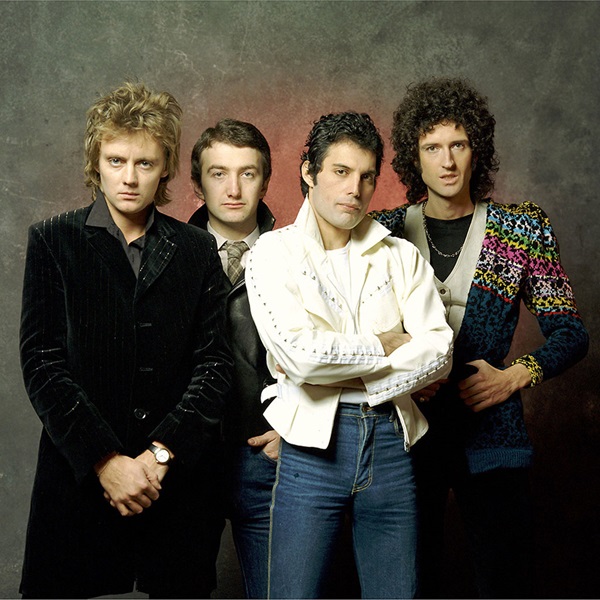
Queen entered the 1980s with a new album, The Game, and a new and ambitious tour plan. This included two hits by Freddie, “Play the Game” and one of Queen’s biggest songs, “Crazy Little Thing Called Love.” It also featured Brian’s “Save Me,” a hit and one that in later years would be used as a symbol for his campaigns against animal cruelty. John Deacon’s funk-inspired “Another One Bites the Dust” would also be a huge hit for the band all over the world.
The touring continued with a major United States outing, along with Canada and Europe. Whereas previous albums had been recorded in England, in Montreux, Switzerland, and in France (Jazz), the recording work now shifted to Munich, Germany, which the band members loved but which exposed them to a “dangerous” world of excess. The band also recorded an album to serve as soundtrack for the sci-fi film Flash Gordon.
Written by Freddie in a bathtub in the Munich Hilton in 10 minutes, “Crazy Little Thing” was a conscious attempt at recreating an authentic 1950s rockabilly sound. It marks one of the rare times that May used a guitar other than the Red Special. “I was in the studio with our producer Reinhold Mack, who’s a rather dour German,” says May. “His humor was very dark. I wanted a conscious echo of the ’50s as we were consciously playing in Elvis’ style. I said to Mack, ‘Hey, I can make my guitar sound pretty much like a Telecaster,’ which has that ’50s sound. He said, ‘If you want it to sound like a Telecaster, why the hell don’t you just use a Telecaster?’ So I did.”
Queen’s relentless schedule careened forward. The band played huge soccer stadiums in Argentina, Brazil, Venezuela, and Mexico. In 1982 the new album, Hot Space, took a direction that not all fans were crazy about. Tracks like “Back Chat” and “Body Language” strayed increasingly away from the Queen sound and had some labeling the band’s full entrance into disco.
The album’s big hit, however, came from a chance session with old London friend David Bowie. “Under Pressure” was a collaboration between Deacon, who came up with the repeating bass line, Bowie, and the other three Queen members — although at first Brian was unenthusiastic. The song and its famous scat singing by Freddie nonetheless caught on and became a huge concert staple. Again in 1982 the band was touring in the United States, Europe, and Japan.
Queen now routinely filled huge outdoor stadiums, and the band’s incredible musicianship, Freddie’s outrageous stage persona and amazing voice, and fabulous songs had it riding high as the greatest band of the era. The pace was crushing, though, and things had to slow down a little. In 1984, The Works included May’s hard-rocking “Hammer to Fall” and “Tear It Up,” as well as Taylor’s “Radio Ga Ga,” inspired by his infant son’s words. “Is This the World We Created … ?,” co-written by May and Mercury, soared in concert as an acoustic ballad. Deacon’s “I Want to Break Free” was a big success that didn’t fare well in the United States. The band’s video featuring the guys in drag didn’t work in the American Bible Belt, and Queen lost steam in America because of it.
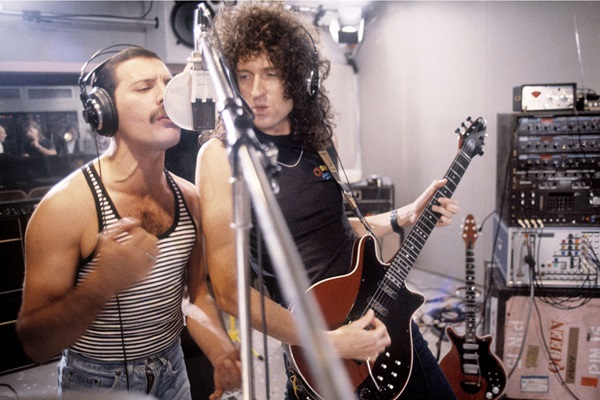
Amid an all-star lineup, Queen stole the show during its 21-minute set that opened with “Bohemian Rhapsody” and closed with “We Are the Champions.” It was the band’s greatest moment, witnessed by 1.9 billion people, and played out on its favorite stage at Wembley. May and Mercury closed out the show later in the day by playing and singing “Is This the World We Created … ?,” which seemed to have been made for the cause. “We wrote that song together as a rare event,” says Brian. “We just sat down and said we need something personal and intimate, and talked about the state the world was in. It was one of those great moments when you can just feel it coming out. That was one of the few times we collaborated directly in that way.”
But what was May’s biggest memory of Live Aid? “Well,” he says. “I think the moment when everyone’s hands went into the air to ‘Radio Ga Ga’ was one, because the audience had not paid to see us. It was a great confirmation that people not only knew the song, but also had seen the video and knew what to do. The power of the video was amazing because the whole 70,000 in the Old Wembley Stadium just erupted into that synchronized arm movement.
“The other amazing moment at Live Aid was just walking back out on stage with Freddie, he in his T-shirt and jeans, me in something similar, and just sitting down with the acoustic guitar,” says Brian. “It was as naked as could be. There was some weird noise, a technical thing, happening as we were singing the song. But we just sang it and the whole place focused on that moment. It was a great feeling.”
Live Aid reinvigorated Queen, and the band launched into another album, A Kind of Magic, and subsequent tour in 1986. Some of the songs had been written for the movie Highlander, and the hits were “One Vision,” written as a shared credit by all four; Taylor’s “A Kind of Magic”; “Friends Will be Friends,” written by Deacon and Mercury; and May’s “Who Wants to Live Forever.” The tour, though limited to Europe, was the most extravagant stadium outing yet — and it would be the last one with Freddie Mercury. The last show all four would play together came August 9, 1986, at Knebworth Park, north of London.
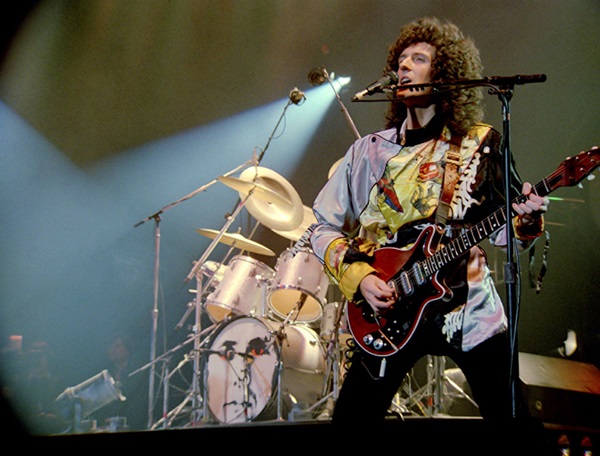
Although to most it seemed that Freddie and Brian were the dominant musical influences in Queen, May is quick to correct that. “It was a very democratic outfit, really,” he says. “We were all conscious of fighting for our voices, but we were also four fairly intelligent human beings, and we realized that everyone had to have an equal part in the creative process or the whole thing would disintegrate.” He points out that “Roger and John definitely grew as creators as time went on. Proportionately, John had a better batting average than any of us. He didn’t write that much, but it was all big. ‘Another One Bites the Dust,’ ‘I Want to Break Free,’ ‘Spread Your Wings’ — his track record was astounding. In later years Roger wrote ‘A Kind of Magic,’ ‘Days of Our Lives,’ and ‘Radio Ga Ga,’ which were huge hits.”
In 1988, rumors swirled around Mercury’s health as he appeared increasingly thin and gaunt. Denials came out quickly to protect him, but the truth was that he had contracted HIV and was increasingly ill. The band continued with albums but stopped touring. 1988’s The Miracle presented special highlights in May’s “I Want It All” and Mercury’s “The Miracle.” Two years later, Innuendo was released. The album featured three songs that struck a special chord with fans, especially watching a clearly ill Mercury working through the videos “I’m Going Slightly Mad,” “The Show Must Go On,” and “These Are the Days of Our Lives.” In November 1991, as he was terribly sick and bedridden, Mercury issued a statement confirming he did have AIDS, and he died 24 hours later. The band’s final album featuring all four musicians, Made in Heaven, was released four years after Freddie’s death.
A new beginning — and back to astronomy
During the late 1980s, May had many challenges. Mercury’s illness had a depressing effect on the band. “There was all that time when we knew Freddie was on the way out,” he says; “we kept our heads down.” Moreover, May’s first marriage ended in 1988, and he fell into a serious depression that lasted into the early 1990s. He has even stated that he contemplated suicide. “My life was falling apart,” he says. And, in a way, astronomy was responsible for bringing him back into a new life, one that came together after his struggles.
“I was deeply depressed,” he says of this period. “I suppose I would call myself a spiritual person in a sense, but I don’t really subscribe to any of the formal religions,” says May. “I went to this clinic in Tucson, Arizona, when I was very down, and they said, ‘We have to find your spirituality — what you most enjoy.’ At the time, I couldn’t think of anything I enjoyed. I was just in a very black place. And then eventually I figured out, because of the beautiful skies there, that one of my greatest joys was just looking at the stars. So I feel anchored to the universe in some way. It’s quite a powerful force in my life.”
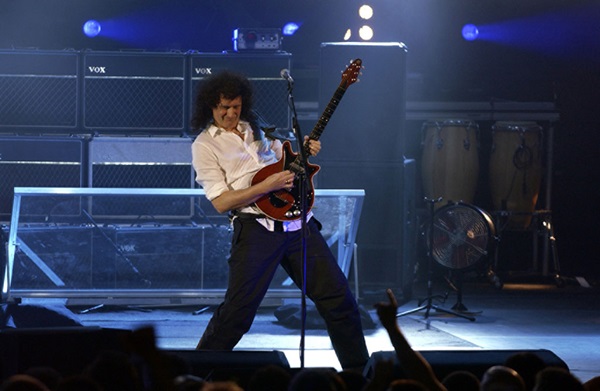
He has recently gone through a bit of a tough time again, and found he had to change his life. “I’ve done that and I’ve gone through the pain of that and I’m good now, I feel fine, very optimistic and strong, and my sense of humor is back.”
Music, of course, continued after Freddie’s death. There was the Freddie Mercury Tribute Concert at Wembley in 1992. May also recorded several works with a changing lineup dubbed the Brian May Band. For several years starting in 2005, Queen+Paul Rodgers toured with the former lead singer of Free and Bad Company. One of May’s biggest musical moments came in 2002 when he and Taylor played on the roof of Buckingham Palace to help celebrate Queen Elizabeth’s Golden Jubilee — and something like a billion people saw it.
The Jubilee moment came about quite by surprise. “Someone just rang me up,” says Brian, “and asked if I’d like to play the national anthem while strolling through the state apartments at Buckingham Palace. I said I didn’t think it would work. They said I should do it as if I were Jimi Hendrix. I said that I wasn’t Jimi Hendrix, and then it struck me that I could do it as a sort of lone piper on the roof of the palace. With a full orchestra. They went silent on the other end, and then called back and said yes.”
May says he was incredibly nervous before that performance, more so than playing in a full football stadium on tour with Queen. “Every time I saw the palace for weeks beforehand, I got this awful feeling in my stomach. I really had to learn to manage fear. They asked me to mime it and I said I couldn’t do that. I wanted to do it all live. The day came, and it was breathtaking — like jumping off Mount Everest. I couldn’t hear the orchestra until about 10 minutes beforehand, and one amp went down, but then it all just happened and worked. It actually worked.”

When asked about his own musical legacy, May replies, “Well, I suppose ‘We Will Rock You’ will be written on my tombstone because that’s the one which connected so many people around the world. You know, every day people send me clips of their babies on YouTube singing it. Soon there will be a fetus in the womb going ‘boom boom chick’ with its feet and hands. I feel happy that it encircled the globe like that.”
What‘s the best song he’s ever written? “ ‘Too Much Love Will Kill You’ might be the best song I’ve written both lyrically and musically. That song is a kind of therapy for me, and I wrote it with two people, Frank Musker and his girlfriend, and it all just poured out. I feel very proud of that song. Some people remember that Freddie sang it, and after he passed away that made the song very special. It‘s just a song about love going wrong.”
What is Brian’s favorite song written by Freddie? “Probably ‘The Miracle,’ ” he says. “It has an incredible lightness, and he wrote it at a time when it must have been very hard for him to be optimistic and light. There’s just such a wonderful transparency to the way it’s recorded and the lyrics have a great whimsy to them. But also a serious overtone. I love that song, but Freddie wrote some corkers; I mean, he wrote some wonderful songs. I always play ‘Love of My Life‘ whenever I’m performing almost anywhere in the world.”
And astronomy reemerged in May’s life with great force. His old friend Sir Patrick Moore convinced him to return to that nearly finished Ph.D. on motions in the zodiacal dust cloud. “Patrick has been such a huge force in my life,” he says. “We met for the first time when Patrick was playing himself in a radio drama that my friend Dirk Maggs was making for the BBC. So we actually did meet, and we did get on like a house on fire and have been firm friends ever since.” Brian had been out of astronomy for some time, playing rock ’n’ roll, and Patrick “invited me back in,” he says. “I appeared on his Sky at Night program, the very program I’d been allowed to stay up late and watch as a kid. And from time to time Patrick would just say, ‘Why don’t you finish off your Ph.D.?’ ”
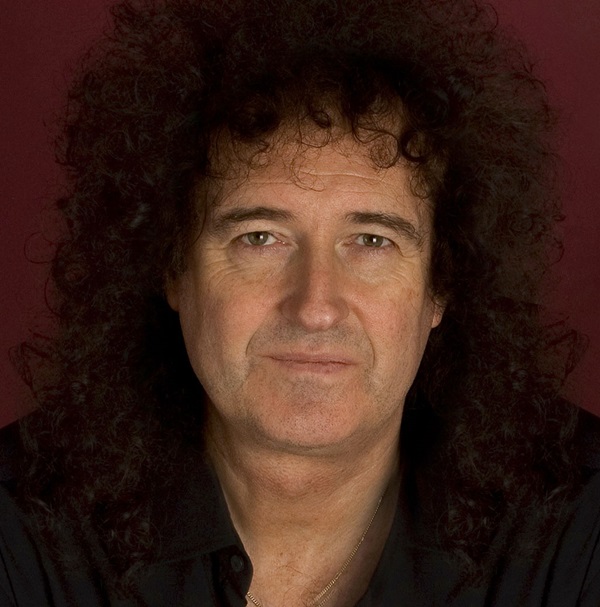
So Michael Rowan-Robinson served as the advisor, and May finished the research. In 2007, he submitted his dissertation, and Springer-Verlag published it as A Survey of Radial Velocities in the Zodiacal Dust Cloud. The next year, he co-authored a popular astronomy book, Bang! The Complete History of the Universe, with Moore and Chris Lintott, published by Johns Hopkins. And the following year, his interest in stereophotography produced a collaborative book with Elena Vidal, A Village Lost and Found, which presented the stereo views of an Oxfordshire village taken by T. R. Williams in the 1850s. (For more on May’s interest in stereo imagery, see “Brian May’s world of stereo astro pictures” in the January 2012 issue of Astronomy.)
When he’s not playing music, worrying about astronomy, or fiddling with stereo photography, May is passionate about animal welfare, and he blogs about it on his website, www.brianmay.com. Fox hunting, badger culls, and other activities raise May’s ire and keep him focused on journalists, members of Britain’s Parliament, and the public with his energetic activism. “The interest in animals was always there,” he says, “and I always promised myself that the time would come when I could devote time to doing something about it.”
May says he has an astronomical approach to animal welfare. “For thousands of years we believed we were at the center of the universe. Turns out we’re not. We’re relegated to a tiny little spot parked way out in the suburbs of a very normal galaxy. If you apply that concept to the way we regard ourselves as a species, to me it’s similar. We think we’re the pinnacle of life on Earth. To me it’s self-evident that all creatures are the pinnacle of evolution and they are all worthy of respect. Every creature is worthy of decent treatment. Unfortunately, we’ve become so self-important that we have relegated many species to the point of unimportance and also to a place where they are abused and used by us. There are so many creatures that will never walk Earth again because we have destroyed them.” For his services in many fields, May received the Commander of the Most Excellent Order of the British Empire (CBE) in 2005.
May is as busy as ever these days. “I’m ashamed to say I get so little time to observe the sky,” he says. “I live in England, where you don’t get clear skies very often, and if you do, you rush out with the first telescope that comes to hand.” His favorite sky objects? “I get most excited about planets, so I’m a local man, really. I never get tired of Jupiter and Saturn.” He was also a bit of a total-solar-eclipse addict for a while, seeing four or five eclipses out of eight or nine attempts. “That first time you see totality, you really understand where you are, on a piece of rock hurtling around the Sun,” he says. “It’s an awesome feeling — a life-changing experience.”
Where does May see the next generation of astronomy enthusiasts, with so many young kids straying away from science? “Well, I guess we’re entering a phase where knowledge for its own sake is not something that’s amassed in the brain,” he says. “In the days of Patrick Moore, you would learn lots of facts and figures and details about everything you came across. But I think things have changed an awful lot. There’s more emphasis on using your smarts to analyze what the facts mean, and more checking of such a huge mass of data from references that are so easily available now. I think we’re moving toward looking for the meaning in things rather than just the pictures.”
He adds, with a laugh: “Although I love the pictures.”
David J. Eicher is editor of Astronomy. He has been a Queen fan since his early teenage years, and enjoys being in the same group of music and astronomy fans as Brian May.