
Key Takeaways:
- The initial discovery of exoplanets in 1991 by Wolszczan and Frail around the pulsar PSR B1257+12 presented a paradox, as planetary survival or formation around a stellar remnant was unexpected.
- It was hypothesized that these planets formed *post-supernova* from a protoplanetary disk composed of stellar debris that failed to escape the neutron star's gravitational pull, subsequently accreting into planetary bodies.
- Observational evidence for such a formation mechanism was provided in 2006 by the Spitzer Space Telescope's detection of a dusty, planet-forming disk around the pulsar 4U 0142+61, containing sufficient material for multiple Earth-mass planets.
- Supernova events incinerate any pre-existing planets; however, a portion of the expelled stellar material can be recaptured by the nascent neutron star, forming a debris disk that serves as a precursor to new planet formation through accretion.

How could such planets exist? After all, any pre-existing planets likely would have been destroyed by the explosion or ejected and left to roam the galaxy after their parent star lost most of its mass (and gravitational pull). Wolszczan suggested that the pulsar’s planets arose from debris left behind by the star’s explosion. The debris first would settle into a disk, where dust grains would start to coalesce. Eventually, collisions would build rocky objects of greater size until small planets would form.
Fast forward to 2006, when the Spitzer Space Telescope detected heat radiating from a dusty disk around the pulsar 4U 0142+61. The disk orbits the pulsar at a distance from roughly 1 million to 10 million miles (1.6 million to 16 million km) and contains enough material to make 10 Earth-mass planets. At last, astronomers had observational evidence that a debris disk could form around a pulsar.
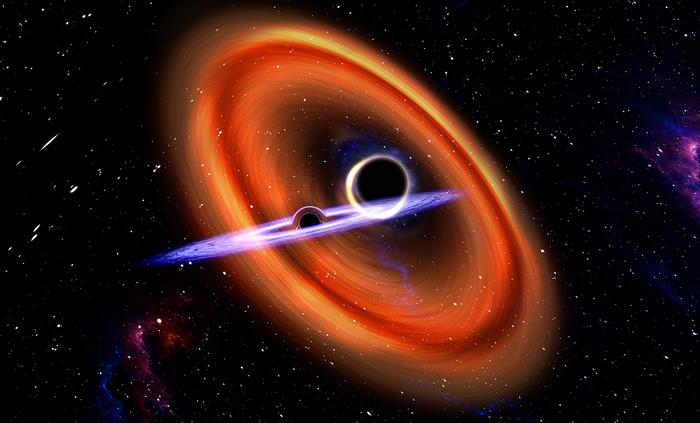
This animation starts with a red supergiant star nearing the end of its life. The star weighs 15 solar masses and has a diameter some 40 times that of the Sun. A hypothetical gas giant planet orbits the star. When the red supergiant exhausts its fuel, its core collapses and generates a shock wave that destroys the rest of the star. This supernova explosion incinerates the existing planet. Meanwhile, the star’s corpse settles down as a neutron star. (Notice that the neutron star’s powerful gravity warps the light passing near it.)
Some of the supernova’s debris never reaches a high-enough velocity to escape the neutron star’s gravitational clutches. This material falls back toward the star and settles into a disk. The animation concludes with the debris coalescing into asteroid-sized bodies, the last step before full-fledged planet formation.
Video credit: NASA/JPL-Caltech/R. Hurt (SSC)