How big are the meteors that we see as shooting stars? What factors affect their color, length, and intensity?

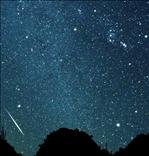
Geminid meteor
January 1999
The vast majority of the meteors you see at night are actually smaller than a grain of sand. However, several hundred tons of meteors burn up in the atmosphere every day.

Most meteors are yellowish or white, with the color depending on how bright they are (your eyes have a hard time discerning color in faint objects) and how hot they get. Some extremely bright meteors can appear blue or white.

The intensity of the meteor depends on how hot it gets, how big it is (a bigger meteor can generate more energy because there is more material to heat up), and how fast it is coming.
The length of the trail the meteor leaves on the sky depends mostly on viewing angle: If the meteor is coming across your line of sight you might see a long trail, but if it is coming straight at you, you won’t see any trail at all (and you’d better hope the meteor burns up!). — PHIL PLAIT, ADVANCED COMPUTER GRAPHICS, INC.
What type of lighting emits the least amount of light pollution?

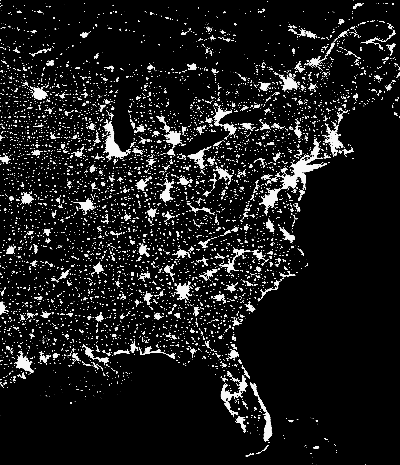
Light Pollution in Eastern North America
October 1998
First, use a good lighting fixture, one that is a “full cutoff.” That means there is no direct upgoing light at all. It generally also means there is very little light just below the horizontal, which is the kind of light that causes glare. Too many installations produce a lot of glare, and that compromises safety and security, not to mention the blinding obnoxious light. Essentially all lighting manufacturers make good full cutoff fixtures, and there is no excuse not to use them.

Second, use the correct amount of light. Overkill does not help visibility and it can waste a lot of energy. Going from darker areas to overlit areas means the eye does not adapt to the bright areas, and visibility is compromised. Follow the published guidelines of the Illuminating Engineering Society of North America.

If you have chosen a good light fixture and used the appropriate amount of light, the choice of the light source is less important. In the vicinity of major observatories, and for those who want the maximum energy savings, one should use low pressure sodium (LPS) lights. These lights are essentially monochromatic, so astronomers can filter their emission out, and the sky remains dark at all other wavelengths. LPS is also the most energy-efficient light source. Many astronomers, however, prefer to use high pressure sodium (a sort of amber light) or metal halide (whitish) sources. HPS is fairly energy efficient, and metal halide is the most energy efficient of the white light sources.

Dark skies need our help. Those with additional interest can go to the International Dark-Sky Association (IDA) website (http://www.darksky.org), which has links to other sites, including many in the lighting industry. Or write IDA at:

International Dark-Sky Association
3225 N. First Avenue
Tucson, AZ 85719.

DAVE CRAWFORD, IDA EXECUTIVE DIRECTOR

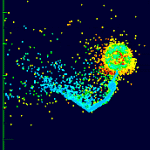
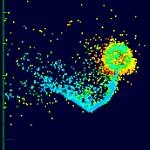
What evidence supports the collision theory for the formation of the Moon and what alternate theories exist?

Moon-forming impact
January 1998
The idea that the Moon formed from a giant collision now seems to be the leading theory to explain its existence. One of the most puzzling properties of the Moon is that it has much less iron than does Earth, as evidenced by its much lower mean density, 3.3 times that of water as compared to Earth’s 5.5 times that of water. Another way of saying the same thing is that the Moon is made of material that looks more like rock from Earth’s mantle than like the overall composition of Earth. Thus, one piece of evidence in favor of the impact idea is that the impact blew off rocky material from Earth’s mantle (and from the impactor’s mantle) and this debris formed the Moon. In this scenario, the iron cores of both bodies had already formed, and core material did not make it into Earth orbit. This explains the Moon’s lack of iron.

Another piece of evidence, from the lunar samples, is that the Moon’s composition of certain isotopes exactly matches that of Earth, but it doesn’t match those of bodies from elsewhere in the solar system. Still another positive feature of the collision theory is that it explains the Moon’s lack of water and lightweight volatile compounds: The impact heated the debris to high temperatures, and all volatiles turned to gas and escaped into space.

Alternative theories can’t explain these properties. One older theory, that the Earth and Moon grew side by side, doesn’t explain why one contains iron and the other doesn’t. Another old theory, that the Moon formed far away and was captured by Earth, violates the isotope evidence that they formed in the same location. A third old theory, that the Moon spun off the outer layers of Earth, violates energy and angular momentum considerations. The impact seems to be needed to blow the debris into orbit. — WILLIAM K. HARTMANN, PLANETARY SCIENCE INSTITUTE

Search for other articles by this author