Looking for a sky event this week? Check out our full Sky This Week column.
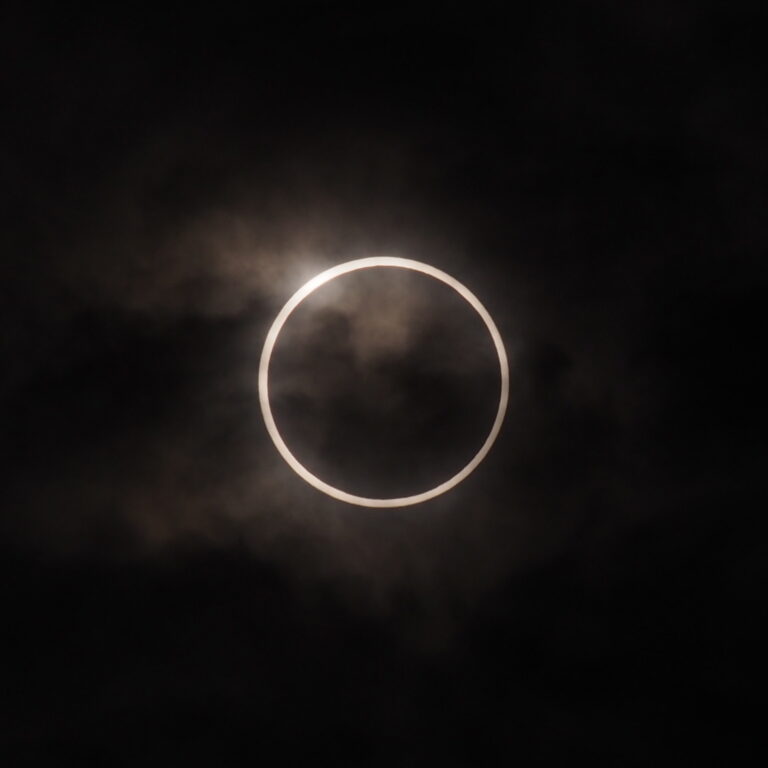
February 17: An Antarctic annular eclipse
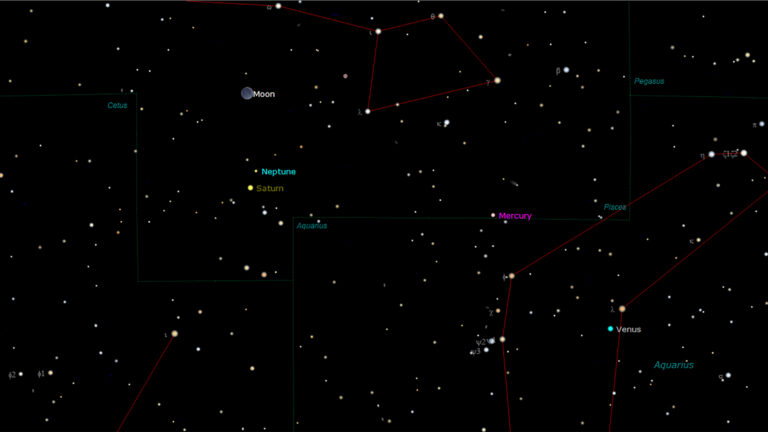
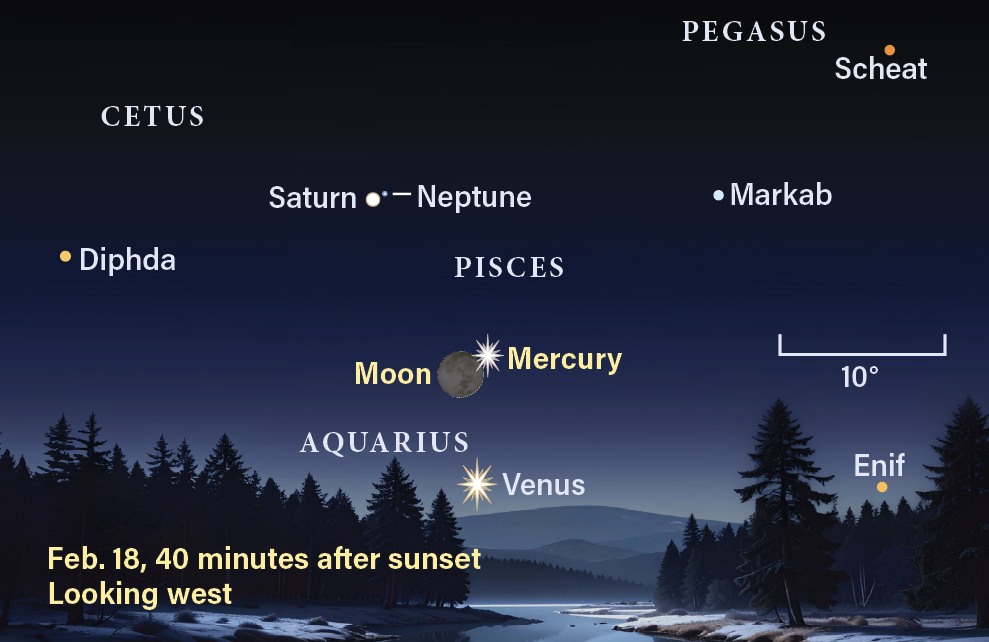
The Moon passes 1.8° north of Venus at 4 A.M. EST, then passes 0.1° south of Mercury at 6 P.M. EST.
Both planets are visible in the evening sky, though Venus is low, only about 12° high in the southwest half an hour after sunset. However, Venus is bright (magnitude –3.9), so should still be easy to find in the darkening sky as long as you have a clear horizon. Mercury is higher, standing 10° above the horizon 30 minutes after sunset, nestled beside the 1.5-day-old Moon. Shining at magnitude –0.6, the tiny planet should be an easy find just to the upper right of the lunar crescent as viewed from the middle of the U.S. Note that because our Moon moves quickly through the sky, its position relative to Mercury will change depending on your location. From the East Coast, Mercury will be north of the Moon; by the time sunset occurs on the West Coast, Mercury will be west of the Moon and located to our satellite’s lower right. The chart above shows their relative position shortly after sunset from the Midwest.
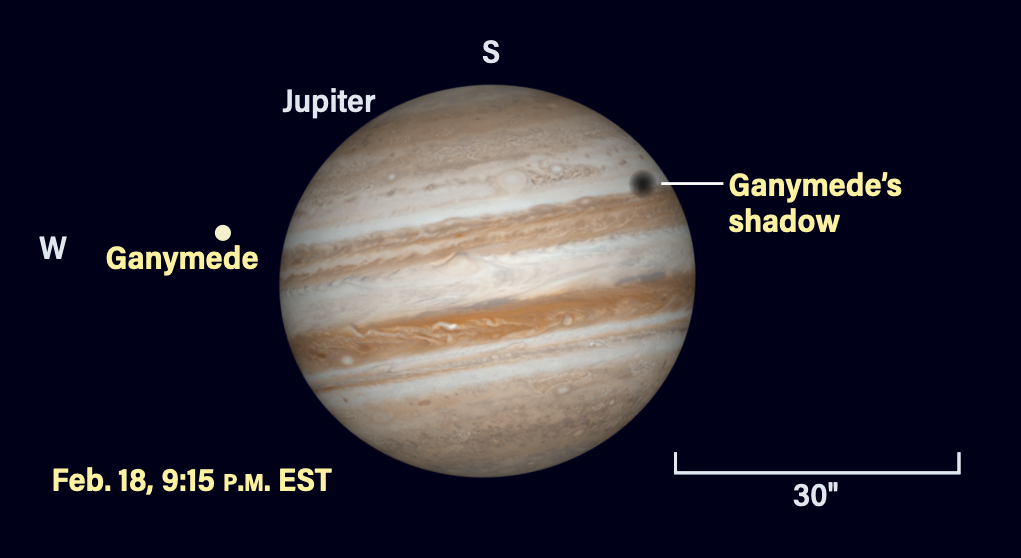
There’s also some action occurring over at Jupiter this evening, as Ganymede transits the gas giant’s disk, followed by its shadow. Located in Gemini, Jupiter is climbing in the east after sunset. Most of the U.S. sees Ganymede already transiting as darkness falls, with the exception of the West Coast, as the moon’s transit ends at 5:44 P.M. PST, roughly sunset from this location. But there’s still more to come, as Ganymede’s huge shadow appears on the disk at the southeastern limb shortly before 9 P.M. EST, taking several minutes to fully appear. See how long it takes you to notice the dark “bite” grow along the limb. The shadow transit lasts more than three hours, ending around 12:20 A.M. EST, early on the 19th for the Eastern time zone only (and still late on the 18th for the rest of the U.S.).
Sunrise: 6:49 A.M.
Sunset: 5:40 P.M.
Moonrise: 7:25 A.M.
Moonset: 7:12 P.M.
Moon Phase: Waxing crescent (3%)
*Times for sunrise, sunset, moonrise, and moonset are given in local time from 40° N 90° W. The Moon’s illumination is given at 10 P.M. local time from the same location.