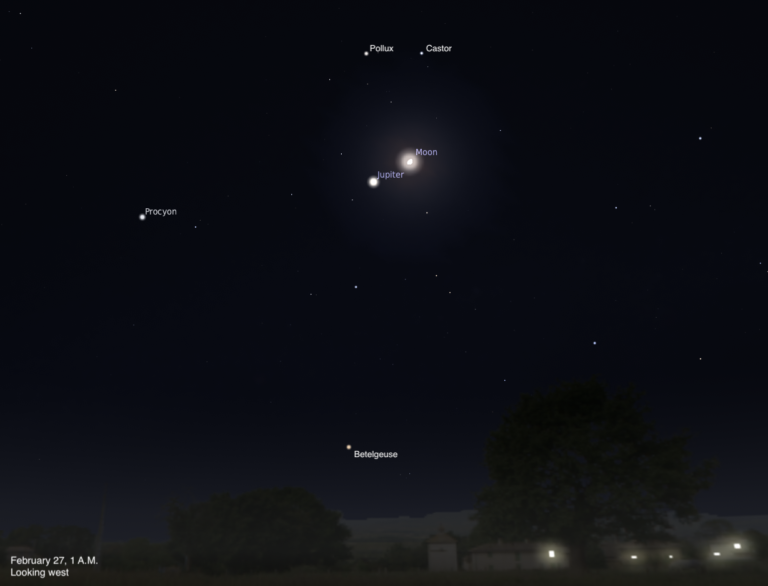
The Moon passes 5° north of Jupiter at 7 A.M. EDT. Early risers can enjoy the pairing before sunrise, standing some 50° high in the east an hour before the Sun crests the horizon. Now in its waning crescent phase, the Moon is less than 30 percent lit and not quite so glaring, allowing you to make out the stars of the surrounding constellations. The Moon is some 4° west of Pollux this morning, standing between this star and Jupiter.
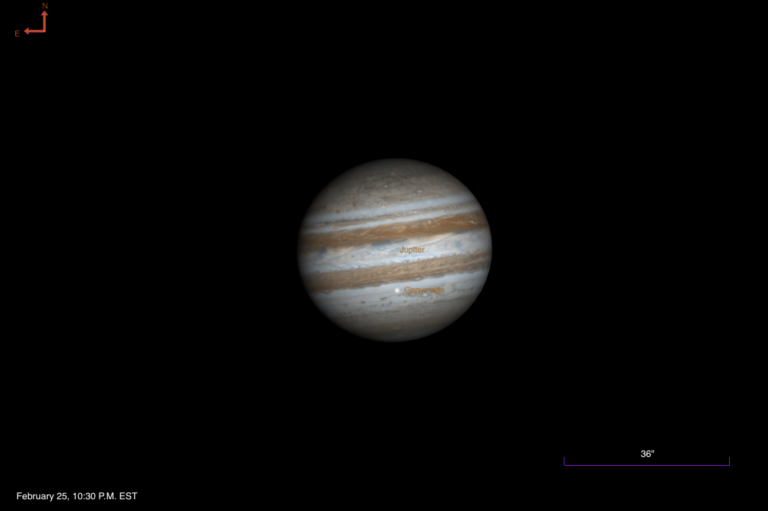
All four of Jupiter’s Galilean moons are visible, best seen with a telescope (any size will do). To the planet’s east, Europa is closer with Io farther out; to the west, Callisto is closest and Ganymede is farthest from the planet. Observers in the western two-thirds of the U.S. might be able to catch a shadow transit as Europa closes in, casting its shadow on Jupiter’s cloud tops beginning around 6 A.M. CDT. The sky is brightening for those in the Central time zone at this time, so observers farther west will have a better view. Follow the shadow as long as you can, but take care to put away any optics at least several minutes before sunrise from your location, which may differ from the time given below.
The shadow is still nearing the planet’s western limb when Europa’s transit finally begins around 6:20 A.M. PDT, very close to sunrise on the West Coast.
Sunrise: 6:42 A.M.
Sunset: 7:07 P.M.
Moonrise: 12:53 A.M.
Moonset: 4:42 P.M.
Moon Phase: Waning crescent (26%)
*Times for sunrise, sunset, moonrise, and moonset are given in local time from 40° N 90° W. The Moon’s illumination is given at 12 P.M. local time from the same location.
For a look ahead at more upcoming sky events, check out our full Sky This Week column.