Looking for a sky event this week? Check out our full Sky This Week column.
January 26: Saturn’s moons in motion
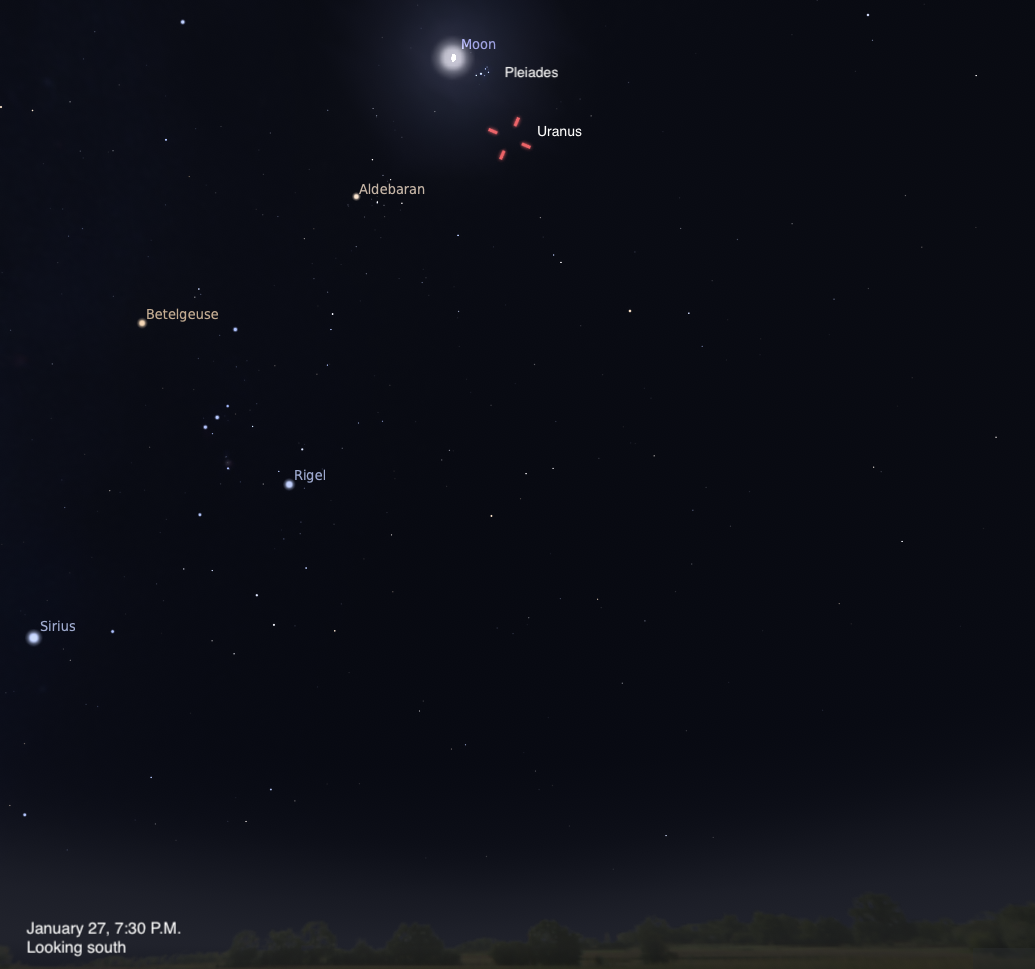
The gibbous Moon passes 5° north of Uranus at 2 P.M. EST. Tonight, you’ll find our satellite just northeast of the Pleiades star cluster in Taurus, with Uranus to their southwest.
Many areas in Europe will see the Moon occult the Pleiades, passing in front of several of the cluster’s stars. By the time night falls in North America, however, the Moon will have cleared the cluster’s outer regions and sits well away from its stars, although the two will still make for a lovely sight in the deepening twilight.
Wait until full dark to go looking for Uranus. The ice giant shines at magnitude 5.7; with the bright Moon so close, you’ll need optical aid to spot it. Start by centering your view on the Pleiades, then drop about 4.6° south-southwest to land on a pair of stars in an east-west line: 13 and 14 Tauri. The brighter of the two is 13 Tau, which also shines at magnitude 5.7 and is the westernmost star. Uranus is about 45’ southwest of this star. Look for a small, “flat” star of the same brightness as 13 Tau in this region. Uranus’ tiny disk is only 4” across, thanks to its vast distance from Earth.
Sunrise: 7:13 A.M.
Sunset: 5:13 P.M.
Moonrise: 11:40 A.M.
Moonset: 2:11 A.M.
Moon Phase: Waxing gibbous (72%)
*Times for sunrise, sunset, moonrise, and moonset are given in local time from 40° N 90° W. The Moon’s illumination is given at 10 P.M. local time from the same location.
There’s plenty to view in the early-morning sky of January 28, especially with no Moon visible before dawn.

Although anchored by the bright star Arcturus, the constellation Boötes is relatively devoid of bright deep-sky treasures. Nonetheless, without the Moon to cast its light over the sky, the brightest of its deep-sky trove — globular cluster NGC 5466 — is within reach.
Shining at magnitude 9.1, this ancient ball of stars is quite compact, spanning just 11’. You can find it about 9.6° north-northwest of Arcturus, near Boötes’ border with neighboring Canes Venatici. Discovered in 1784, NGC 5466 is some 53,000 light-years distant. Astronomy contributor and longtime columnist Phil Harrington recommends looking for the cluster as a dim, gray glow just west of a slightly brighter, 7th-magnitude field star. He recommends seeking out the darkest (least light-polluted) skies you can, especially if you’re trying to net this one with binoculars. Telescopic observers will have an easier time, although dark skies are still advantageous, bringing out more of the cluster’s stars.
Sunrise: 7:12 A.M.
Sunset: 5:15 P.M.
Moonrise: 12:28 P.M.
Moonset: 3:28 A.M.
Moon Phase: Waxing gibbous (82%)