
Key Takeaways:
- The Moon is scheduled to perform a series of occultations of stars within the Pleiades open cluster in Taurus, an event primarily visible across North America.
- Observational conditions indicate that the disappearance of stars behind the bright leading limb of the waning gibbous Moon will be more challenging than their reappearance at the darker, trailing limb.
- Event timings are highly localized, typically occurring between 11 P.M. and 1 A.M. EDT, with precise observational data available through the International Occultation Timing Association.
- Further celestial context includes the proximity of the ice giant Uranus, situated approximately 4° south of the Pleiades, which the Moon will pass north of.
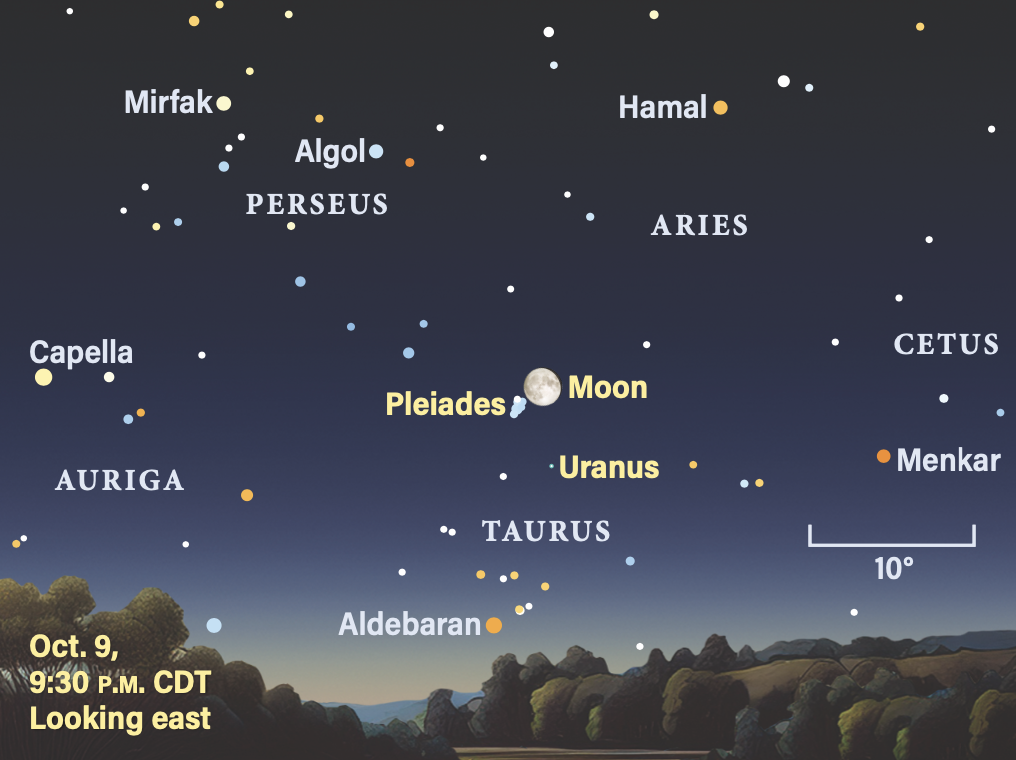
The Moon crosses in front of several stars in the Pleiades star cluster of Taurus this evening, creating a series of occultations that many in North America will be able to catch. Note, however, that the Moon’s waning gibbous phase means the stars will vanish behind the bright leading edge of the Moon, which makes this harder to see. The stars’ reappearance at the darker eastern limb will be easier to view.
The timing of the event is heavily location dependent, but the best time to observe is between about 11 P.M. and 1 A.M. EDT (so, overnight into Friday morning for the eastern half of the U.S.). For example, Electra disappears from New York City around 11:38 P.M. EDT and reappears around 12:15 A.M. EDT (now on the 10th in that location). To determine which stars will be occulted from your observing site and when, visit the International Occultation Timing Association’s webpage for 2025 bright star occultations by location and select the appropriate region.
Nearby is the distant ice giant Uranus, which lies about 4° south of the Pleiades. The Moon will pass due north of Uranus early tomorrow morning as our satellite continues making its way through Taurus.
Sunrise: 7:05 A.M.
Sunset: 6:29 P.M.
Moonrise: 7:51 P.M.
Moonset: 10:17 A.M.
Moon Phase: Waning gibbous (91%)
*Times for sunrise, sunset, moonrise, and moonset are given in local time from 40° N 90° W. The Moon’s illumination is given at 12 P.M. local time from the same location.
For a look ahead at more upcoming sky events, check out our full Sky This Week column.