Looking for a sky event this week? Check out our full Sky This Week column.
October 25: Two shadows on Jupiter’s cloud tops
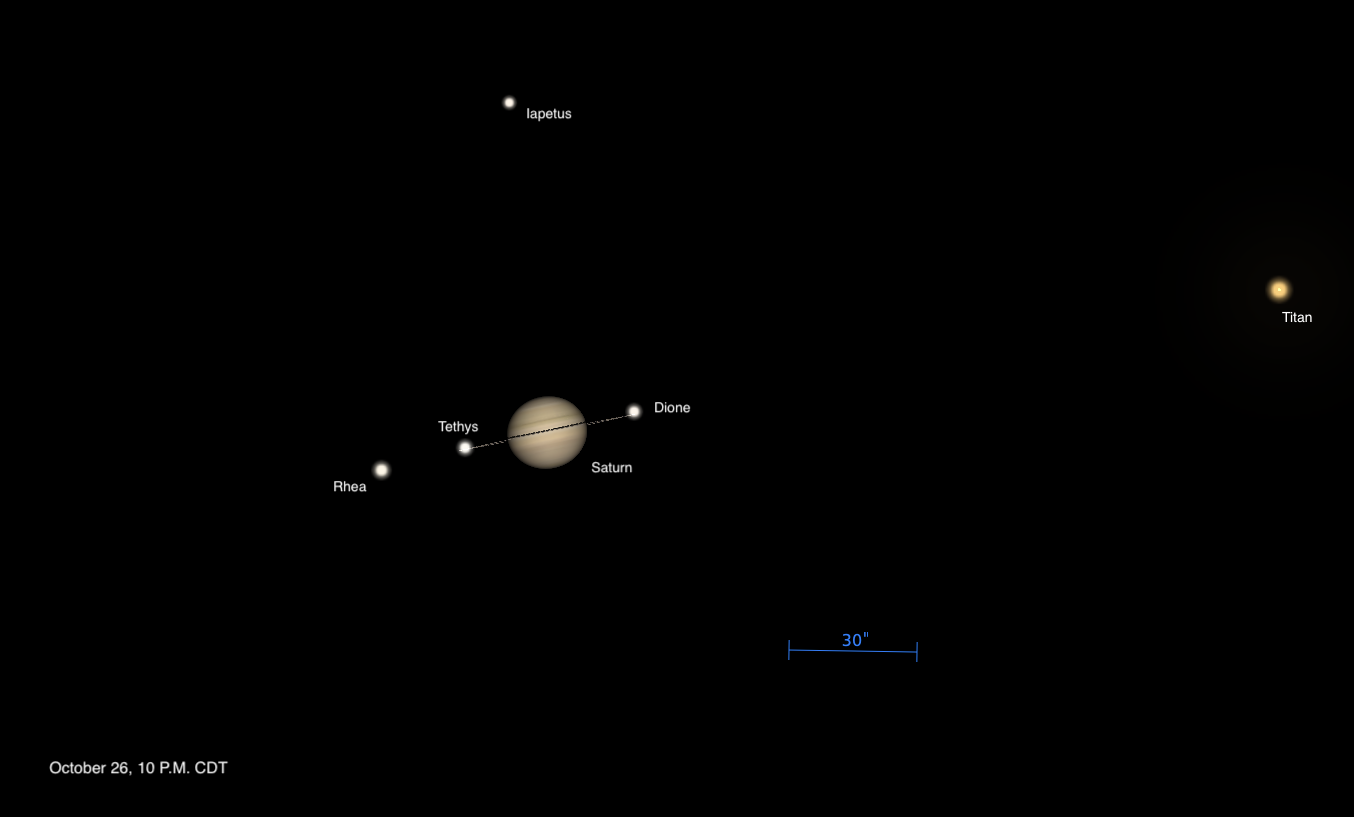
Saturn’s moon Iapetus reaches inferior conjunction tonight, sitting 1.3′ due north of Saturn and glowing at roughly 11th magnitude. This oft-elusive moon is easier to find when it is close to its parent planet, so give it a try tonight.
Magnitude 0.7 Saturn is highest around 10 P.M. local daylight time, when it is the brightest point of light in the southern sky, hanging below the Circlet of Pisces and to the far upper left of Fomalhaut in Piscis Austrinus. Through a telescope, its rings stretch 43” wide, while its disk is 19” across.
At 10 P.M. CDT, Saturn’s largest and brightest moon, Titan, lies far to the planet’s west. Much closer to the western edge of the rings is smaller, 10th-magnitude Dione. Just above the rings’ eastern tip is similarly bright Tethys, with Rhea farther to the east. And north of the planet is Iapetus. Note that while the positions of Dione, Tethys, and Rhea will change throughout the night, Titan and Iapetus should remain relatively stationary for all observers.
Sunrise: 7:23 A.M.
Sunset: 6:04 P.M.
Moonrise: 12:29 P.M.
Moonset: 9:10 P.M.
Moon Phase: Waxing crescent (26%)
*Times for sunrise, sunset, moonrise, and moonset are given in local time from 40° N 90° W. The Moon’s illumination is given at 10 P.M. local time from the same location.