Looking for a sky event this week? Check out our full Sky This Week column.
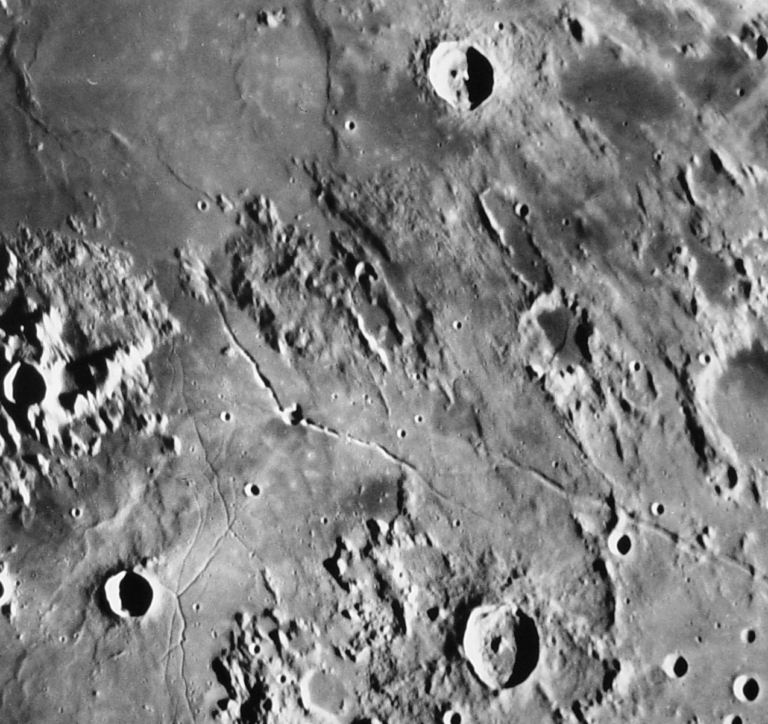
January 25: Aries’ Hoofprint
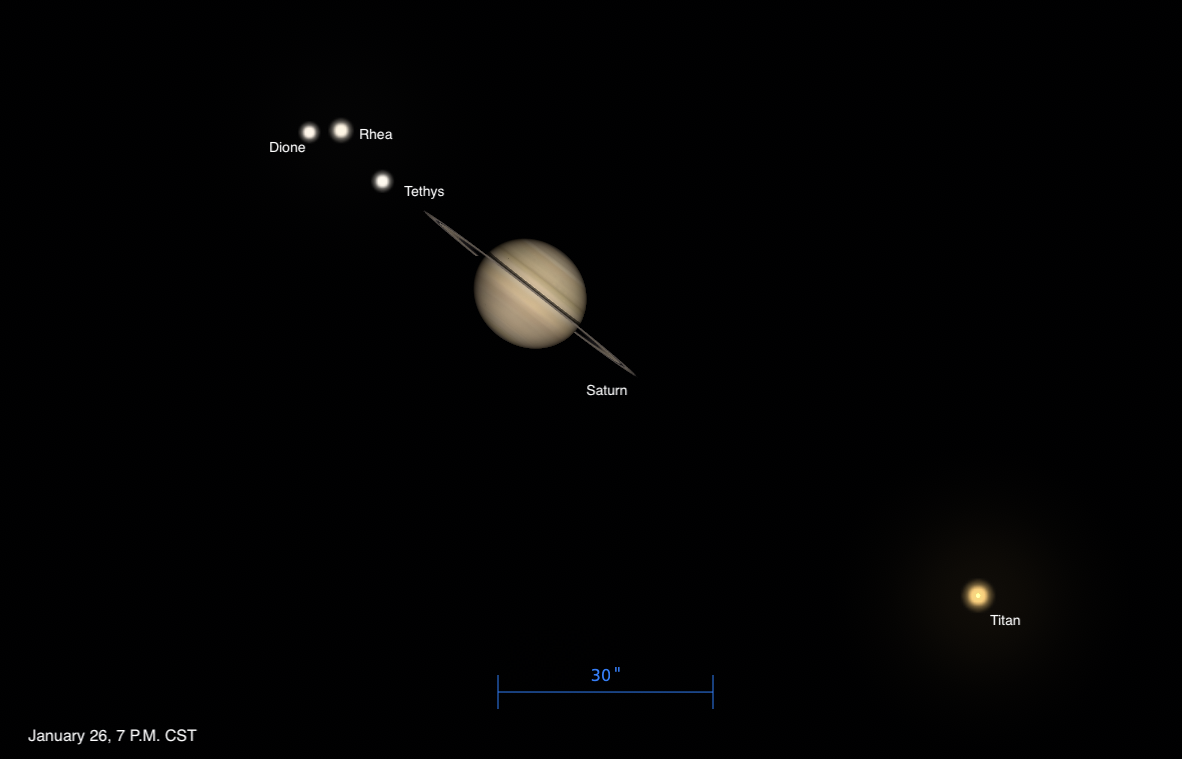
Saturn’s four brightest moons are lined up for ideal viewing this evening. You can catch the ringed planet for a few hours after sunset, as it slowly sinks toward the western horizon.
Around 7 P.M. local time, Saturn is still some 25° high in the west. It shines at 1st magnitude — easy to find because nothing else is as bright in this region of the sky. Zoom in on Saturn with a telescope and you should easily see the moon Titan, shining around magnitude 8.5 and sitting due west of the planet. It will remain there all night.
On the eastern side of Saturn and its rings, three smaller, fainter moons may also be visible: 10th-magnitude Dione, Rhea, and Tethys. These are closer to the planet and change position quickly, so their orientation will depend on the time you view them. At 7 P.M. EST, Tethys is just off the eastern edge of the rings. Dione is next, with Rhea close by, but farther east. An hour later, Dione is now farther from Saturn than Rhea, as the two moons have swapped positions. Rhea then approaches Tethys, which is moving east as Rhea tracks west; the two moons seem to blend together around 7 P.M. MST. By 7 P.M. PST, the three fainter moons are lined up again east of Saturn, now with Rhea closest to the rings, then Tethys, and Dione farthest east.
Sunrise: 7:14 A.M.
Sunset: 5:12 P.M.
Moonrise: 11:02 A.M.
Moonset: 12:55 A.M.
Moon Phase: Waxing gibbous (61%)
*Times for sunrise, sunset, moonrise, and moonset are given in local time from 40° N 90° W. The Moon’s illumination is given at 10 P.M. local time from the same location.