Looking for a sky event this week? Check out our full Sky This Week column.
December 28: The stars are smiling
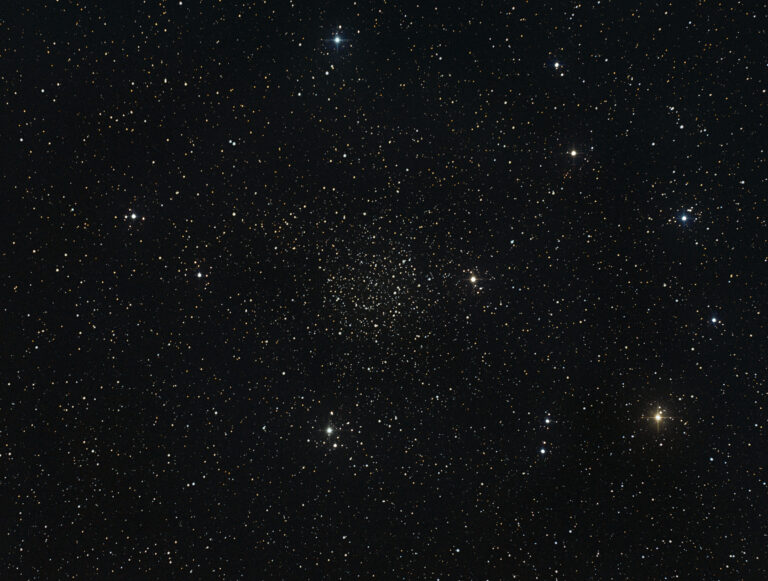
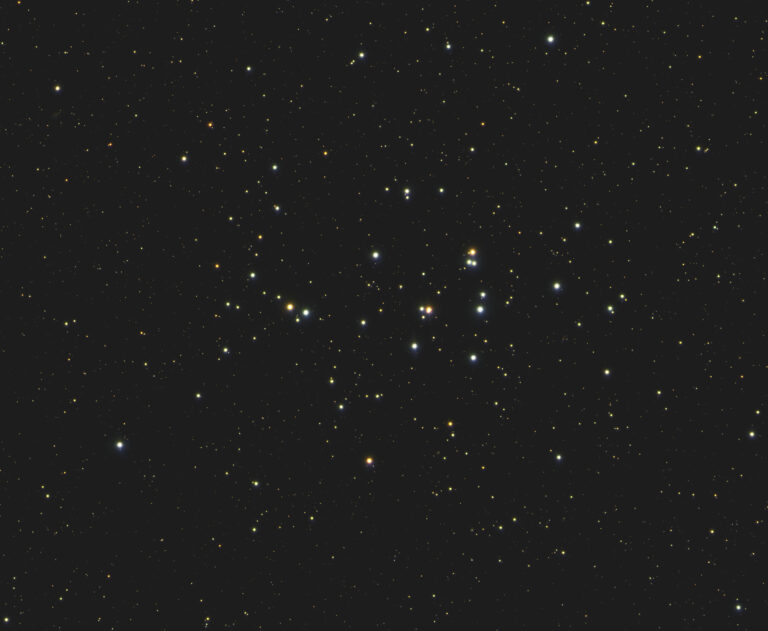
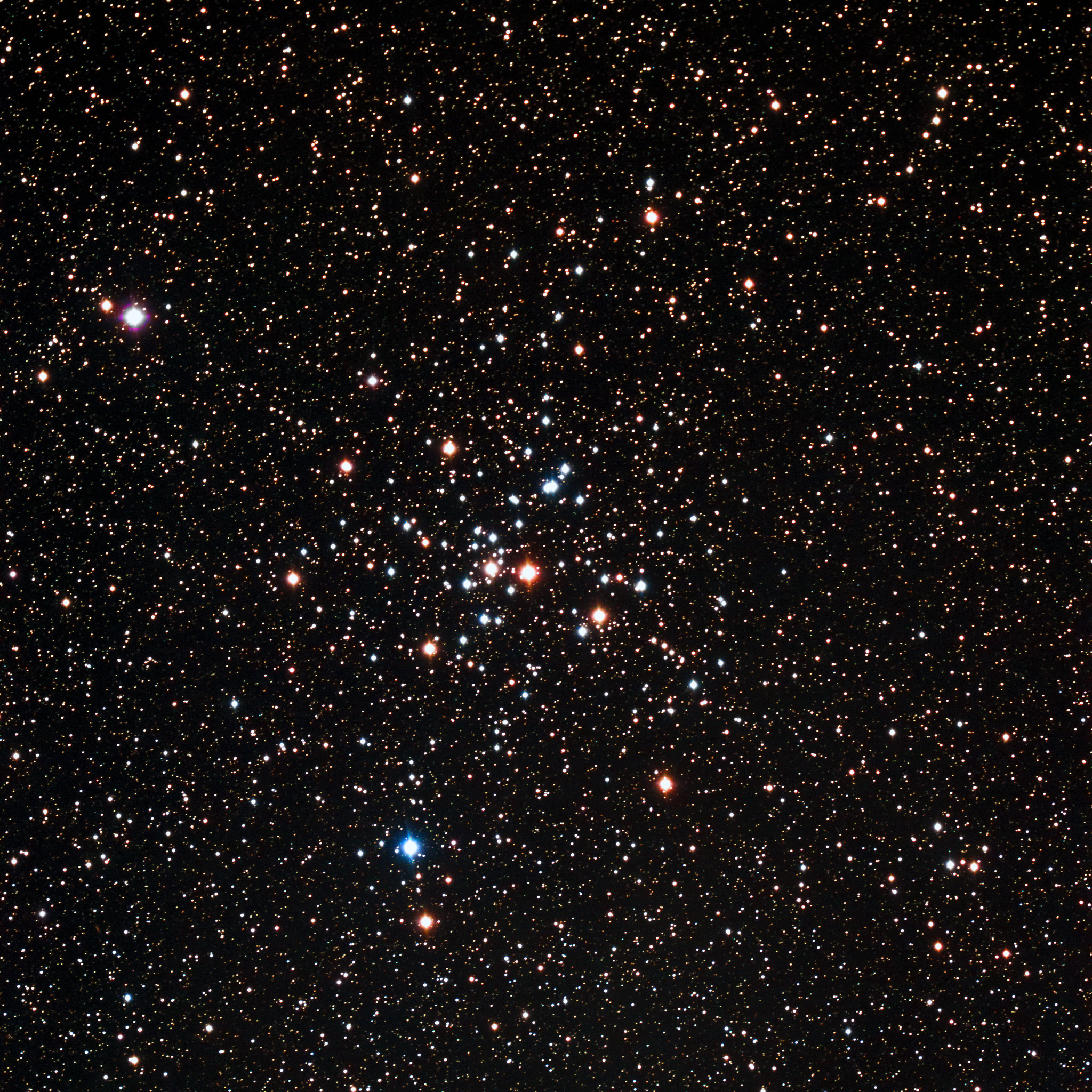
If you’re looking for some pops of color in your nighttime sky, then open cluster M41 is for you. Located in Canis Major within the Big Dog’s body, this bright gaggle of stars is highest around local midnight, when it stands 30° above the southern horizon and hangs just below the brightest star in the northern sky, Sirius.
Finding blazing Sirius in binoculars or a telescope should be a snap. From there, simply drop 4° south to land on your target. M41 shines at magnitude 4.5, making it a bright, easy target for any observer and great to view under any magnification. It may even pop out to your naked eyes as a misty glow.
M41 spans a little more than half a degree on the sky and is home to some 100 young suns about 240 million years old. Even under low magnification (7x) you should see nearly two dozen stars, with that number increasing as you bump up the power (though your field of view will also shrink). At magnifications of 14x or more, you’ll start to notice the contrasting colors of the stars, with some appearing blue-white while others glow golden yellow, orange, or red. At the center of the cluster is a bright red star, with more reddish suns spreading outward from it almost like the arms of a starfish.
Sunrise: 7:22 A.M.
Sunset: 4:43 P.M.
Moonrise: 12:30 P.M.
Moonset: 1:53 A.M.
Moon Phase: Waxing gibbous (76%)
*Times for sunrise, sunset, moonrise, and moonset are given in local time from 40° N 90° W. The Moon’s illumination is given at 10 P.M. local time from the same location.
Mercury may be a bright magnitude –0.6, but it is sinking quickly toward the horizon. The small planet will only be visible in the predawn sky for a few more days at most, so try to grab your chance to spot it on December 30. It is heading toward superior conjunction in late January, a configuration that places the planet behind the Sun from our point of view. Some 94 percent of Mercury’s face is now lit by the Sun, helping to keep the planet bright in the early-morning sky.
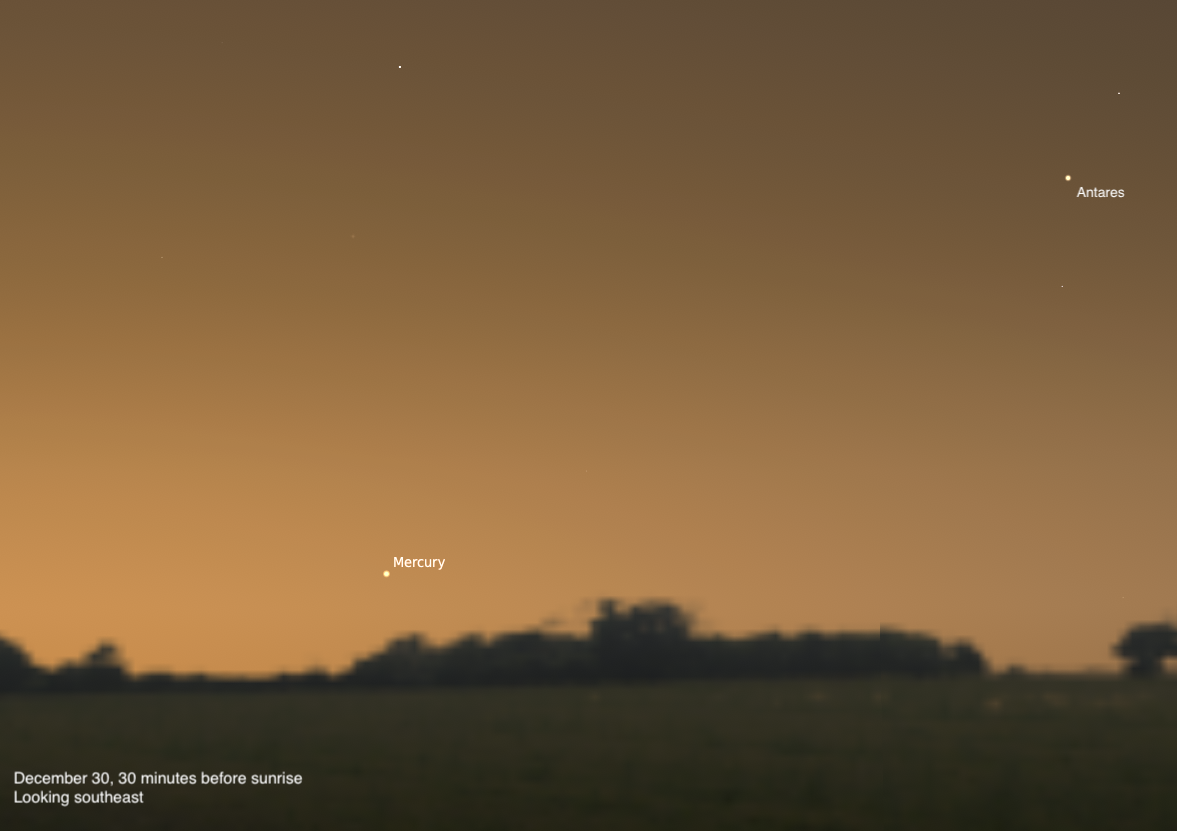
See if you can find Mercury in the growing twilight some 30 minutes before sunrise, when it is just 3° high in the southeast. Your best bet is to sweep the southeastern horizon with binoculars, moving slowly back and forth to look for the planet’s reflected light. A bit earlier you might spot Antares — the ruby-hued heart of Scorpius the Scorpion — above the horizon as well. Mercury lies to this star’s far lower left. Antares, at magnitude 1.1, will disappear first in the oncoming dawn.
The observing window is very short, and you should make sure to stop your search and put away your instruments at least several minutes before sunrise from your specific location.