Looking for a sky event this week? Check out our full Sky This Week column.
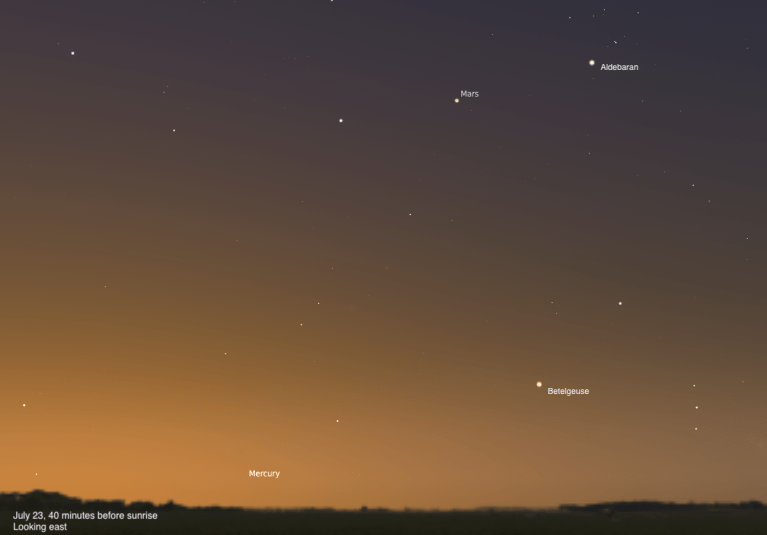
July 23: Mercury’s retrograde path ends
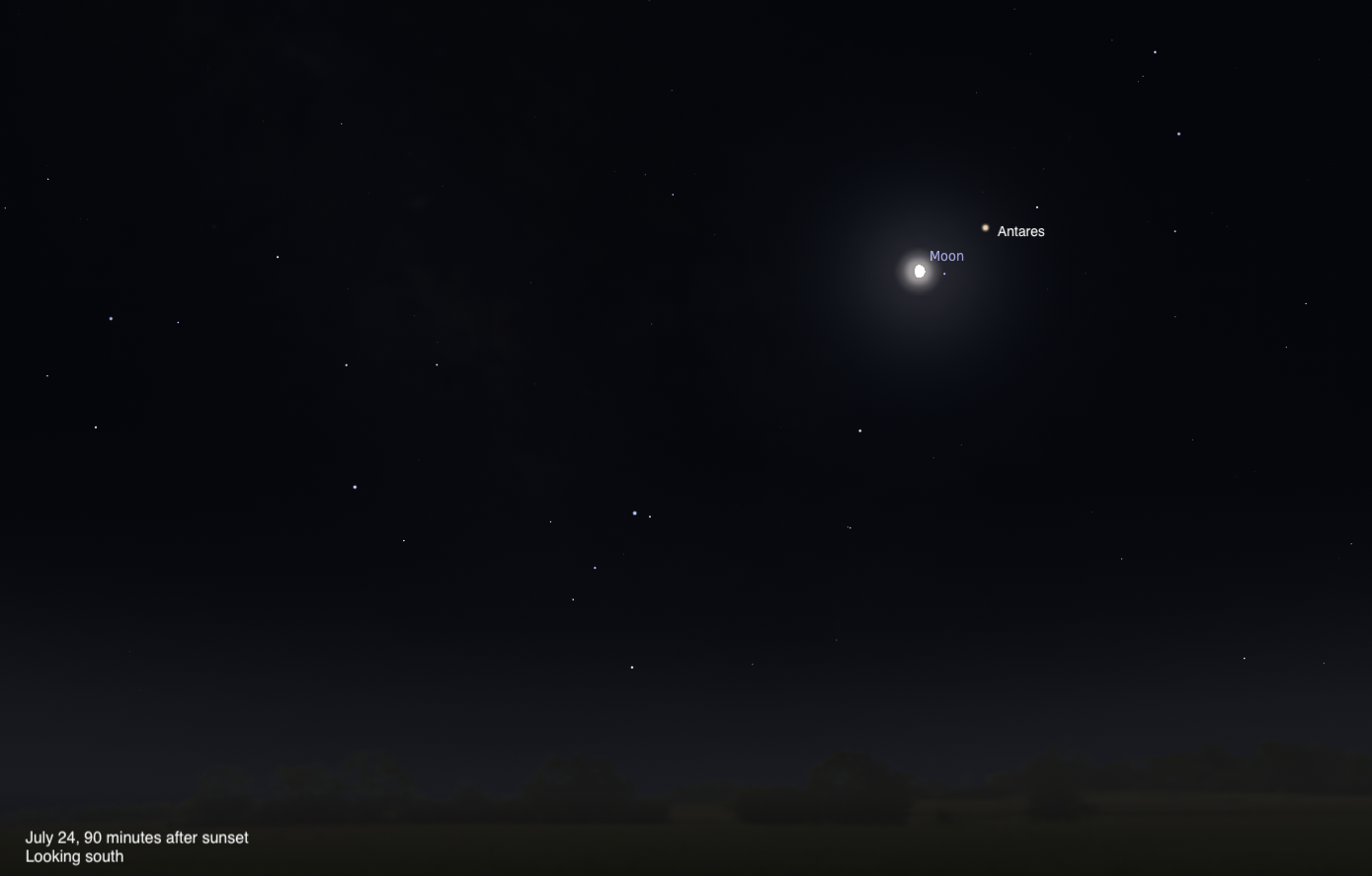
The Moon passes 0.6° south of Antares, the heart of Scorpius the Scorpion, at 6 P.M. EDT. This evening, the two remain nestled close, a lovely sight in the southern sky after sunset.
About 90 minutes after the Sun disappears, the stars are truly starting to appear in the darkened sky. The waxing gibbous Moon is now about 20° high in the south, just to the lower left of ruby-red Antares. This red giant star shines at magnitude 1.0; its color helped inspire its name, which is often translated to mean “rival of Mars” because the two can be so easily confused, thanks to their similar hues and brightness.
From most U.S. locations, as you look south this evening the entire curving figure of Scorpius should be above the horizon, from its sweeping front claws to its long, winding tail. To its left is the boxy form of the Sagittarius Teapot asterism, while far to the upper right is the bright star Arcturus in Boötes, and to the far upper left is the luminary Altair in Aquila.
If you’re planning to be up past midnight, keep an eye on both Antares and the Moon, checking in every so often. As the hours tick past, the Moon will appear to pull farther away from the star, widening the distance between them as our satellite tracks quickly across our sky. Its motion relative to the stars isn’t always obvious, except when there’s a nearby signpost, as tonight.
Sunrise: 5:51 A.M.
Sunset: 8:21 P.M.
Moonrise: 5:04 P.M.
Moonset: 1:13 A.M.
Moon Phase: Waxing gibbous (82%)
*Times for sunrise, sunset, moonrise, and moonset are given in local time from 40° N 90° W. The Moon’s illumination is given at 10 P.M. local time from the same location.
Alison Klesman is senior editor of Astronomy magazine. She holds a Ph.D. in astronomy and has studied a variety of topics, from minor planets to supermassive black holes.