
Sky This Week is brought to you in part by Celestron.
Friday, March 13
Look north this evening a couple hours after sunset and you’ll easily spot the large shape of the Big Dipper as it sits upside-down in the sky, appearing to pour from its cup into that of the smaller Little Dipper, anchored by the North Star. Our target today is actually more of a naked-eye test: the famous double star Alcor and Mizar in the Big Dipper’s handle. Many people can see these two stars separately without any optical aid at all; even if it turns out you can’t, they’re a great target for binoculars or any scope, ideal for beginners.
To find the pair, first locate the star at the very end of the Big Dipper’s handle. This is magnitude 1.9 Alkaid, formally cataloged as Eta (η) Ursae Majoris. From Alkaid, move one star in, where the long handle of the dipper appears to have a kink. Look carefully. Is there one star here, or two? The brighter star that everyone can see is magnitude 2.3 Mizar, cataloged as Zeta (ζ) UMa. But located just under 12′ to its northeast (to the lower left around 9 P.M. local daylight time this evening) is much fainter magnitude 4 Alcor, also known as 80 UMa. This star is still within reach of the naked eye, so their close proximity is the challenge here. Try using averted vision if you’re having trouble — look at Mizar out of the corner of your eye, rather than directly at it. This may help Alcor pop into view. Again, both are readily visible using any type of optical aid.
Although they appear close together in the sky, they are not a physical pair. In truth, there’s roughly a light-year of distance between these two stars in space. Although not orbiting each other, the two stars do still seem bound, as they are moving in the same direction and with the same speed through the galaxy. In fact, they are part of a group of several stars in the Big Dipper all moving together, known collectively as the Ursa Major Moving Group.
Sunrise: 7:15 A.M.
Sunset: 7:05 P.M.
Moonrise: 4:23 A.M.
Moonset: 1:23 P.M.
Moon Phase: Waning crescent (25%)
*Times for sunrise, sunset, moonrise, and moonset are given in local time from 40° N 90° W. The Moon’s illumination is given at 10 P.M. local time from the same location.
Saturday, March 14
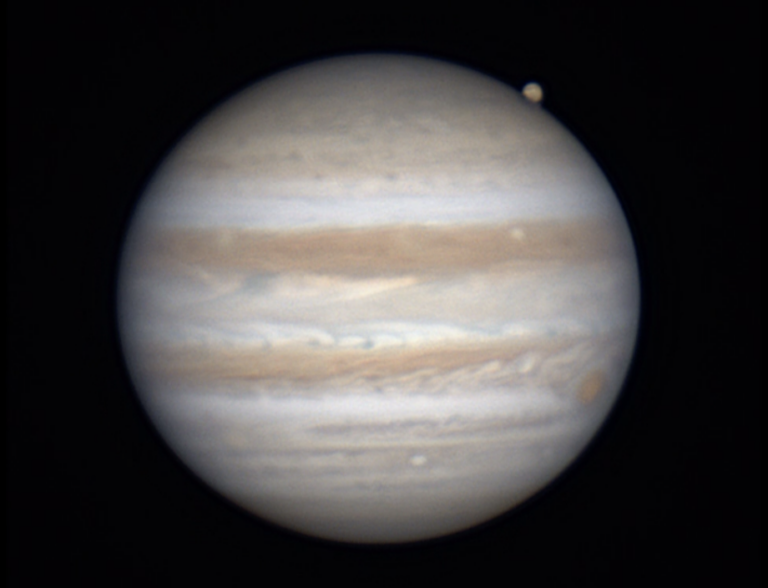
A transit of Io and its shadow occurs early this morning, after which Io reaches the western extent of its orbit and comes back around, passing behind Jupiter in an occultation visible late tonight.
First up is the transit, which begins at 2:52 A.M. EDT this morning, with Jupiter — currently located in Gemini — quickly sinking in the west for the eastern half of the U.S. Io is moving from east to west, and by the time its shadow joins in at 2:00 A.M. MDT, the planet has set for observers in the Eastern time zone and is very low for those in the Central time zone. As its shadow creeps inward from the eastern limb, Io sits in the middle of the disk, moving quickly toward the western limb. Io’s transit ends shortly after 2 A.M. PDT, with its shadow now approaching the middle of Jupiter’s visible disk.
This evening, Io has come back around and is approaching the western limb as darkness falls. It finally slips behind the disk late tonight, around 12:10 A.M. EDT (now on the 15th in the Eastern time zone only). It won’t reappear until 2:40 A.M. CDT on the 15th, with Jupiter too low for East Coast observers to catch it. That reappearance also occurs some 20” east of the planet’s eastern limb, as Io has traveled not only behind the planet but also through its long, dark shadow, which extends east of the planet in space, showing off the geometry of the Earth, Sun, and Jupiter to give us this view.
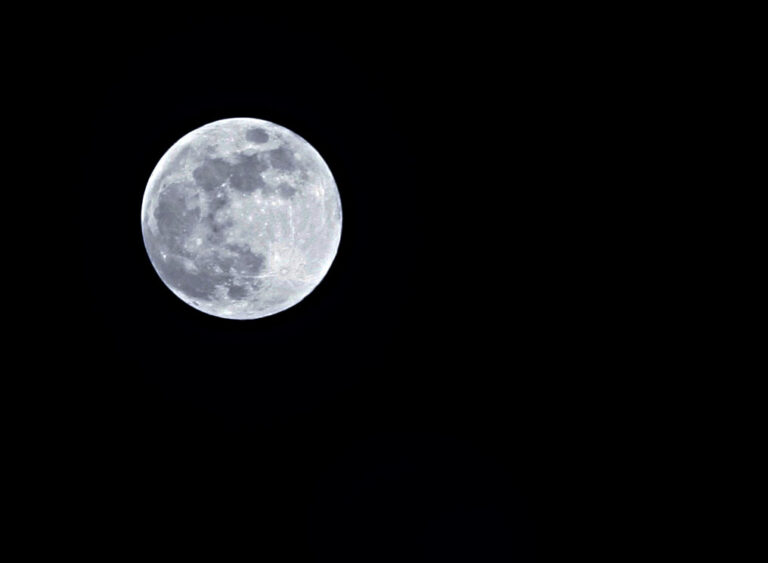
The Moon passes 1.0° north of Pluto at 9 P.M. EDT, with neither above the horizon.
Sunrise: 7:13 A.M.
Sunset: 7:06 P.M.
Moonrise: 5:02 A.M.
Moonset: 2:28 P.M.
Moon Phase: Waning crescent (17%)
Sunday, March 15
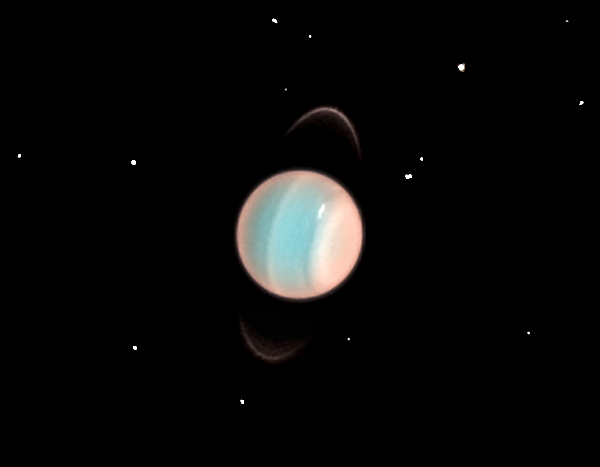
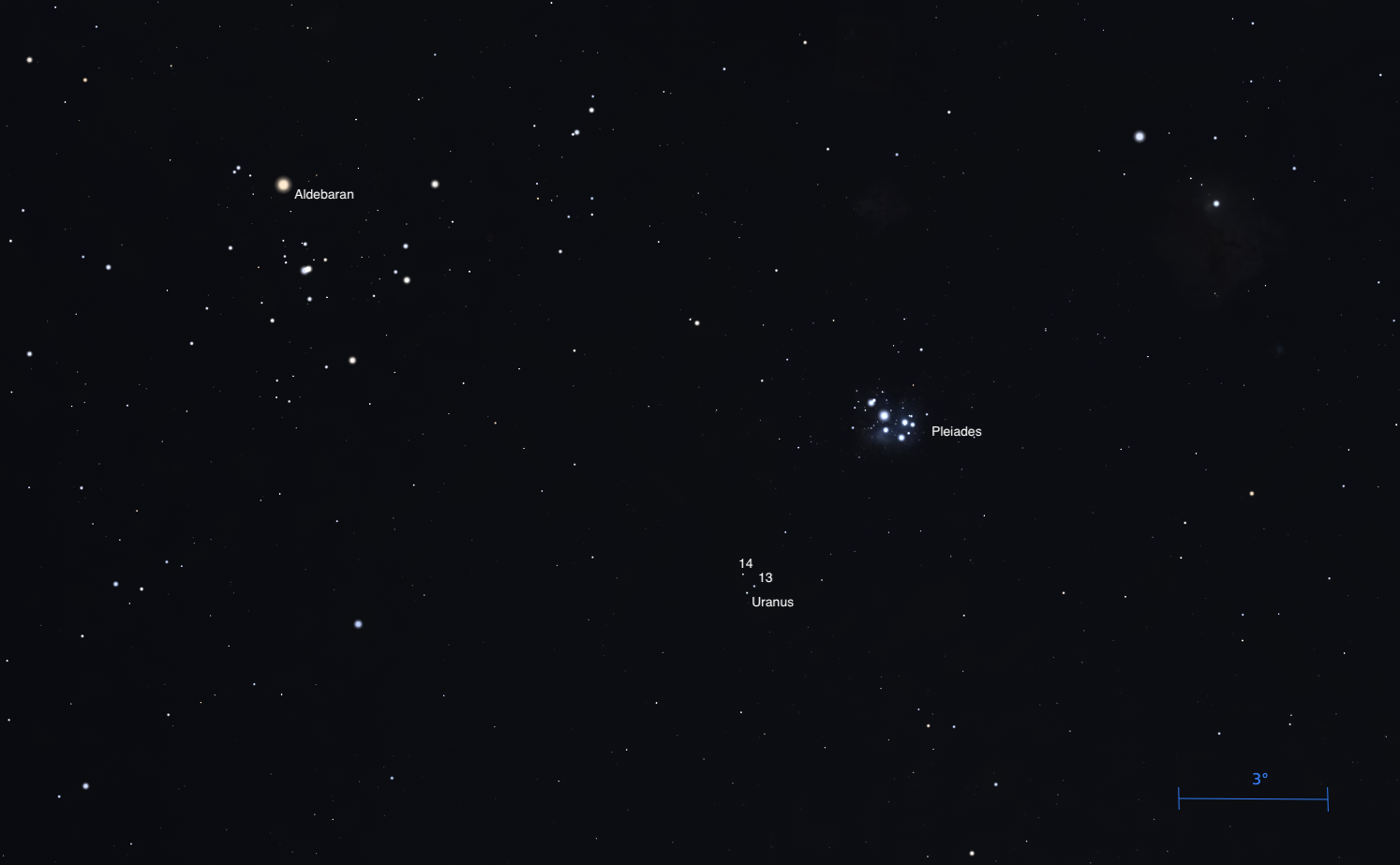
The distant ice giant Uranus is located in Taurus right now, not far from the famous (and easy-to-find) Pleiades star cluster, cataloged as M45. Tonight, the planet also sits a short distance due south of a 6th-magnitude field star of roughly the same brightness, further aiding in its identification.
Around 9 P.M. local daylight time, you can easily spot the Pleiades 40° above the southwestern horizon, slowly preparing to sink lower in the west as the night goes on. From the Pleiades’ center, drop 4.5° south-southwest to land on a pair of 6th-magnitude stars in an east-west line. The easternmost star is fainter magnitude 6.1 14 Tauri, while the westernmost star is brighter magnitude 5.7 13 Tauri.
Magnitude 5.8 Uranus will appear like a twin to 13 Tau, sitting 12’ due south of this star. The distant planet may look “flatter” compared to the star’s pinprick-like light, with a tiny disk spanning 4” that may appear grayish-blue through your scope.
Sunrise: 7:11 A.M.
Sunset: 7:07 P.M.
Moonrise: 5:34 A.M.
Moonset: 3:36 P.M.
Moon Phase: Waning crescent (10%)
Monday, March 16
High in the south this evening is Canis Minor the Little Dog, shining above the bright star Sirius, which lies closer to the horizon. True to its name, the Little Dog is a little constellation, beating out fewer than 20 other constellations in size. However, it makes up in brightness what it lacks in stature: Canis Minor’s alpha star, Procyon, is the eighth-brightest star in the sky.
Shining at magnitude 0.34, Procyon is just 11.4 light-years from Earth. It shines as brightly as seven Suns and is roughly one and a half times the mass of our home star. And like its counterpart Sirius in Canis Major, Procyon has a white dwarf companion. Glowing a far fainter 11th magnitude, this tiny stellar corpse lies less than 5” of Procyon and is a true challenge to view in amateur scopes.
The Little Dog’s second-brightest star is Beta (β) Canis Minoris, also called Gomeisa. It shines at 3rd magnitude just over 4° northwest of Procyon, to the brighter star’s upper right in the sky as you look south this evening.
Sunrise: 7:10 A.M.
Sunset: 7:08 P.M.
Moonrise: 6:01 A.M.
Moonset: 4:44 P.M.
Moon Phase: Waning crescent (5%)
Tuesday, March 17
The Moon passes 2° south of Mercury at 10 A.M. EDT, then passes 1.5° north of Mars at 6 P.M. EDT. Both planets are in the early-morning sky, and the trio is visible for only a short time before sunrise. Just 20 minutes before sunrise, Mars is only 1° high and magnitude 1.1. Mercury is higher — 5° above the horizon — but even fainter, at magnitude 1.7. And the waning Moon, which might normally serve as a beacon and steppingstone, is just 3 percent lit, one day from New.
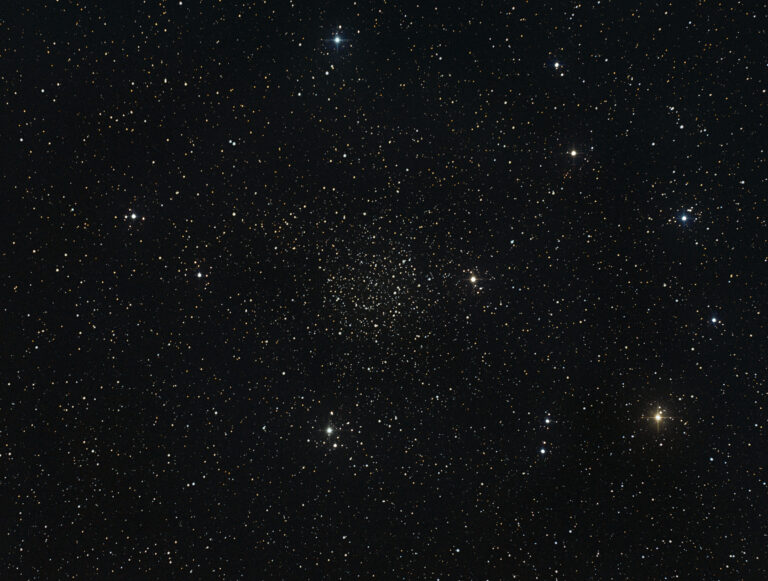
A much easier observation earlier in the morning is the lovely open cluster M29 in Cygnus the Swan. Around 5 A.M. local daylight time, M29 is some 35° high in the east. It’s easy to find, too, located just under 2° south of 2nd-magnitude Sadir (Gamma [γ] Cygni), which serves as the center point in the cross-shaped constellation Cygnus.
Spanning about 7’, M29 shines at 7th magnitude and is a great target for binoculars or any small scope. In fact, lower powers are better when looking with a telescope, allowing you to view the entirety of this young open cluster at once.
This cluster was named the Cooling Tower by amateur astronomer Jeff Bondono, who thought its brightest stars sketched out the curved outline of a nuclear power plant’s iconic cooling tower. Take a look — do you agree?
Sunrise: 7:08 A.M.
Sunset: 7:09 P.M.
Moonrise: 6:26 A.M.
Moonset: 5:54 P.M.
Moon Phase: Waning crescent (1%)
Wednesday, March 18
New Moon occurs at 9:23 P.M. EDT, leaving the skies dark for those who want to chase down fainter targets.
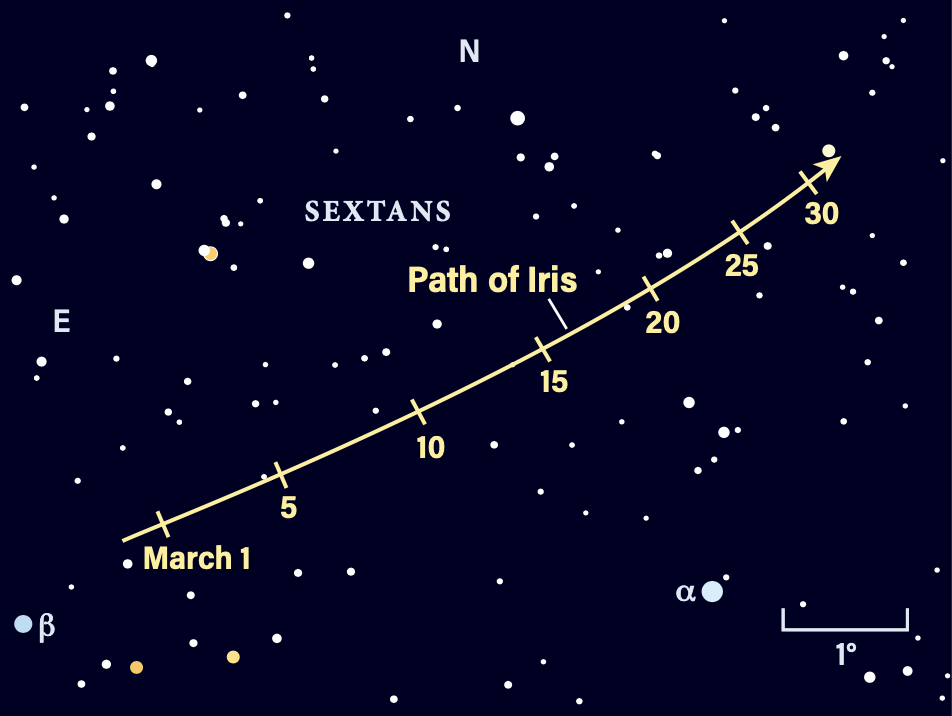
Tonight, let’s seek out main-belt asteroid 7 Iris, currently making its way through Sextans near that constellation’s two brightest stars. This region is highest in the hour before local midnight, when it is some 50° above the southern horizon, although it’s visible most of the night, so you can begin searching soon after full dark if you prefer to observe earlier in the evening.
Sextans’ brightest star is magnitude 4.5 Alpha (α) Sextantis, and tonight Iris is just 2.5° north-northeast of this luminary. Shining at magnitude 9.3, Iris is located just 8.5’ east of a slightly brighter magnitude 8.5 field star, forming a wide double. Tomorrow night, Iris will be even closer to this sun, standing just 4’ to its northwest.
You might also notice a doublet of two stars some 0.7° northwest of Iris’ position tonight, comprising a brighter and a fainter star. Iris will quickly close in on this pair, passing near it from the 20th to the 22nd.
Sunrise: 7:07 A.M.
Sunset: 7:10 P.M.
Moonrise: 6:49 A.M.
Moonset: 7:04 P.M.
Moon Phase: New
Thursday, March 19
Mercury is stationary at 4 P.M. EDT, standing still against the stars of Aquarius. The tiny planet is visible in the mornings now before sunrise, rising just under an hour before the Sun. It’s a bit of a challenging view, but you can try catching Mercury some 30 minutes before sunrise, when it stands nearly 4° high in the east.
You’ll need a clear horizon and possibly some optical aid. This morning, Mercury glows at magnitude 1.3. It has been brightening as it rises higher above the horizon following its conjunction with the Sun earlier this month. The planet will continue growing brighter by the day, and will reach magnitude 0.9 by the 22nd, when it will rise a full hour before the Sun. If you have difficulty viewing it this morning, try your luck in the coming days — just make sure to put away any optics well in advance of sunrise from your viewing location, which may differ from the time listed below.
Through your optics, you’ll see this morning that Mercury’s 10”-wide disk is a slim, 20-percent-lit crescent. That phase will continue to increase as the planet brightens in the coming days.
Sunrise: 7:05 A.M.
Sunset: 7:11 P.M.
Moonrise: 7:13 A.M.
Moonset: 8:16 P.M.
Moon Phase: Waxing crescent (2%)
Friday, March 20
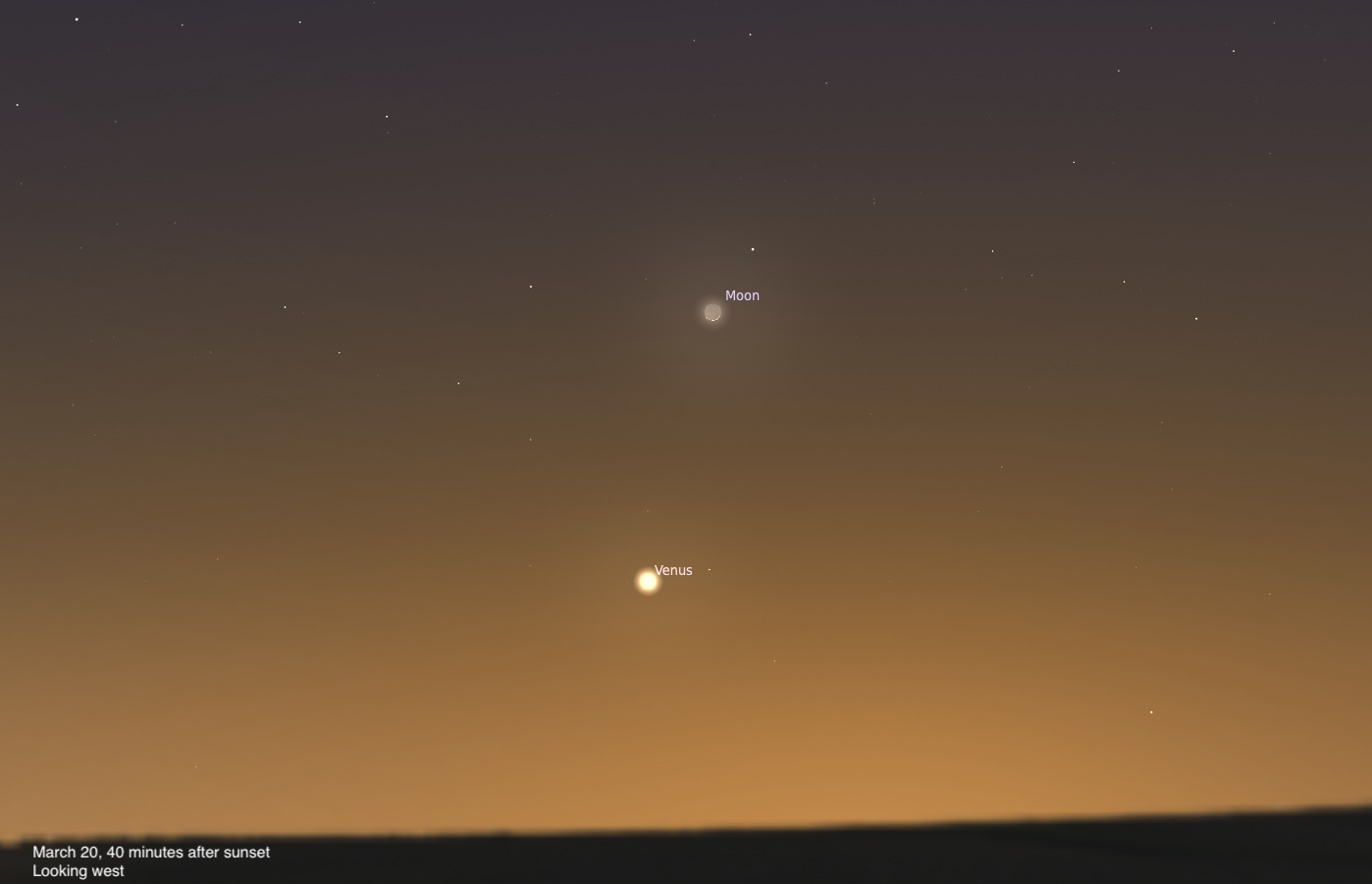
The Moon passes 5° north of Venus at 9 A.M. EDT, although neither is visible then. Instead, you can view them together in the evening sky.
Some 40 minutes after sunset, the first bright stars are likely starting to pop into view as twilight falls. Venus outshines them all at magnitude –3.9; the bright planet stands just under 10° above the western horizon at this time, located in southeastern Pisces.
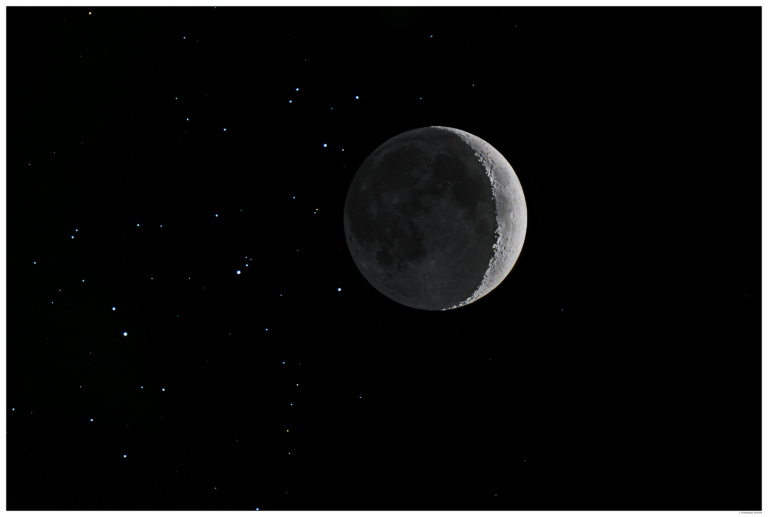
The Moon may be more challenging — it’s a thin, two-day-old sliver just 5 percent lit, now nearly 9° above Venus. Its eastern limb is just starting to experience sunrise, while the rest of the nearside remains in darkness. However, you might see some of the darkened surface thanks to sunlight bouncing off Earth, a phenomenon called earthshine.
If you take some time to view Venus through a telescope, you’ll see the bright planet’s disk is nearly fully lit (95 percent) and stretches 10” across. The best time to view it is in early twilight while the background sky is still bright. Venus sets around 8:40 P.M. local daylight time, so you should have plenty of time to view it.
The vernal equinox occurs at 10:46 A.M. EDT, ushering spring into the Northern Hemisphere.
Sunrise: 7:03 A.M.
Sunset: 7:12 P.M.
Moonrise: 7:38 A.M.
Moonset: 9:31 P.M.
Moon Phase: Waxing crescent (6%)