
Key Takeaways:
- The article emphasizes the escalating issue of satellite trails appearing in astronomical images.
- An astronomer documented capturing 44 60-second exposures of Comet C/2025 A6 Lemmon, noting that only six of these frames were devoid of satellite trails.
- Star trailing in the images was attributed to the standard technique of tracking the comet's nucleus, while the numerous streaks were identified as satellite pathways.
- Although post-processing techniques like "sigma reject" can remove these artifacts, the primary motivation for sharing the unfiltered images was to demonstrate the substantial increase in visible orbital traffic, with over 30 trails counted in one negative.
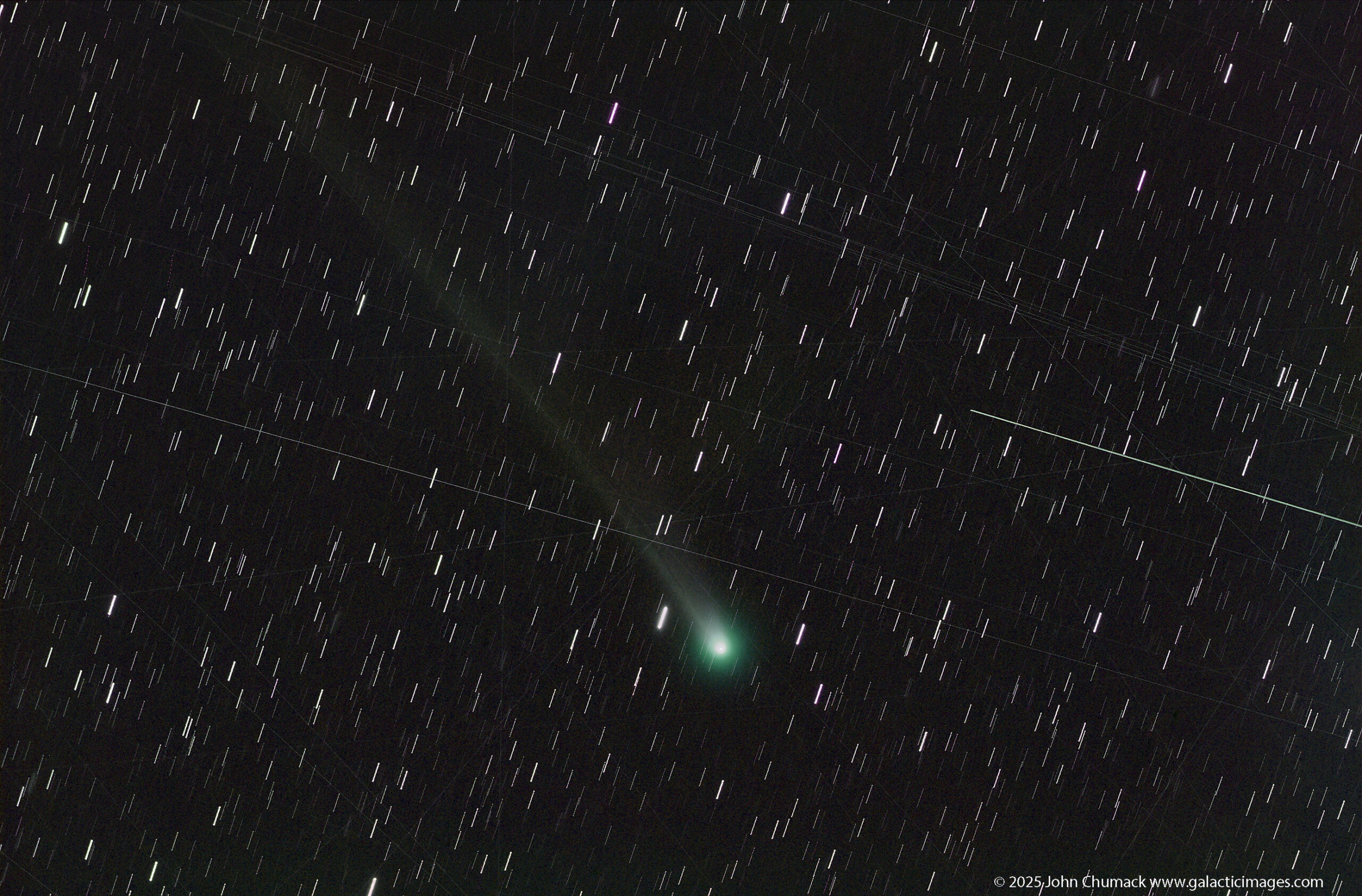
I wanted to share the above image with you to demonstrate how prevalent satellite trails are becoming in astroimages. I received it from John Chumack, a longtime contributor to Astronomy magazine. He actually labeled the image, “Insane Satellite Traffic.” And he’s not wrong.
He was in his observatory taking 60-second exposures of Comet C/2025 A6 Lemmon. He captured 44 of them to stack for his final image. Of those, he noted that only six did not have satellite trails in them. That is insane.
You may notice that the stars are trailed. That’s because he was tracking the comet’s nucleus as it drifted against the background stars, a standard technique used by comet photographers.
He wrote that he will later use sigma reject, a popular way to remove satellite trails during processing so as to produce a clean image of the comet. But in his email, he said, “I thought I would share with you this crazy unfiltered stacked shot to show the satellite traffic.”
He advised me (and I’m advising you) to zoom in to see the fainter trails. In his negative image, he counted more than 30 trails.
Thanks, John, for reminding us about some of the hardware orbiting our planet between us and the stars. Oh, and do send the clean image soon!