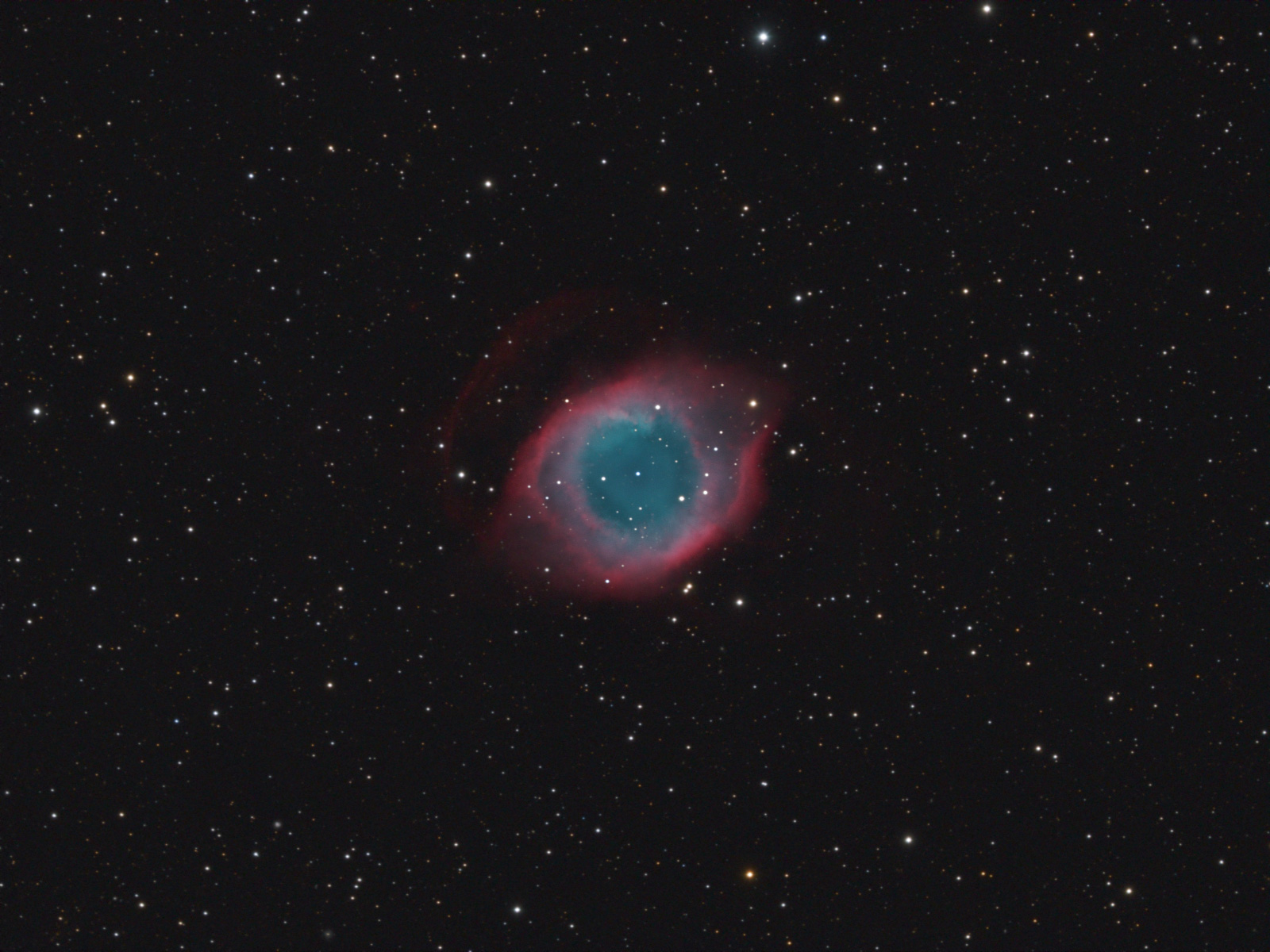
Credit: Bernhard Hubl

Key Takeaways:
- The Helix Nebula (NGC 7293/Caldwell 63) is a planetary nebula located approximately 655 light-years distant in the constellation Aquarius, first documented by Karl Ludwig Harding in 1827.
- Despite an integrated magnitude nearing 7th, its low surface brightness presents an observational challenge, with an apparent angular diameter of 25 arcminutes.
- Optimal visual observation under dark, moonless conditions is recommended using binoculars (7-15x magnification with >50mm aperture), with naked-eye detection possible for younger observers in exceptionally dark environments.
- Larger telescopes (11-inch or greater) employing a nebula filter can reveal structural details, including brightness variations within its ring and a central region appearing brighter than the background, though its inherent colors are not perceptible visually.
One of your nighttime sky targets for the next month or so should be the Helix Nebula in the constellation Aquarius the Water-bearer. Some observers call it the Sunflower Nebula, but you won’t hear that much anymore. And ever since the Lord of the Rings movies became popular, it’s gotten the moniker “The Eye of Sauron.” In catalogs, it’s either NGC 7293 or Caldwell 63. It’s a planetary nebula some 655 light-years away, relatively close for that type of object.
I like to think of the Helix as one of the brightest hard-to-see objects in the sky. Although its total light output nearly reaches 7th magnitude, its surface brightness is disappointingly low. For best results, use binoculars that provide 7 to 15 magnification and have front lenses larger than 50 millimeters.
If you’re relatively young and your site is dark — and I mean really dark — try to spot the Helix with your naked eyes. A naked-eye sighting is a bit easier if you first find the Helix through binoculars. Fortunately, no stars of equivalent brightness lie in the Helix’s immediate vicinity. By the way, my initial comment about youth relates to my and many friends’ experience where, a decade ago we could spot the Helix naked-eye, but now that observation has been removed from us because our eyes have aged.
Through 11-inch and larger telescopes, and using a nebula filter, you can pick out brightness differences within the nebula’s ring. Slightly brighter concentrations lie on the northern and southern edges. Also note that the central ‘‘dark’’ area appears brighter than the background sky outside the ring. Unfortunately, no scope will allow your eye to pick up the colors evident in images.
German astronomer Karl Ludwig Harding published an account of his discovery of the Helix Nebula in the Berliner Jahrbuch in 1827. He probably first saw it a few years before that, however.
You’ll find this great object 1.2° west of the 5th-magnitude star Upsilon Aquarii. It spans a whopping 25′, nearly the diameter of the Full Moon.
But don’t try to see the Helix Nebula if the Moon is bright. Head out when our nearest celestial neighbor lies below the horizon. Good luck!