Credit: Anthony Ayiomamitis
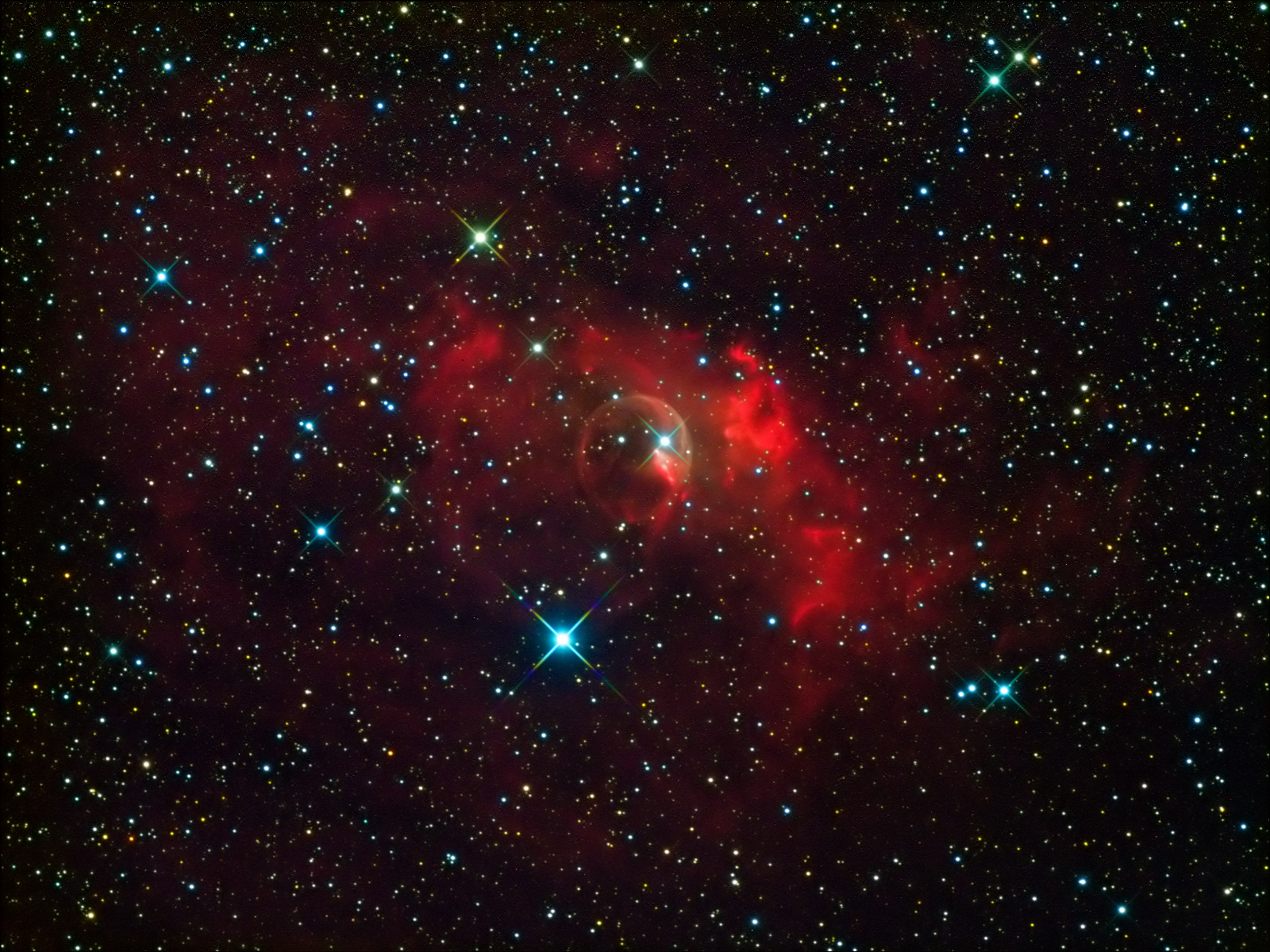
The Bubble Nebula (also designated NGC 7635) is a faint emission nebula in the constellation Cassiopeia the Queen near its border with Cepheus. It rides high in the sky at this time of year. You can use the bright open cluster M52 in Cassiopeia as a guide to the Bubble. The nebula lies 0.6° southeast of M52. When you observe it, you’ll get a glimpse of how a star interacts with what’s around it.
The remarkably spherical bubble marks the boundary between an intense wind of particles from a massive, hot star, BD+602522, and the nebula’s interior. The central star is 40 times more massive than the Sun and emits a stellar wind moving at 4 million mph (7 million km/h). The bubble’s surface actually marks the leading edge of this wind’s gust front, which slows as it plows into the denser surrounding material.
The bubble’s surface is not uniform because as the shell expands outward it encounters gaseous regions of different densities that impede the expansion by differing amounts. More material lies to the northeast than to the southwest, so the wind progresses less in that direction, offsetting the central star from the bubble’s center.
Sir William Herschel discovered the Bubble Nebula in 1787. Of it, he wrote, ‘‘A star of 9th magnitude with very faint nebulosity of small extent about it.’’ The star measures a magnitude brighter than Herschel’s estimate, but his assessment of the nebula was correct — it’s faint.
An 8-inch telescope at a dark site barely shows NGC 7635 as a 3′ by 1′ arc surrounding the star. This wisp of light floats in a rich field of faint background stars. Through a 14-inch scope, you’ll see the whole bubble, which measures 15′ by 8′. Try to detect a fainter haze north of the bright arc and separated from it by a dark lane. A nebula filter will dim the star and definitely help you see this object better. Good luck!