
Key Takeaways:
- M87 is a dominant giant elliptical galaxy located 50-55 million light-years away in the center of the Virgo cluster, harboring a central black hole with a mass roughly 6 billion times that of the Sun.
- This black hole generates a 5,000-light-year-long jet by channeling surrounding material through magnetic fields, within which hot plasma spirals around a helix-shaped magnetic field.
- Astronomers utilized the Hubble Space Telescope to capture approximately 500 images of this jet over a 13-year period, from 1995 to 2008.
- These images were compiled into a movie demonstrating the internal motion of the jet's material, which travels at nearly the speed of light, rendering its movements observable despite M87's vast distance.
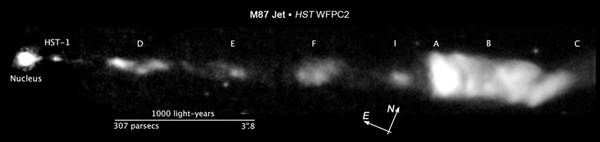
The M87 jet
NASA/ESA/Z. Levay (STScI/AURA)
The giant elliptical galaxy M87 resides near the center of the vast Virgo cluster, a collection of more than 1,000 galaxies located some 50 to 55 million light-years from Earth. The bright X-ray emission coming from M87 shows it to be the cluster’s dominant member. The galaxy also harbors a central black hole with a mass roughly 6 billion times that of the Sun. As the black hole draws in surrounding material, magnetic fields channel some of it into a jet that extends about 5,000 light-years.
Astronomers using the Hubble Space Telescope took approximately 500 images of this jet over a 13-year span from 1995 to 2008. They then combined those pictures to create a movie that shows hot plasma spiraling around the jet’s helix-shaped magnetic field. The video starts with a wide-field view of Virgo and then zooms into the galaxy before penetrating to the core. Despite M87’s great distance, motion within the jet shows up because the material travels at nearly the speed of light.
Animation credit: NASA/ESA/G. Bacon (STScI)