Key Takeaways:
- The article outlines ambitious private sector plans for Mars colonization, which raise critical scientific and logistical questions concerning human survival, radiation protection, mobility, and waste management on the Red Planet.
- NASA's Haughton-Mars Project (HMP) on Devon Island has served for two decades as a terrestrial analog research station, addressing these challenges in an environment that closely simulates Martian conditions.
- Devon Island, characterized by its extreme isolation and Mars-like geomorphology, facilitates the testing of essential technologies such as robots, spacesuits, and drills, and provides a proving ground for human factors relevant to future Martian inhabitants.
- Experiential field research, exemplified by the HMP Okarian expedition simulating a long-duration pressurized rover traverse, highlighted the formidable environmental and operational difficulties of Mars surface exploration, with findings disseminated through the documentary "Passage to Mars."

He outlined an ambitious plan to begin sending cargo missions to Mars by 2018, with the first manned missions leaving by 2022 or 2023. Along the way, he hopes to improve the cost of trips by “5 million percent”, and establish a colony of 1 million souls there within 40 to 100 years. Let’s just say people had questions — The Verge’s Loren Grush outlined a few of them.
How will humans survive? What about radiation? How will they get around? What happens to the waste colonists flush down the toilet? We didn’t get a clear answer form Musk, but these are the kinds of questions that NASA scientists have been working to answer for two decades in one of the most remote, empty places on earth: Devon Island.
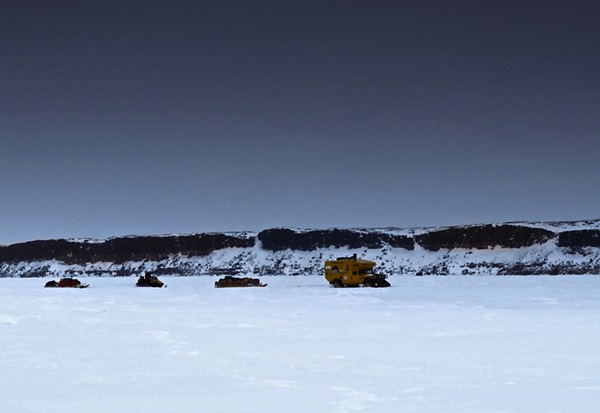
The HMP Okarian team making progress on its journey.
On the island, researchers have tested robots, spacesuits, drills and other tools that would aid future Mars explorers. It’s also a proving ground for would-be Mars colonists. Devon Island is isolated, the environment is brutal and the area is poorly mapped, which makes it the perfect place to get a taste of what might go wrong out there.

“Astronauts bound for Mars will train on Devon Island, and we hope this film will inspire and ready all explorers,” says Lee.
This post originally appeared on Discover.