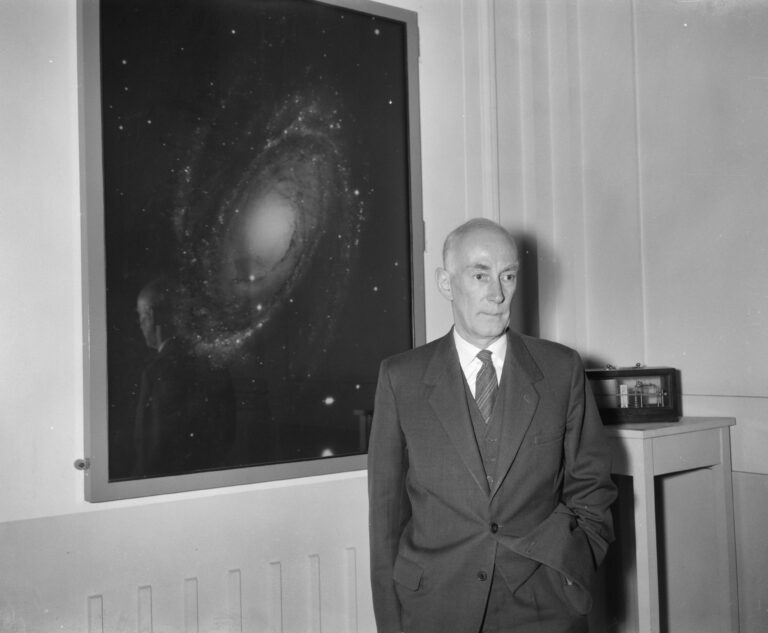
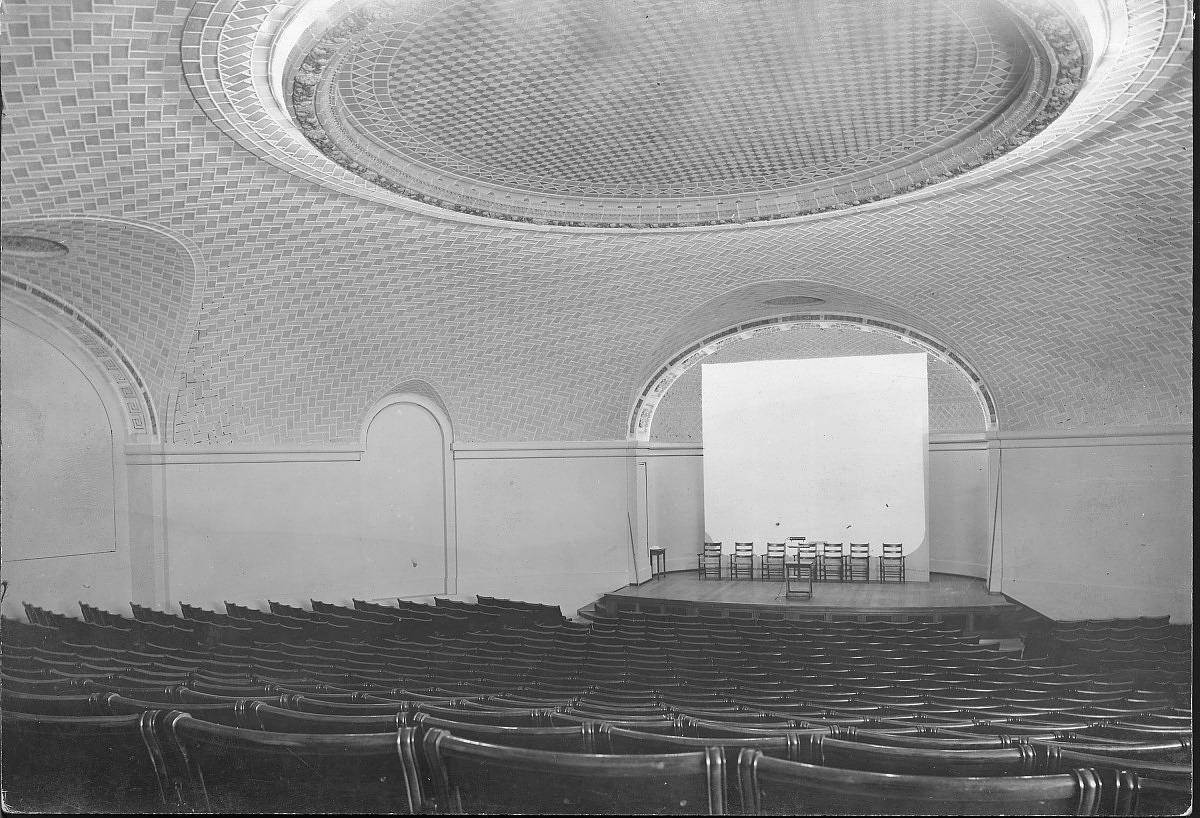
On April 26, 1920, Harlow Shapley of Mount Wilson Observatory and Heber Curtis of Lick Observatory held a public debate at the Smithsonian Museum of Natural History. In two back-to-back 40-minute presentations, the pair offered their respective explanations of the size and nature of the Milky Way: Shapley was certain that the Milky Way was enormous – roughly 300,000 light-years across – so large, in fact, that it must be the entirety of the universe. He also argued that our solar system was located far from the center of the galaxy, and that “spiral nebulae” were merely gas clouds in the Milky Way.
On the other hand, Curtis believed the Milky Way was, in keeping with the models standard at the time, smaller (30,000 light-years across) and centered on the Sun. But he firmly believed that spiral nebulae were “island universes” – i.e., galaxies outside the Milky Way, meaning the Milky Way was not the entirety of the universe.
Both men were, of course, a little right and a little wrong. Shapley was correct in his belief that the Milky Way was far larger than had been imagined, and that our solar system was not its center. But Curtis was correct in his assertion that the Milky Way was not the only galaxy, and in the nature of spiral nebulae. A few years later, Edwin Hubble would discover Cepheid variables in the Andromeda Galaxy and definitively prove the “island universes” theory, putting the Great Debate to rest.