Astronomers typically describe the cosmos with numbers that are, well, astronomical. They measure distances within our galaxy in light-years, where 1 light-year equals 5.9 trillion miles (9.5 trillion kilometers), while other galaxies lie millions or even billions of light-years away. And stars typically live billions of years within a universe some 13.7 billion years old.
But these enormous numbers obscure the remarkable pace at which some events transpire. For example, it takes no more than a few million years for micron-sized dust grains to grow into planets thousands of miles across. Scientists don’t fully understand how this happens so quickly, though evidence abounds that it has occurred not only in our solar system but also around most of our galaxy’s stars.
An edge-on view
A big part of the problem stems from the dust and gas that permeate the protoplanetary disks where the action takes place. This material obscures our view of the process, particularly in visible light. But the infrared-sensitive James Webb Space Telescope (JWST) provides a better perspective as well as superb resolution.
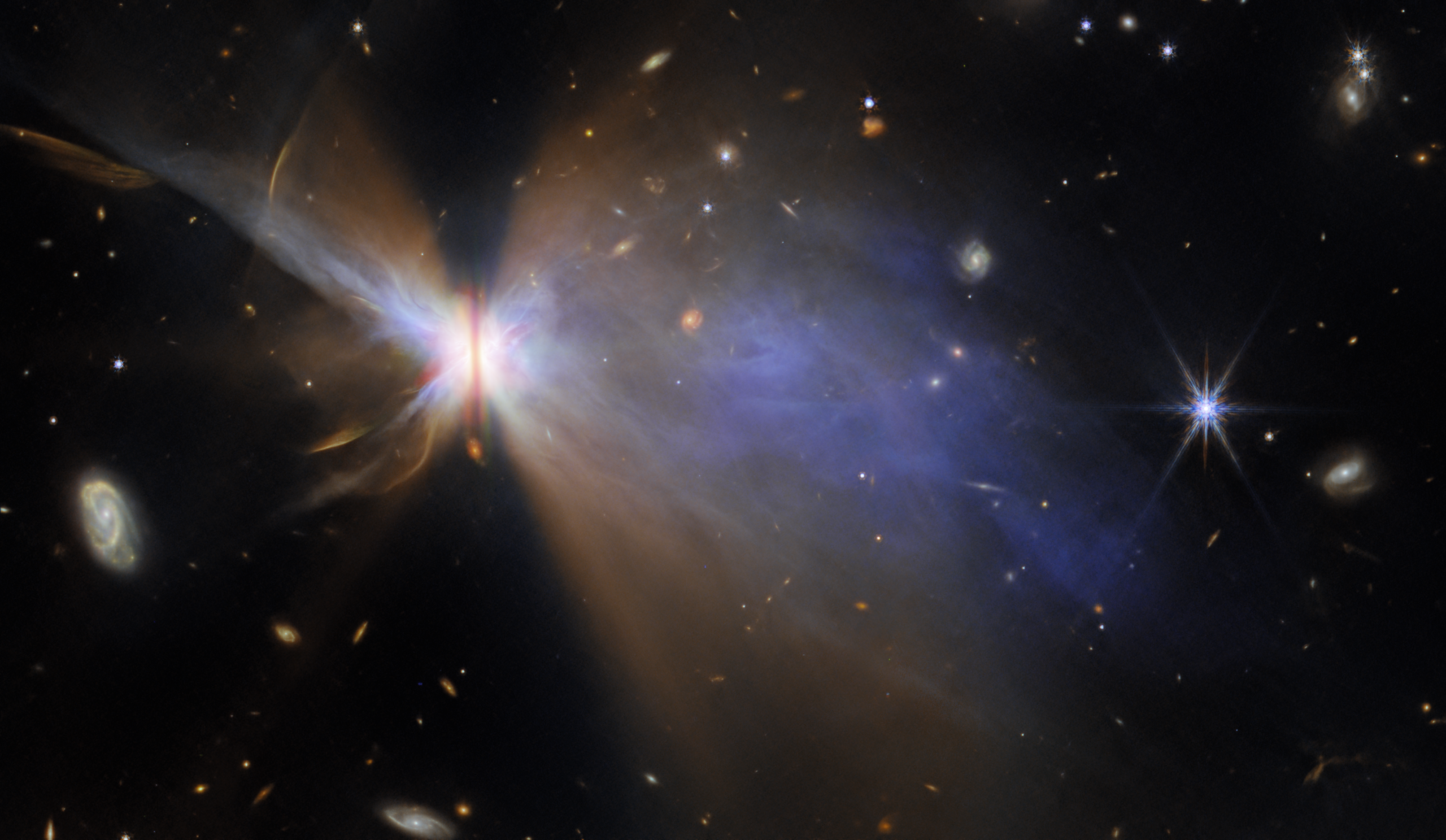
Astrophysicist Marion Villenave at Caltech’s Jet Propulsion Laboratory in Pasadena, California, led a team of researchers who used JWST to image the protoplanetary disk that surrounds the young star IRAS 04302+2247. They chose this object because it appears edge-on from our point of view. While a face-on system may reveal rings and gaps that indicate the presence of nascent planets, an edge-on structure shows the disk’s thickness, which helps measure the density of dust and the efficiency with which it can form planets.
IRAS 04302+2247 lies about 525 light-years from Earth in L1536, a dark cloud in the Taurus star-forming region. The star itself — hidden by the dust — weighs 1.6 solar masses. It shows the hallmarks of a Class 1 protostar, one at an intermediate stage that appears especially bright at infrared wavelengths but whose gaseous envelope has started to disperse.
The scientists viewed the object with both the Near-InfraRed Camera (NIRCam) and the Mid-InfraRed Instrument (MIRI) at five wavelengths ranging from 2.0 to 21 microns. To create the image at left, they added near-infrared observations from Hubble.
The dark vertical slash running through the center of the glowing gas at left marks the protoplanetary disk. The disk’s width doesn’t change much with wavelength, suggesting that it consists of intermediate-sized grains some 10 microns in diameter. It extends about 40 billion miles (65 billion km), more than five times the diameter of Neptune’s orbit around the Sun. On each side of the disk lies a reflection nebula consisting of dust grains that reflect light from the central protostar.
A changing perspective
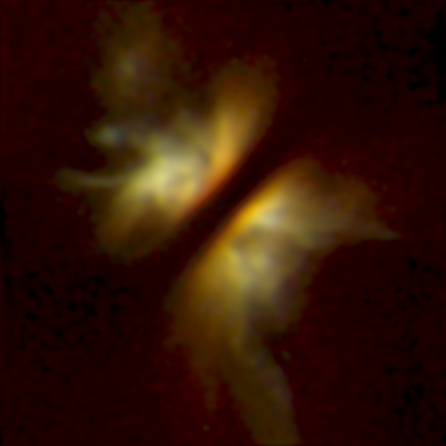
Intriguingly, the research team notes that the intensity of the two nebulae changes with wavelength. At shorter infrared wavelengths, the eastern side (at right) glows brighter, but the western section wins out at 21 microns. The scientists think the discrepancy arises because the disk’s inner region tilts slightly relative to the rest of the structure.
The astronomers also compared the JWST images to those Hubble took some 25 years earlier and found one feature that had moved about 16 astronomical units between the two eras. (One astronomical unit, or AU, is the average Earth-Sun distance of 93 million miles [150 million km].) They suspect this represents a dust knot that has been moving away from the protostar at some 6,700 mph (10,800 km/h).