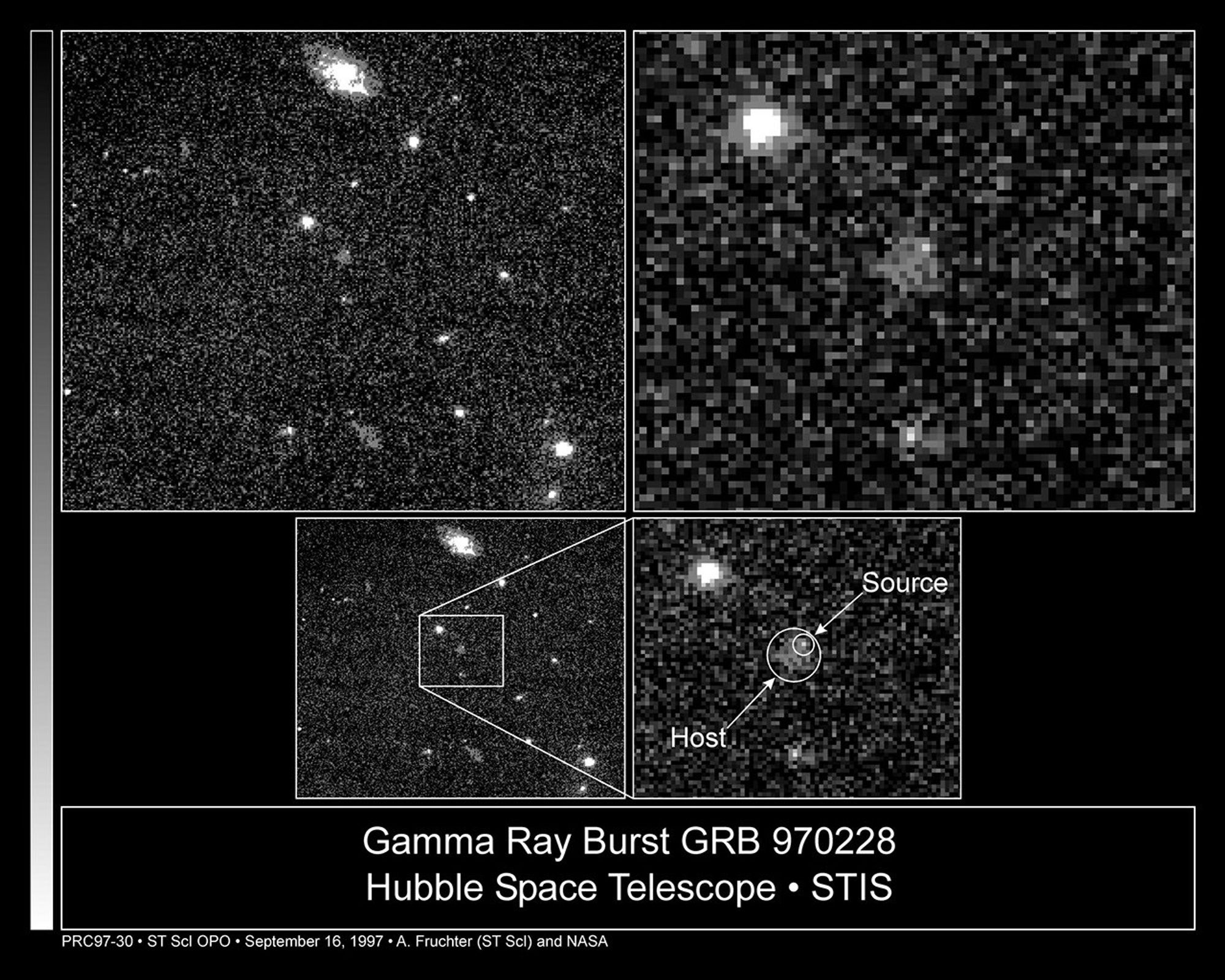
On Feb. 28, 1997, the Gamma Ray Burst Monitor on the Italian-Dutch Satellite BeppoSAX detected GRB 970228. The gamma ray burst (GRB) lasted about 80 seconds. BeppoSAX’s rapid determination of its position allowed multiple other observatories to quickly begin campaigns in multiple wavelengths.
On March 27, the Hubble Space Telescope began observing GRB 970228 and, later that year, was able to separate the light from the GRB’s host galaxy from the fading light of the explosion itself. The object was not moving against its galaxy background, meaning it was not nearby. Looking for and finding that afterglow – a first in astronomy – had allowed astronomers to determine the GRB’s location at the edge of a distant galaxy and lay to rest the long-standing debate about whether GRBs occurred within the Milky Way or beyond it.