
Sky This Week is brought to you in part by Celestron.
Friday, January 9
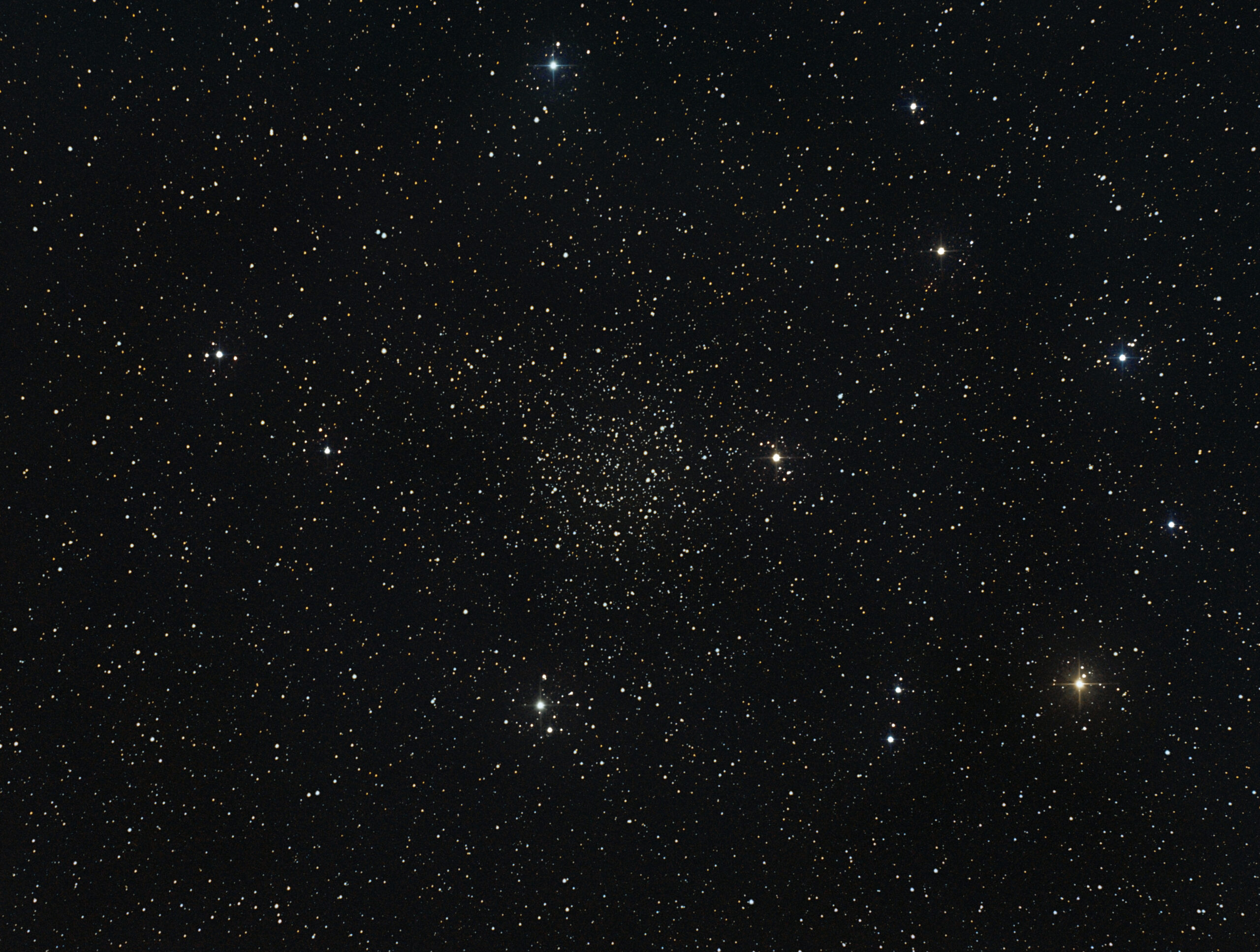
Cygnus may be sinking toward the horizon a few hours after sunset, but there’s still a bit of time to glimpse some of this constellation’s many treasures. Today let’s try for M39, a loose open cluster in the northeastern reaches of the Swan.
Cygnus’ alpha star, Deneb, is still nearly 20° above the northwestern horizon at 8 P.M. local time. M39 is about 9.2° above this star, almost due east of it on the sky. This cluster covers about the same diameter as the Full Moon on the sky, so when using optical aid to view it, you’ll want to opt for lower powers. It looks great in binoculars and small amateur scopes. Its brightest sun is magnitude 6.8, but together the stars shine collectively around 5th magnitude, rendering the cluster as a whole visible to sharp-eyed observers.
M39 contains some 30 confirmed member stars. Although its age is uncertain, the cluster is likely around 270 million years old.
Sunrise: 7:20 A.M.
Sunset: 5:01 P.M.
Moonrise: 6:05 A.M.
Moonset: 2:48 P.M.
Moon Phase: Waning crescent (3%)
*Times for sunrise, sunset, moonrise, and moonset are given in local time from 40° N 90° W. The Moon’s illumination is given at 10 P.M. local time from the same location.
Saturday, January 17
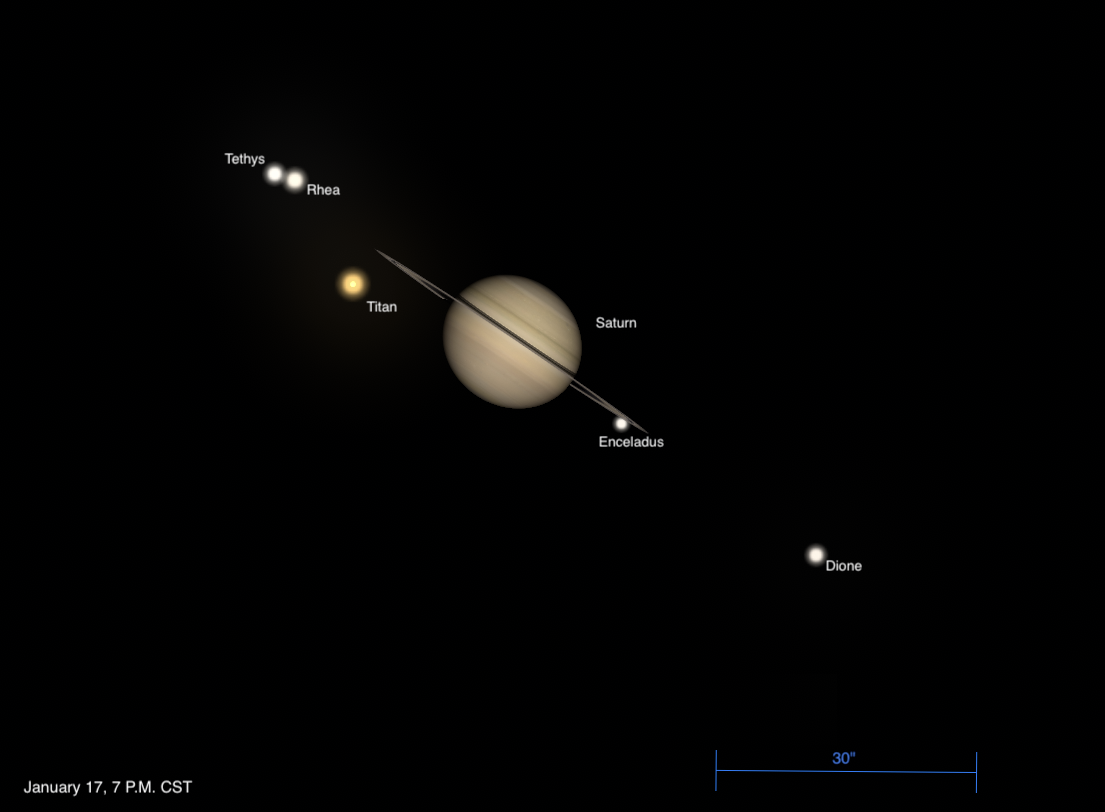
Saturn’s largest moon, Titan, is also its brightest. Shining at mid-8th-magnitude, Titan is located near the disk of the ringed planet tonight, making it easy to find.
You can spot Saturn roughly 30° high in the southwestern sky two hours after sunset this evening. It’s an easy object to pick out, shining brighter than any stars in this region. To find Titan, turn a telescope on the ringed planet. Without our own moon in the evening sky, the background sky is dark enough that you may see several of Saturn’s satellites in the eyepiece.
The brightest is Titan, which today sits just southeast of the planet, about 20” from the center of the disk all night. A few fainter moons are also visible around Saturn, though their locations may change throughout the night. Around 7 P.M. CST, 10th-magnitude Tethys and Rhea lie close to each other off the eastern edge of the rings, while similarly bright Dione is west of the rings. The chart above shows the moons’ positions at this time.
Larger scopes may also be able to pick up 12th-magnitude Enceladus, which is just south of the rings on the western side of the planet at this time.
Sunrise: 7:19 A.M.
Sunset: 5:02 P.M.
Moonrise: 6:52 A.M.
Moonset: 3:49 P.M.
Moon Phase: Waning crescent (1%)
Sunday, January 18
New Moon occurs at 2:52 P.M. EST.
The moonless sky this week is the perfect time to enjoy deep-sky observing; tonight our target is the open cluster NGC 7789. It is also called Caroline’s Rose for its discoverer, Caroline Herschel, who first spotted it in 1783.
Shining at magnitude 6.7, you’ll find this young cluster of stars in the north near Caph (Beta [β] Cassiopeiae) in Cassiopeia the Queen. From 2nd-magnitude Caph, which appears closest to the ground in the upside-down M shape of the Queen around 9 P.M. local time tonight, NGC 7789 is a short jump to the lower left, about 2.9° south-southwest of the star.
Spanning about 16’ on the sky, NGC 7789 gets its common name from the way the stars within it appear to form loops in between areas of darkness, looking like the curving petals of a rose as viewed from, above. Although still young, these stars are more than 1 billion years old, making Caroline’s Rose one of the older open clusters in our Milky Way Galaxy.
Sunrise: 7:19 A.M.
Sunset: 5:03 P.M.
Moonrise: 7:32 A.M.
Moonset: 4:54 P.M.
Moon Phase: New
Monday, January 19
Our dark skies continue and tonight we’re visiting a classic: the first object on Messier’s list, the Crab Nebula (M1). Located in Taurus, this well-known supernova remnant is perfectly placed for viewing in the January evening sky.
Around 9 P.M., the V-shape of Taurus the Bull is high in the south. We are looking for the star marking the tip of the Bull’s southeastern (lower) horn, 3rd-magnitude Zeta (ζ) Tauri. From this star, it’s a very short 1.1° journey northwest to M1, making this object quite easy to find!
The trick is that M1 is also faint, requiring binoculars or a telescope to spot at magnitude 8.4. Through your optics, it will likely look like an oval-shaped gray smudge against the darker background sky. This is the glowing, expanding gas left over from the explosion of a massive star, which ended its life in a supernova seen in Earth’s skies on July 4, 1054. The glow remained visible to the naked eye during the day for nearly a month, and shone in the sky for almost two years before fading from view. Today, we know the remnant houses a pulsar — the rapidly spinning leftover core of the progenitor star — and we have even seen the gas of the nebula expanding into space over time.
While the nebula is visible in most scopes, the largest amateur instruments may also be able to pick up the 16th-magnitude pulsar at its center, though a planetarium program or star chart is essential to ensure you’re identifying the correct faint point of light.
Sunrise: 7:18 A.M.
Sunset: 5:04 P.M.
Moonrise: 8:05 A.M.
Moonset: 6:01 P.M.
Moon Phase: Waxing crescent (2%)
Tuesday, January 20
Comet C/2024 E1 (Wierzchoś) reaches perihelion, the closest point to the Sun in its orbit, today — though it is currently visible only in the Southern Hemisphere in the constellation Microscopium. Last reported around magnitude 8, it is not apparent to the naked eye but should show up in optics and astrophotos.
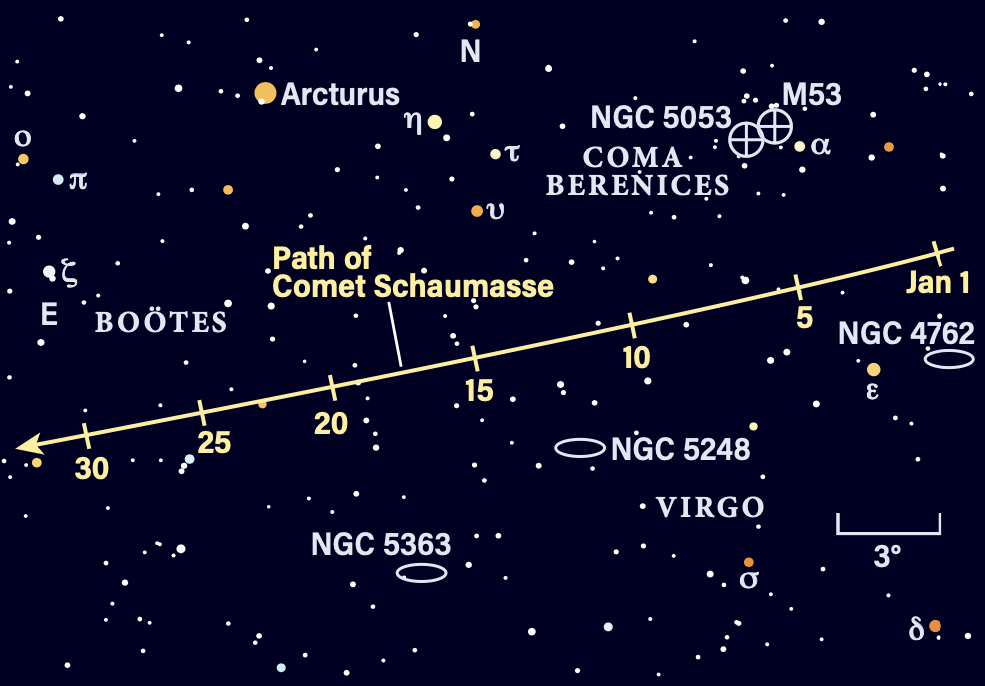
In the Northern Hemisphere, Comet 24P/Schaumasse is roughly 10th magnitude, also requiring optics or photography to bring it out. Rising shortly before local midnight, Schaumasse is best seen in the early-morning hours — and with no Moon in the sky, it’s a great time to look for it in southern Boötes, not far from the bright star Arcturus.
Let’s use that magnitude –0.1 luminary as our jumping-off point today. Around 4 A.M. local time, Arcturus is readily visible some 55° high in the east. Center your optics on this star, then drop about 9° south-southwest to land on Schaumasse.
Given the moonless sky, you might try observing a few nearby galaxies as well. Check out the chart above to help you find NGC 5363 and NGC 5248. Both sine at magnitude 10.2, roughly the same brightness as the comet. NGC 5363 is a lenticular galaxy in Virgo, located some 6.3° southwest of Schaumasse this morning. NGC 5248 is a spiral in Boötes, lying about 8° west of Schaumasse today. Consider the appearance of both galaxies relative to each other as well as the comet — how do they all compare?
Sunrise: 7:18 A.M.
Sunset: 5:05 P.M.
Moonrise: 8:33 A.M.
Moonset: 7:09 P.M.
Moon Phase: Waxing crescent (6%)
Wednesday, January 21
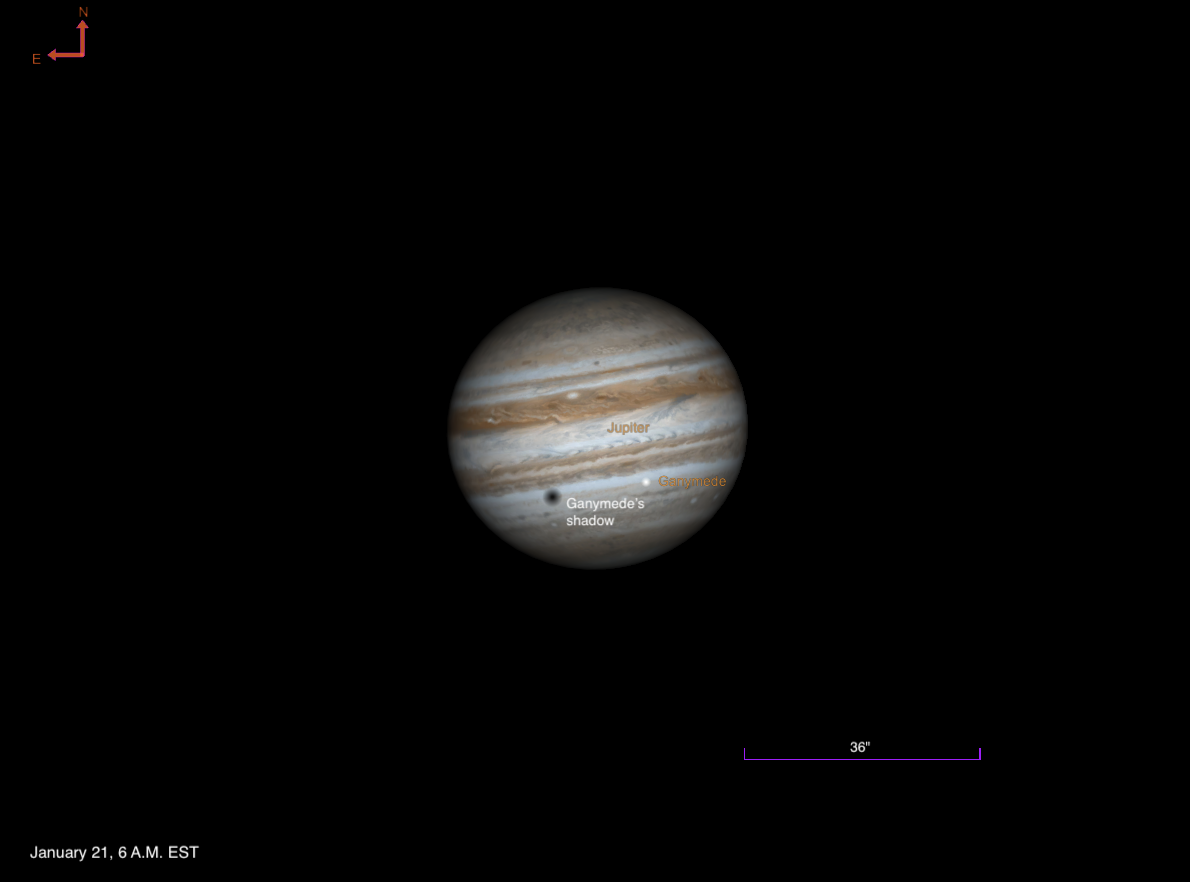
Ganymede transits the face of Jupiter this morning, trailed by its large shadow. The event starts just before 4 A.M. EST, as Jupiter is slowly setting in the west for much of the U.S. (The planet is still high in the southwest for those on the Pacific Coast, who will have the best views of the entire transit.)
Jupiter hangs beneath the bright star Pollux in Gemini — in fact, the gas giant outshines the star, making it the brightest point of light in the Twins by far. Train your telescope on Jupiter and you’ll see that before the transit starts, all four Galilean moons are lined up on the planet’s eastern side. Callisto is farthest away, with Europa slightly closer, followed by Io; Ganymede sits closest to the planet’s southeastern limb. Ganymede begins to transit at 3:51 A.M. EST, moving from east to west across the large world’s face. It takes more than an hour for its shadow to appear, around 4:58 A.M. EST, as Ganymede is nearing the halfway point in its journey.
Ganymede’s transit ends shortly after 6 A.M. CST, with the planet only 5° high in the Midwest and only about an hour to go before sunrise there as well. The shadow finally disappears from Jupiter’s southwestern limb around 6:20 MST, visible only in the western half of the U.S. (and again, best seen from the West Coast).
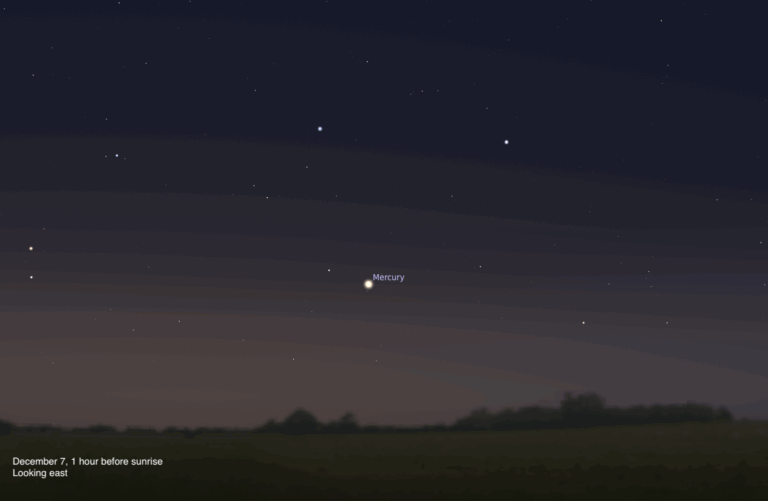
Mercury reaches superior conjunction at 11 A.M. EST. It is currently invisible to us here on Earth, but will reappear in the morning sky early next month.
Sunrise: 7:17 A.M.
Sunset: 5:06 P.M.
Moonrise: 8:58 A.M.
Moonset: 8:16 P.M.
Moon Phase: Waxing crescent (11%)
Thursday, January 22
Let’s continue taking advantage of the dark window before the crescent Moon rises to explore the Rosette Nebula, also cataloged as NGC 2237. This gorgeous sight is made up of a central open star cluster surrounded by dusty, star-forming clouds, all located about 5,200 light-years away in the constellation Monoceros. If you aren’t familiar with this constellation, don’t worry — it’s easy to find, located just to the east of Orion and his famous three-star belt.
By 8 P.M. local time, Orion’s Belt is already more than 40° above the southeastern horizon. Below it sparkles Sirius, the brightest star in the sky. Look to the lower left of Orion’s Belt and to the upper left of Sirius — that’s the constellation Monoceros. The Rosette Nebula is located in its northwestern region, about 9° east of the bright red giant star Betelgeuse, which marks Orion’s shoulder and sits to the upper left of the belt as Orion rises tonight.
The open cluster at the center of the Rosette is NGC 2244. At 5th magnitude, it’s the easiest part of this complex to see, apparent in any telescope. To view the nebular regions around it, you’ll want to try adding a nebula filter to suppress the stars and bring out the glowing gas, as well as a low-power eyepiece to give you a larger field of view around the central cluster.
Sunrise: 7:16 A.M.
Sunset: 5:07 P.M.
Moonrise: 9:21 A.M.
Moonset: 9:24 P.M.
Moon Phase: Waxing crescent (19%)
Friday, January 23
Pluto is in conjunction with the Sun at 5 A.M. EST this morning.
The Moon passes 4° north of Saturn at 8 A.M. EST, then passes 4° north of Neptune at 11 A.M. EST. The trio stands in the southwestern sky this evening and remains visible for several hours after sunset. Around 6:30 P.M. local time, they are roughly 40° high — still far enough above the horizon that you have a good chance to catch Neptune before it sinks into the turbulent air near the ground.
First-magnitude Saturn is easy to spot below the crescent Moon — it’s brighter than any star in this part of the sky. The pair is lovely to observe by eye, but a telescope will show Saturn’s full beauty: its stunning ring system, stretching 37” from end to end and tilted just under 2° to our line of sight. Look also for Titan — the planet’s largest and brightest moon — shining around magnitude 8.5 some 1.7’ east of Saturn’s center and having moved from its position nearer the ringed world earlier this week.
Neptune — only visible in binoculars or a telescope — lies 2.2° northeast of Saturn, roughly ⅓ of the distance along a line drawn from the ringed planet toward the Moon. The faraway ice giant spans only 2” on the sky and shines at magnitude 7.8. It will appear as a “flat” bluish-gray star in the eyepiece.
Asteroid 44 Nysa reaches opposition at noon EST. We’ll observe this main-belt world, currently in Cancer and also visible in the evening sky, in next week’s column.
Sunrise: 7:16 A.M.
Sunset: 5:09 P.M.
Moonrise: 9:43 A.M.
Moonset: 10:31 P.M.
Moon Phase: Waxing crescent (28%)