
Key Takeaways:
- The vast majority of stars form and reside within galaxies due to the presence of cold, dense molecular gas clouds conducive to star formation.
- True intergalactic space, characterized by low-density and warm gas, is largely devoid of stars as it lacks the conditions necessary for stellar birth.
- However, stars can be gravitationally stripped from galaxies during collisions, contributing to tidal tails and forming intracluster light within galaxy clusters.
- Stars can also be ejected from galaxies at high velocities through interactions with supermassive black holes, particularly binary systems, at galactic centers.
Do all stars exist in galaxies, or do some exist in intergalactic space?
Thomas Griffilth
Atlantic City, New Jersey
Nearly all stars are found inside or around galaxies, because that’s where the conditions are right for stars to form. Within galaxies, stars form inside cold, dense molecular gas clouds like those found in the spiral arms of our Milky Way. In the voids between galaxies, the gas is much lower in density and too warm to form stars, so true intergalactic space has very few stars in it.
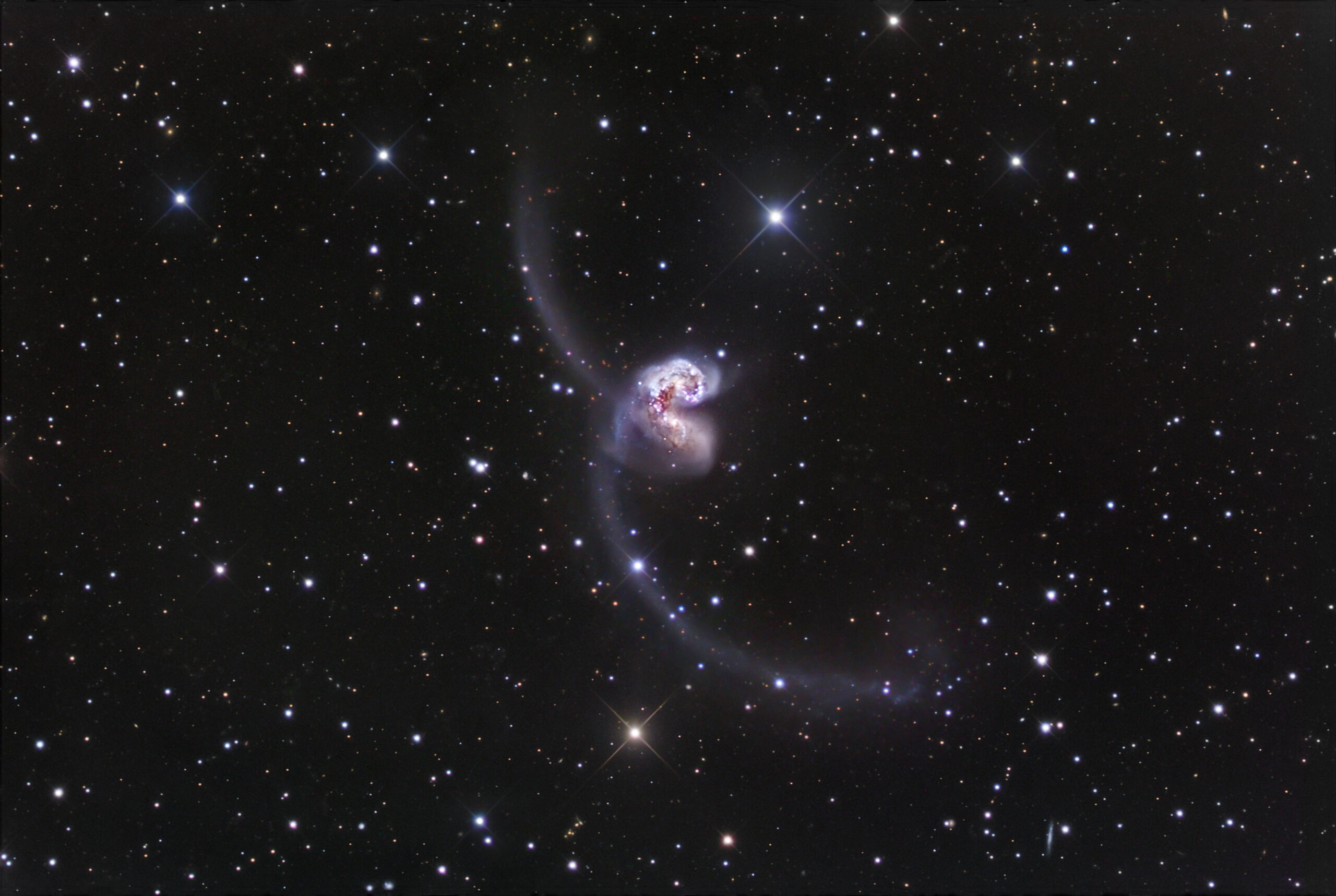
But there are a few ways for stars to get out of galaxies and into intergalactic space. One way is through galaxy collisions, where gravitational forces can strip stars out of galaxies and fling them out into space in long streams called tidal tails. Such collisions are frequent inside galaxy clusters, where the effects of many galaxy collisions plus the intense gravitational pull of the cluster as a whole can combine to strip many stars out of galaxies and into the space between the galaxies in the cluster. These orphaned stars make up what astronomers call the intracluster light, which might hold 20 percent or more of the total starlight in a giant galaxy cluster.
Another way stars can get out of galaxies is through being ejected by a supermassive black hole at the center of a galaxy. In this scenario, a binary star system passes too close to the black hole and in a complex gravitational dance, one of the stars is captured by the black hole and the other is ejected at very high speed and can escape its parent galaxy. We see examples of high-velocity stars leaving our own Milky Way Galaxy this way, and it’s even possible that some of the stars passing through the Milky Way may have been ejected by our neighboring Andromeda Galaxy. And some galaxies may have binary supermassive black holes in their nuclei, which can eject even more stars from their host galaxy.
So, even though they don’t form far outside galaxies, there are a variety of ways that stars can be ejected from their home galaxy, meaning that intergalactic space isn’t completely devoid of them.
Chris Mihos
Warner Professor of Astronomy, Case Western Reserve University, Cleveland, Ohio