
Key Takeaways:
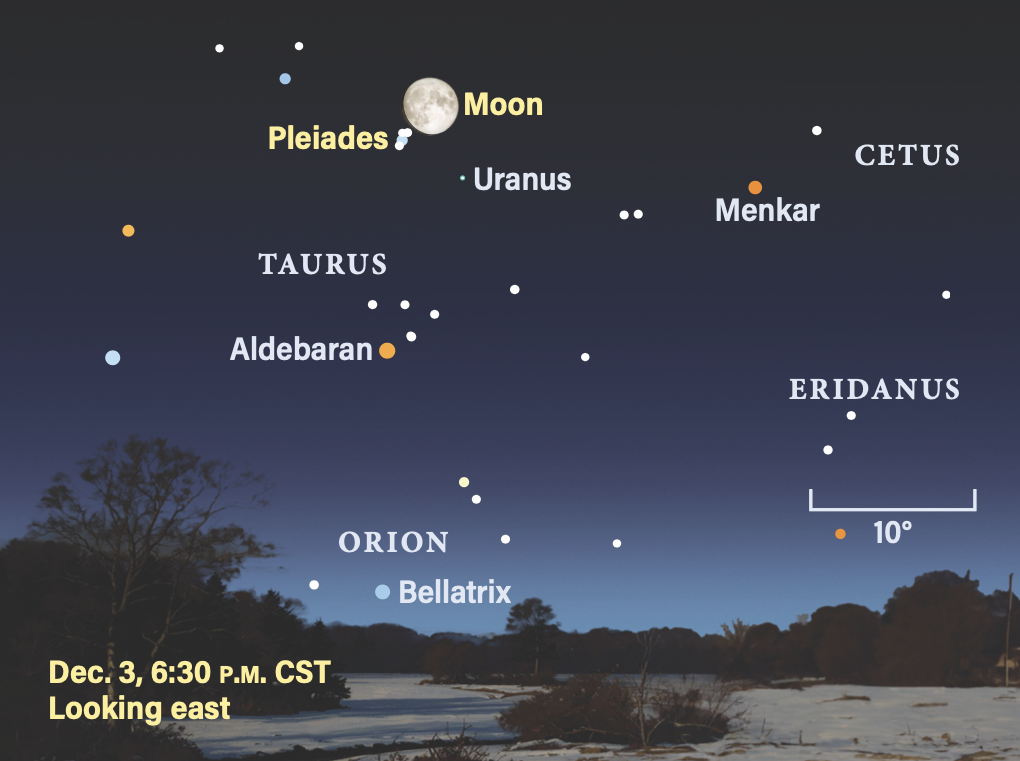
- On December 2, a nearly Full Moon is scheduled to pass 5° north of Uranus within the constellation Taurus at 10 P.M. EST.
- Concurrently, a lunar occultation of several stars in the Pleiades cluster (M45) will occur between approximately 7 P.M. and 9:30 P.M. CST, observable from North America, Greenland, and parts of Europe.
- Specific stars projected for occultation include magnitude 3.7 Electra (17 Tauri), magnitude 4.3 Taygeta (19 Tau), and magnitude 3.9 Maia (20 Tau), with binoculars or a telescope recommended for observation.
- Uranus, situated approximately 4.5° south of the Pleiades, will require optical aid for detection, potentially facing observational challenges due to the proximity of the bright Moon.
Looking for a sky event this week? Check out our full Sky This Week column.
December 2: Visit the Winter Albireo
The Moon passes 5° north of Uranus in the constellation Taurus at 10 P.M. EST; before that, though, a nearly Full Moon passes in front of several stars in the Pleiades star cluster (M45), occulting them for observers in North America, Greenland, and parts of Europe. The entire event takes place between about 7 P.M. and 9:30 P.M. CST, with at least some disappearances and reappearances visible across the U.S.
By the time darkness falls, the Pleiades and the Moon should be visible close together in the eastern sky. The first bright star in the cluster to disappear behind our satellite is magnitude 3.7 Electra (17 Tauri), which vanishes behind the dark leading edge of the Moon just after 7 P.M. CST. Other stars, including magnitude 4.3 Taygeta (19 Tau) and magnitude 3.9 Maia (20 Tau), follow. To watch the event, you’ll want binoculars or a telescope — the latter is best. Bump up the magnification to really zoom in on the Moon’s leading edge, which will cut more of the bright, blinding Moon out of your field of view and let you focus on its approach to each star.
For details on the exact timing of disappearances and reappearances from your location, visit the International Occultation Timing Association’s website for lunar occultations here and scroll down to the December 4 events (all times are given in Universal Time).
Uranus, now just past opposition, still lies about 4.5° south of the Pleiades. It is not far from a pair of similarly bright 6th-magnitude stars, 13 and 14 Tau, just 0.4° east of the latter. You’ll need binoculars or a telescope to spot the planet, and may find it challenging with the bright Moon nearby.
Sunrise: 7:05 A.M.
Sunset: 4:35 P.M.
Moonrise: 3:13 P.M.
Moonset: 5:36 A.M.
Moon Phase: Waxing gibbous (99%)
*Times for sunrise, sunset, moonrise, and moonset are given in local time from 40° N 90° W. The Moon’s illumination is given at 10 P.M. local time from the same location.