Looking for a sky event this week? Check out our full Sky This Week column.
November 15: Ceres passes a double star
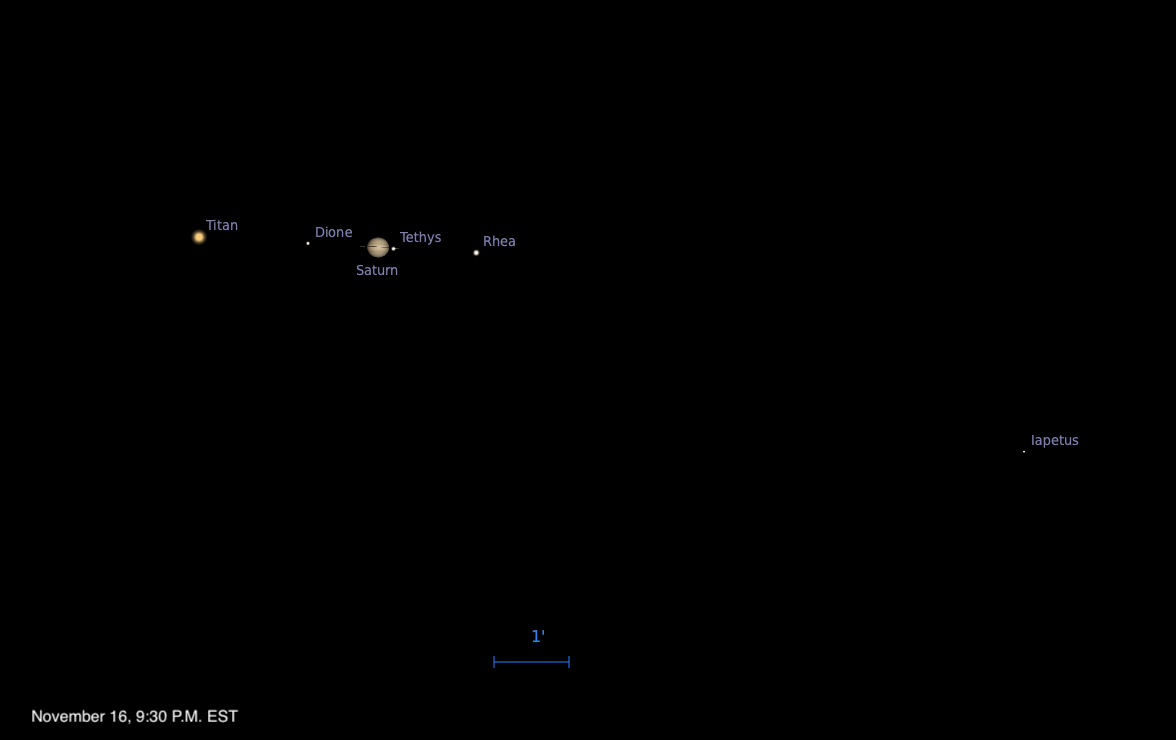
Saturn’s moon Iapetus reaches western elongation today, when it is at its brightest. Now around 10th magnitude, you can find Iapetus some 10’ west of Saturn.
The ringed planet is already above the horizon as the Sun sets; two hours later it is 40° high in the south, hanging below the Circlet of Pisces. It’s the brightest light in this part of the sky, shining at magnitude 0.8. Don’t confuse it with slightly fainter magnitude 1.2 Fomalhaut, which lies much closer to the horizon to Saturn’s lower right.
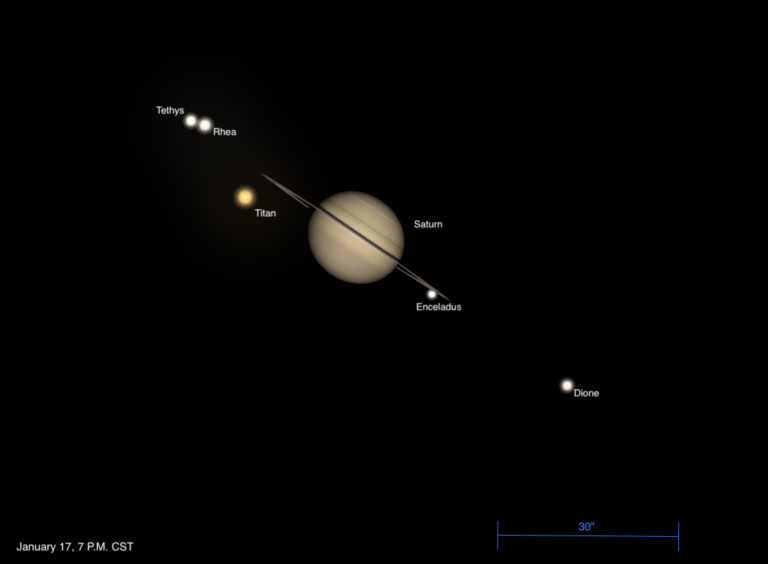
Zoom in on Saturn with a telescope to view its brighter moons. Easiest to find is mid-8th-magnitude Titan, which lies some 2.3’ east of Saturn this evening. Closer to Saturn, 10th-magnitude Dione, Rhea, and Tethys may also be visible, depending on when you look. Dione lies just east of Saturn, while Rhea is just to the west. Tethys is transiting the planet — likely invisible to visual observers — for three hours, between roughly 6 P.M. to 9 P.M. EST. Before this, it is visible close to Saturn’s eastern limb; afterward, it can be seen moving away from the planet’s western limb.
Iapetus is roughly the same magnitude as these three fainter moons, but much farther from the planet. It lies 10’ to the planet’s west. There is a slightly fainter 11th-magnitude field star just 5’ farther west than Iapetus, so make note not to confuse the two. Of the two, Iapetus is slightly brighter and closer to Saturn.
Sunrise: 6:47 A.M.
Sunset: 4:42 P.M.
Moonrise: 3:21 A.M.
Moonset: 2:43 P.M.
Moon Phase: Waning crescent (9%)
*Times for sunrise, sunset, moonrise, and moonset are given in local time from 40° N 90° W. The Moon’s illumination is given at 10 P.M. local time from the same location.
The Moon passes 1.2° south of Spica at 6 A.M. EST. The pair is visible in the early-morning sky before sunrise, our Moon now a delicate crescent with just 7 percent of its nearside illuminated by the Sun. If you step outside at 6 A.M. local time, you’ll also catch bright Venus to the lower left of the pair, just a bit more than 2° above the eastern horizon in Libra.
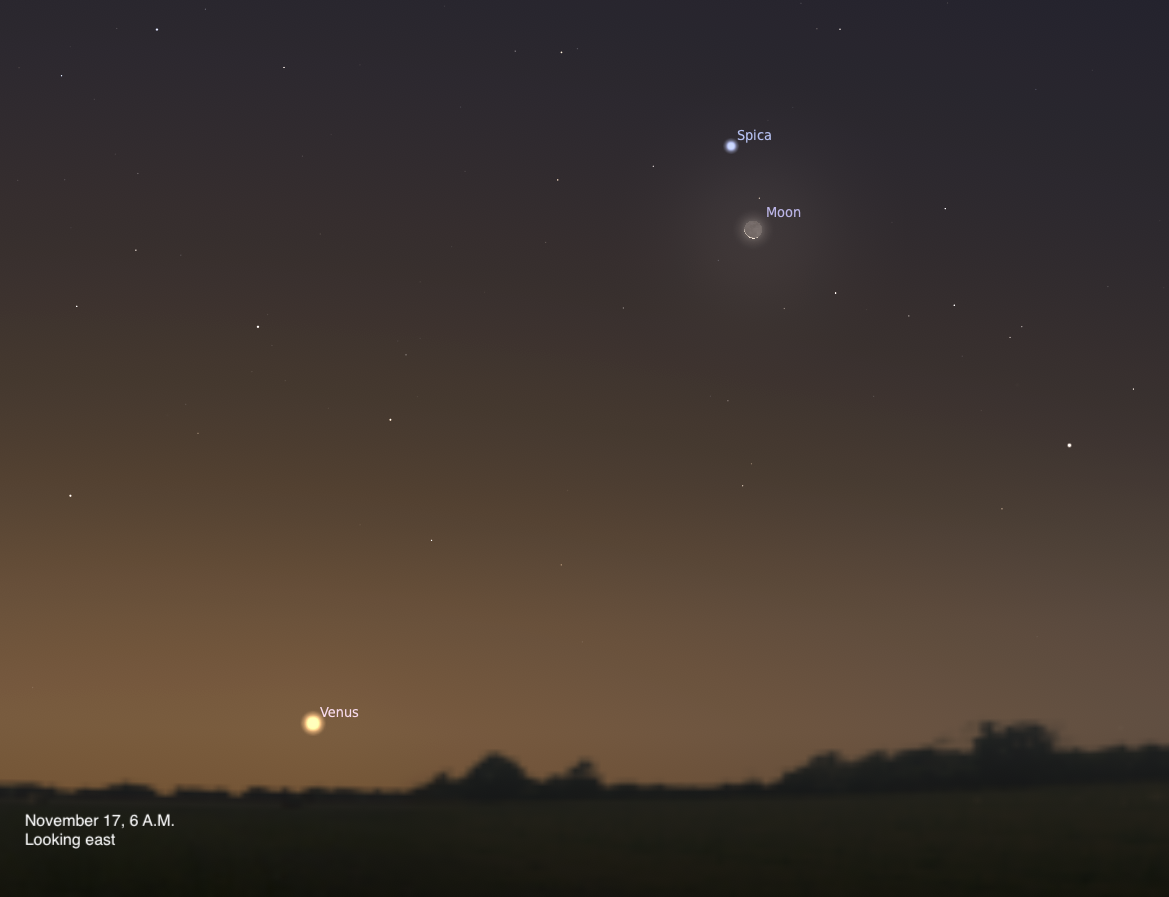
Pull out a telescope and you’ll see that Venus’ 10”-wide disk is 98 percent lit, looking nearly full. By contrast, the Moon is largely dark, but you can still make out features on the nearside thanks to earthshine, as light from the illuminated Earth lights up the Moon’s shadowed regions. Make sure to put away any optics at least several minutes before sunrise from your location.