
Key Takeaways:
- Merrill's Star (WR 124), a high-velocity Wolf-Rayet star discovered in 1938, possesses one of the highest known radial velocities in the Milky Way, measured at approximately 720,000 km/h.
- This star is encircled by a planetary nebula (M1–67/Sharpless 2–80), which formed an estimated 20,000 years ago due to extreme stellar winds propelling gas at 150,000 km/h and leading to a mass loss of roughly 1/10,000 solar mass annually.
- Based on 2020 Gaia Early Data Release 3, WR 124 is located about 21,000 light-years away and exhibits a luminosity approximately 500,000 times that of the Sun, with a surface temperature of 44,400 °C, a diameter 12 times the Sun's, and a mass equivalent to 20 Suns.
- Spectroscopic studies indicate that WR 124's composition consists of only 15 percent hydrogen, a significant departure from the typical 75 percent hydrogen found in stars like the Sun.
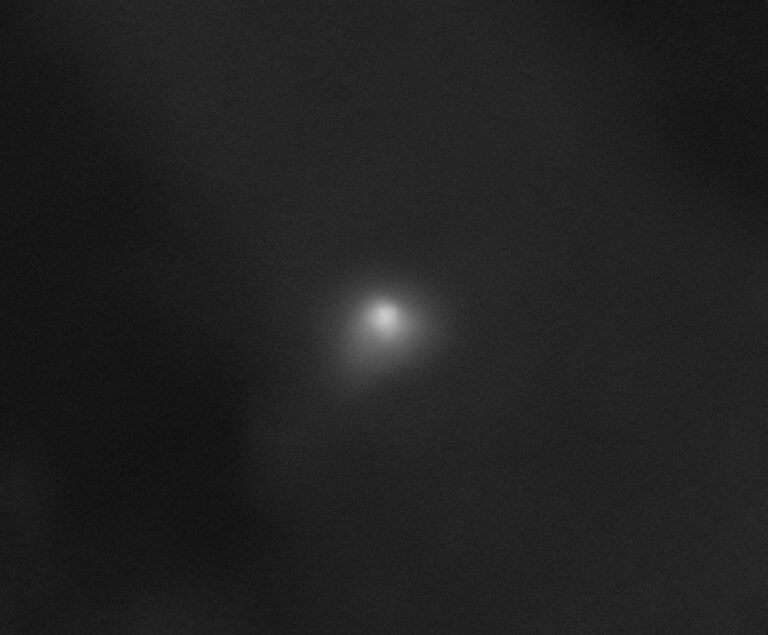
Merrill’s Star is a high-velocity Wolf-Rayet star discovered in the constellation Sagitta the Arrow in 1938 by American astronomer Paul W. Merrill. As a Wolf-Rayet star — a kind of massive star with powerful winds — it carries the designation WR 124. Of stars in the Milky Way, it has one of the highest known radial velocities: about 450,000 mph (720,000 km/h). The star is ever-so-slightly variable (its brightness changes by only 0.08 magnitude), so it’s also called QR Sagittae.
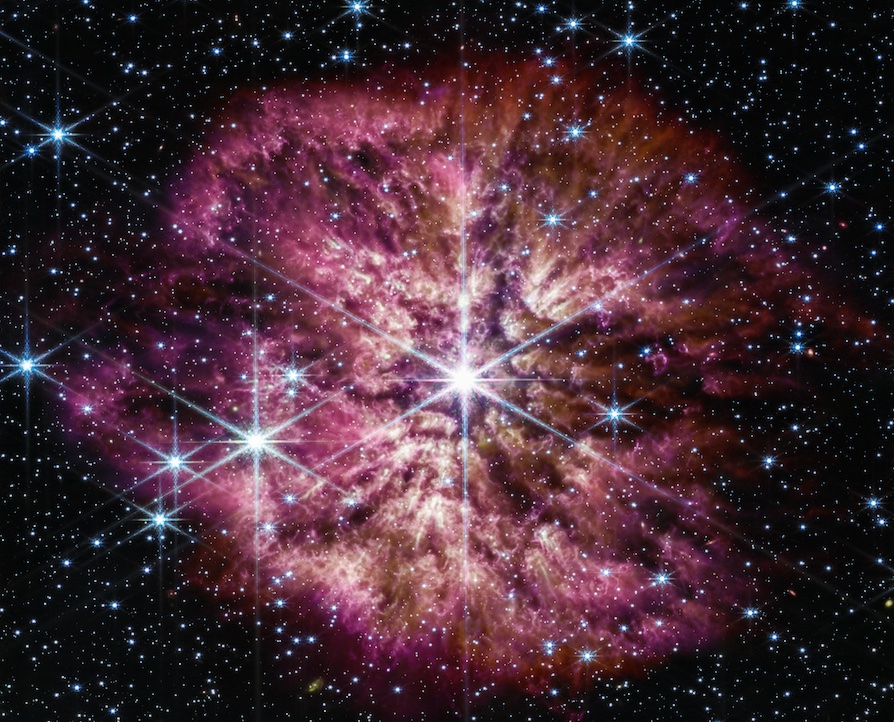
Around the star is a planetary nebula cataloged as M1–67 and Sharpless 2–80. The extreme stellar wind of Merrill’s Star propels the gas outward into space at a speed of 93,000 mph (150,000 km/h). Astronomers estimate that the star is losing about 1/10,000 the mass of the Sun each year. Currently, the diameter of the nebula is 6 light-years. Astronomers think that the planetary nebula formed about 20,000 years ago.
In 2020, the Gaia Early Data Release 3 put the distance to Merrill’s Star at around 21,000 light-years. That would mean that the star is about 500,000 times brighter than the Sun.
The nebula stands out well because WR 124 has a surface temperature of 80,000 degrees Fahrenheit (44,400 degrees Celsius). That means most of its energy is emitted as ultraviolet light, which excites the atoms in the expanding gas cloud. Astronomers think WR 124’s diameter is about 12 times that of the Sun and that it contains a mass equal to roughly 20 Suns.
Spectroscopic study reveals WR 124’s composition is only 15 percent hydrogen. Compare that to our Sun (and, indeed, most of the stars in space), which is made up of 75 percent hydrogen.