Key Takeaways:
- A recent image of Mars' 51-mile (82 km) wide Korolev crater, captured by the European Space Agency’s Mars Express probe, was compiled from five distinct image strips.
- Located in the Martian northern lowlands, Korolev crater harbors a significant reservoir of water ice, reaching depths of nearly 1.1 miles (1.8 kilometers).
- The continuous preservation of this ice is attributed to a "cold trap" phenomenon, wherein a cool, thin layer of air settles over the ice, acting as a thermal shield.
- The crater is named after Sergei Korolev, a prominent Soviet rocket engineer recognized for his leadership in key early space achievements.
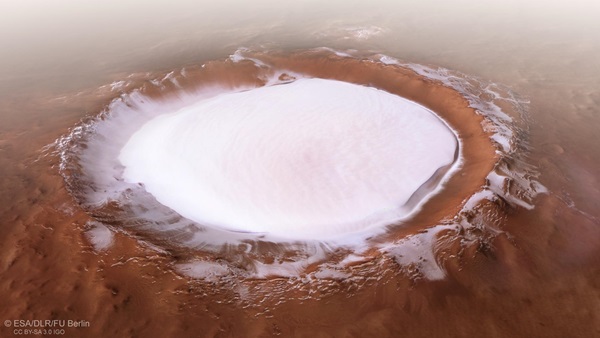
Mars is cold, mostly dry, and a place where liquid water appears only fleetingly. But water ice does exist on the Red Planet, and in the northern lowlands, Korolev crater holds a veritable reservoir nearly 1.1 miles (1.8 kilometers) thick in places.
This remarkable photograph is a combination of five different image strips recombined into one that reveals the 51-mile (82 km) wide crater and its ever-present sheet of ice. Due to the cold trap phenomenon, when the thin air settles over the ice, it cools down and creates a chilly layer that behaves as a shield, keeping Korolev continuously icy.
The pictures that make up this image were recorded by the European Space Agency’s Mars Express orbiter which has been snapping pictures of the Martian surface since 2003.
Korolev is named after the enigmatic rocket engineer Sergei Korolev, whose leadership in the Soviet space program vaulted the country ahead of the United States by launching Sputnik and later Yuri Gargarin into orbit. He spent years as a prisoner in Siberia before being released in 1944 to continue his work in aircraft design. He died in 1966 after complications from a minor operation.