Credit: University of Southampton
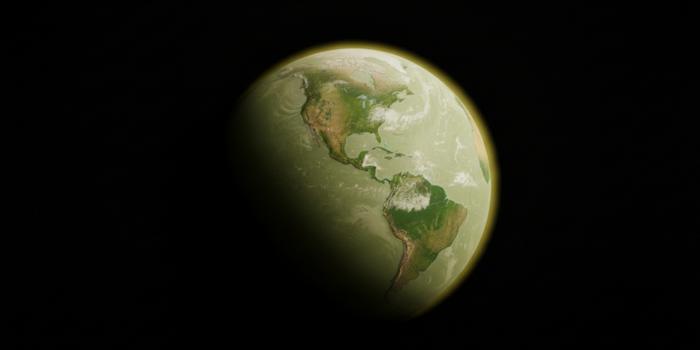
Sixty-six million years ago, Earth was a tropical greenhouse. Today, it’s an ice-capped world. And an international team of experts led by the University of Southampton think they know why. Their new study shows that Earth’s massive drop in temperature after the dinosaurs went extinct could have been caused by a large drop in calcium levels in the ocean.
The study showed that the dramatic calcium shift may have sucked carbon dioxide (CO2) — a major greenhouse gas responsible for global warming — out of the atmosphere, driving global cooling. Lead author David Evans, an ocean and earth scientist from Southampton, said that large changes in the composition of seawater chemistry may have been a key driver for climate change. “Our results show that dissolved calcium levels were twice as high at the start of the Cenozoic Era, shortly after dinosaurs roamed the planet, compared to today.
“When these levels were high, the oceans worked differently, acting to store less carbon in seawater and releasing carbon dioxide into the air. As those levels decreased, CO2 was sucked out of the atmosphere, and the Earth’s temperature followed, dropping our climate by as much as 15 to 20 degrees Celsius (59 to 68 degrees Fahrenheit).”
Lots of data
In addition to the researchers from England, the team consisted of scientists from China, the U.S., Israel, Denmark, Germany, Belgium, and Netherlands. To reconstruct what ocean chemistry was like 66 million years ago, they analyzedfossilized remains of tiny sea creatures, called foraminifera. The data revealed a close link between calcium in seawater and carbon dioxide in the air.
Using computer-made models, the team showed that high levels of calcium change how much carbon is “fixed” by marine life, such as corals and plankton, said Evans. This effectively locked it away from the ocean and atmosphere by storing it in sediments on the seafloor.
As dissolved calcium levels decreased across millions of years, it altered how these organisms created and depositedcalcium carbonate on the seafloor, added co-author Xiaoli Zhou of Tongji University in China. “The process effectively pulls carbon dioxide out of the atmosphere and locks it away. This shift could have changed the composition of the atmosphere, effectively turning down the planet’s thermostat.”
The study also revealed that the drop in calcium closely matched the slowing down of seafloor spreading — the volcanic process that continuously creates new ocean floors. As the rate of seafloor production slowed, the chemical exchange between the rocks and seawater changed, leading to a gradual decline in dissolved calcium concentrations, said co-author Yair Rosenthal from Rutgers University. “Seawater chemistry is typically viewed as something that responds to other factors that lead to changes in our climate, rather than being the cause itself.
“But our new evidence suggests that we must look to changing seawater chemistry to understand our planet’s climate history. It may be that changes in these deep Earth processes are ultimately responsible for much of the large climatic shifts that have taken place over geological time.”