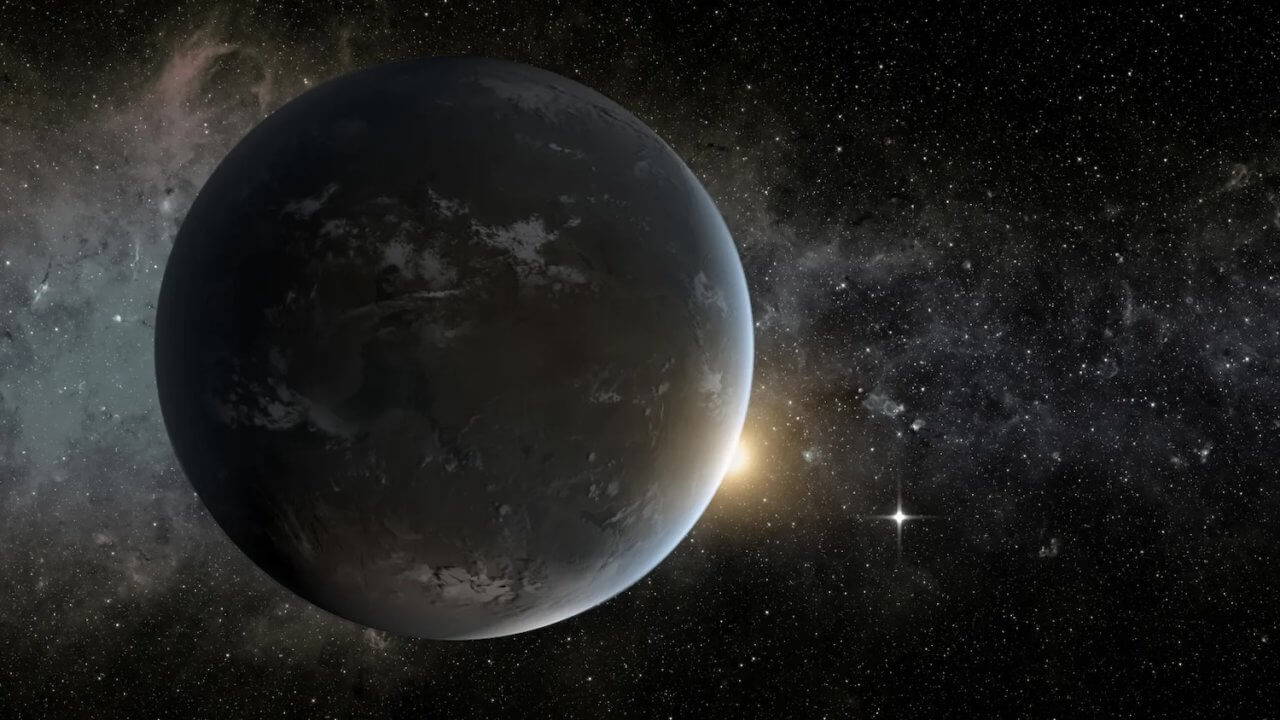
Credit: Courtesy: NASA Ames/JPL-Caltech/Tim Pyle
A new survey led by Sebastián Carrazco-Gaxiola, an astronomy graduate student at Georgia State University, has identified a large number of stars around which Earth-like planets could orbit. Such planets, researchers think, could be places where life might develop. Carrazco-Gaxiola shared the results at the 247th meeting of the American Astronomical Society (AAS), which was held in Phoenix, Arizona, earlier this month.
“This survey marks the first comprehensive look at thousands of the Sun’s lower-mass cousins,” Carrazco-Gaxiola said. “These stars, known as ‘K dwarfs,’ are commonly found throughout space, and they provide a long-term, stable environment for their planetary companions.”
How they did it
Carrazco-Gaxiola’s survey focuses on more than 2,000 K dwarf stars that are closer than 130 light-years to Earth. The observations were made with spectrographs on the SMARTS 60-inch mirror telescope at the Cerro Tololo Interamerican Observatory in Chile and on the same-sized Tillinghast Telescope at the Fred Lawrence Whipple Observatory south of Tucson, Arizona. By using both of these telescopes, Carrazco-Gaxiola and his team were able to identify K-dwarfs in the northern and southern hemispheres of the sky.
“The CHIRON spectrograph on the SMARTS telescope in Chile and the TRES spectrograph on the Tillinghast Telescope in Arizona are such complementary instruments,” said Allyson Bieryla, an astronomer at the Center for Astrophysics | Harvard & Smithsonian. “The power of having these two telescopes in opposite hemispheres is that it gives us access to all the K-dwarfs across the entire sky.”
Why it’s important
K dwarfs are slightly cooler and fainter than the Sun. But there are twice as many K dwarfs as Sun-like stars in our region in space. They also live much longer than Sun-like stars. So any life forms emerging on planets around K dwarfs would have a much greater time span in which to evolve.
When astronomers analyze the survey, they can estimate the stars’ temperatures, ages, rotational speeds, their motions through space, and their magnetic fields. All of these factors are critical to the environments experienced by planets orbiting the stars.
“This survey will be the foundation for studies of nearby stars for decades to come,” said Distinguished University Professor of Physics and Astronomy Todd Henry, who serves as Carrazco-Gaxiola’s adviser and is a senior author on the study. “These stars and their planets will be the destinations for spacecraft exploration in the far future of space travel.”
Carrazco-Gaxiola’s survey, “An All-Sky Spectroscopic Reconnaissance of More Than 2,100 K Dwarfs Within 40 Parsecs Using High-Resolution Spectra,” presented at AAS, featured new, unpublished findings that were selected for their broad scientific interest.