Looking for a sky event this week? Check out our full Sky This Week column.
March 17: Visit M29 in Cygnus
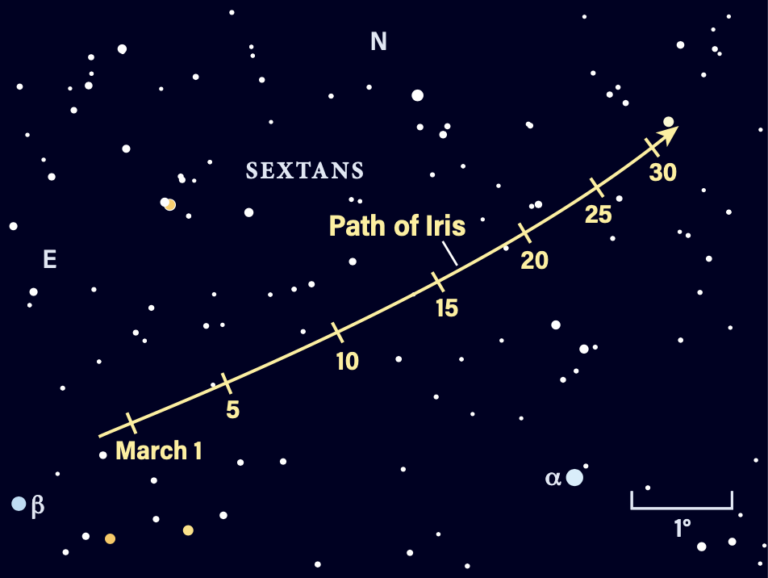
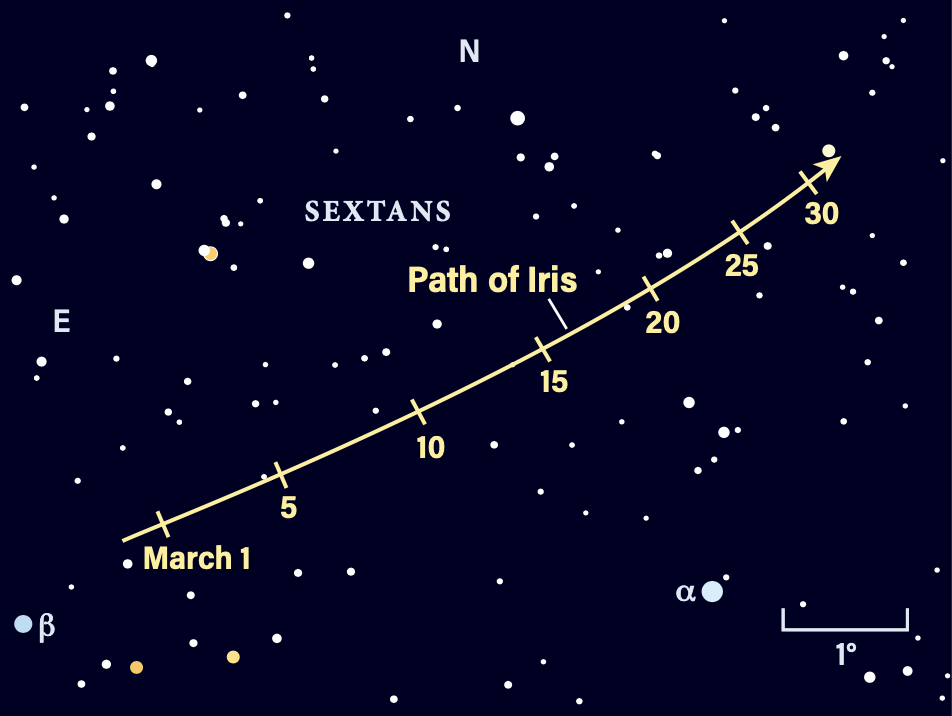
Tonight, seek out main-belt asteroid 7 Iris, currently making its way through Sextans near that constellation’s two brightest stars. This region is highest in the hour before local midnight, when it is some 50° above the southern horizon, although it’s visible most of the night, so you can begin searching soon after full dark if you prefer to observe earlier in the evening.
Sextans’ brightest star is magnitude 4.5 Alpha (α) Sextantis, and tonight Iris is just 2.5° north-northeast of this luminary. Shining at magnitude 9.3, Iris is located just 8.5’ east of a slightly brighter magnitude 8.5 field star, forming a wide double. Tomorrow night, Iris will be even closer to this sun, standing just 4’ to its northwest.
You might also notice a doublet of two stars some 0.7° northwest of Iris’ position tonight, comprising a brighter and a fainter star. Iris will quickly close in on this pair, passing near it from the 20th to the 22nd.
Sunrise: 7:07 A.M.
Sunset: 7:10 P.M.
Moonrise: 6:49 A.M.
Moonset: 7:04 P.M.
Moon Phase: New
*Times for sunrise, sunset, moonrise, and moonset are given in local time from 40° N 90° W. The Moon’s illumination is given at 10 P.M. local time from the same location.
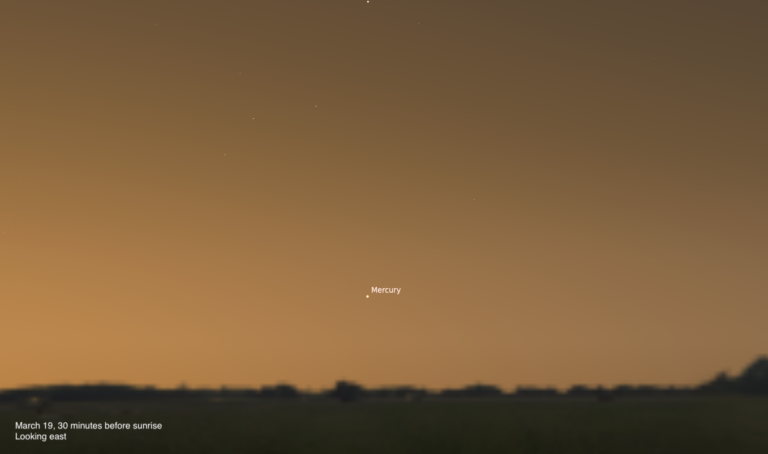
Mercury is stationary tomorrow, March 19, at 4 P.M. EDT in Aquarius. The tiny planet is visible in the mornings now before sunrise, rising just under an hour before the Sun. It’s a bit of a challenging view, but you can try catching Mercury some 30 minutes before sunrise, when it stands nearly 4° high in the east.
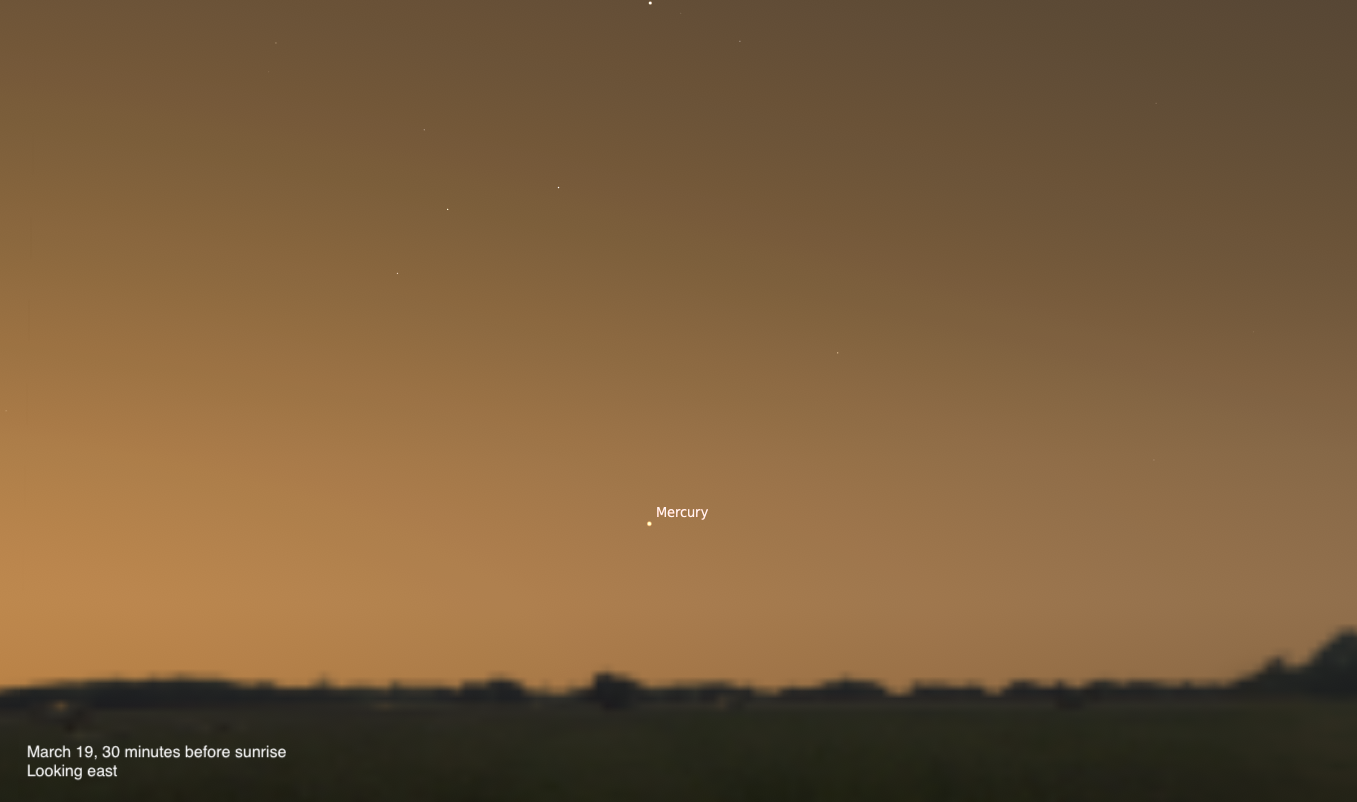
You’ll need a clear horizon and possibly some optical aid. This morning, Mercury glows at magnitude 1.3. It has been brightening as it rises higher above the horizon following its conjunction with the Sun earlier this month. The planet will continue growing brighter by the day, and will reach magnitude 0.9 by the 22nd, when it will rise a full hour before the Sun. If you have difficulty viewing it this morning, try your luck in the coming days — just make sure to put away any optics well in advance of sunrise from your viewing location, which may differ from the time listed below.
Through your optics, you’ll see this morning that Mercury’s 10”-wide disk is a slim, 20-percent-lit crescent. That phase will continue to increase as the planet brightens in the coming days.