Looking for a sky event this week? Check out our full Sky This Week column.
January 13: Ganymede’s turn to transit
Ganymede is transiting Jupiter with its shadow as January 14 opens subsequently in each time zone across the U.S. After the moon and its shadow begin their transits at 12:34 A.M. and 12:58 A.M. EST, respectively, the pair crosses Jupiter for nearly three hours. By 4 A.M. EST (now the 14th across the U.S.), Ganymede’s transit has just ended while its shadow remains visible on the cloud tops, still approaching the limb. The shadow transit finally ends around 4:20 A.M. EST.
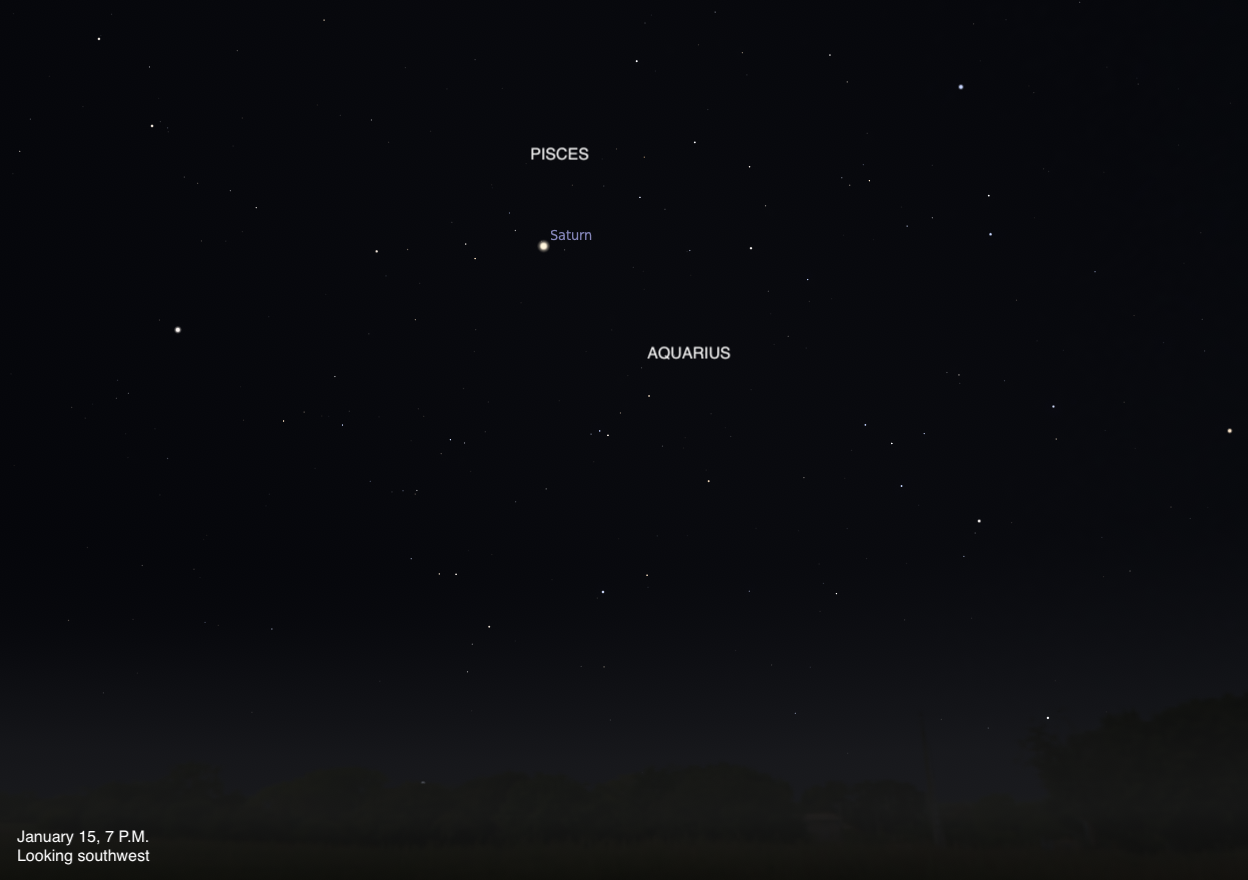
Additionally, Saturn’s two-toned moon Iapetus reaches inferior conjunction today. Telescopic observers may be able to catch the 11th-magnitude moon some 1.2’ due north of Saturn this evening. The best time to look is early evening — about 90 minutes after sunset, Saturn is still more than 30° high in the southwest, glowing at magnitude 1.0. It’s easy to pick out as the brightest point of light here.
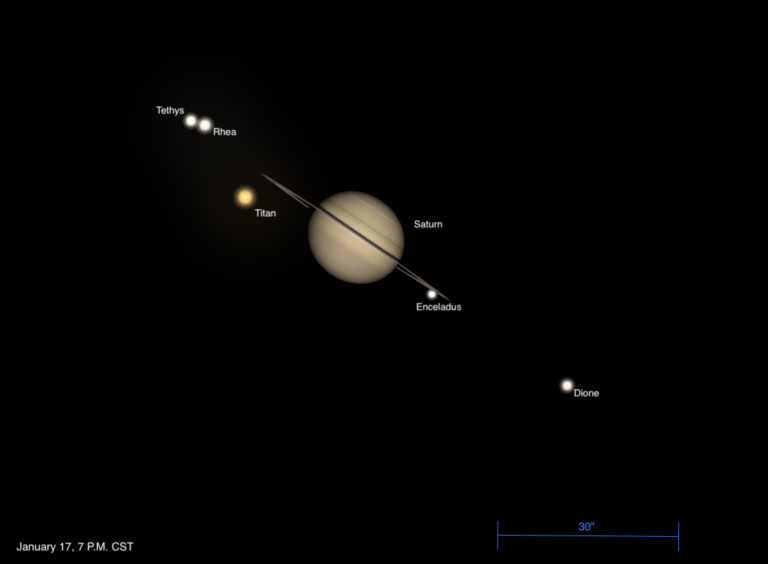
At 7:30 P.M. EST, the eastern half of the U.S. gets a special treat: In addition to Iapetus being easy to spot (thanks to its proximity to the planet), several of the ringed world’s other moons are perfectly lined up west of Saturn at this time. Farthest away is bright, mid-8th-magnitude Titan, which sits 2.5’ west of Saturn. Moving inward, you’ll spot 10th-magnitude Rhea, Dione, and then Tethys, with the latter closest to the planet. Observers with larger scopes might also be able to pick up faint (12th-magnitude) Enceladus, which lies closer to Saturn still, between Tethys and the edge of the rings.
Sunrise: 7:21 A.M.
Sunset: 4:58 P.M.
Moonrise: 4:12 A.M.
Moonset: 1:10 P.M.
Moon Phase: Waning crescent (12%)
*Times for sunrise, sunset, moonrise, and moonset are given in local time from 40° N 90° W. The Moon’s illumination is given at 10 P.M. local time from the same location.