Looking for a sky event this week? Check out our full Sky This Week column.
January 14: Iapetus at inferior conjunction
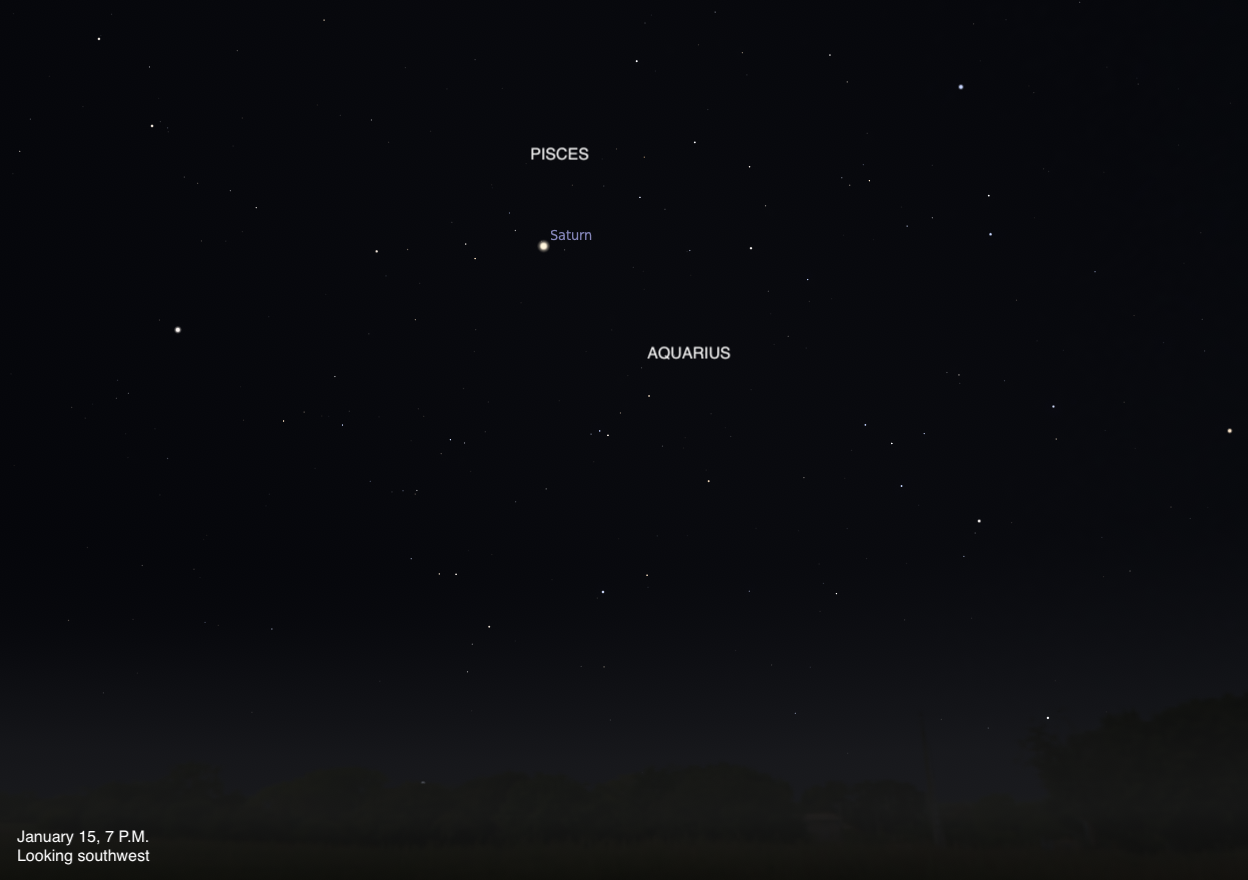
First-magnitude Saturn crosses into Pisces today, readily visible to the naked eye as the brightest light in the southwestern sky as it sinks slowly toward the horizon a few hours after sunset. You’ll want to catch the planet early in the evening, before it gets too low and the turbulent air nearer the horizon muddies the view.
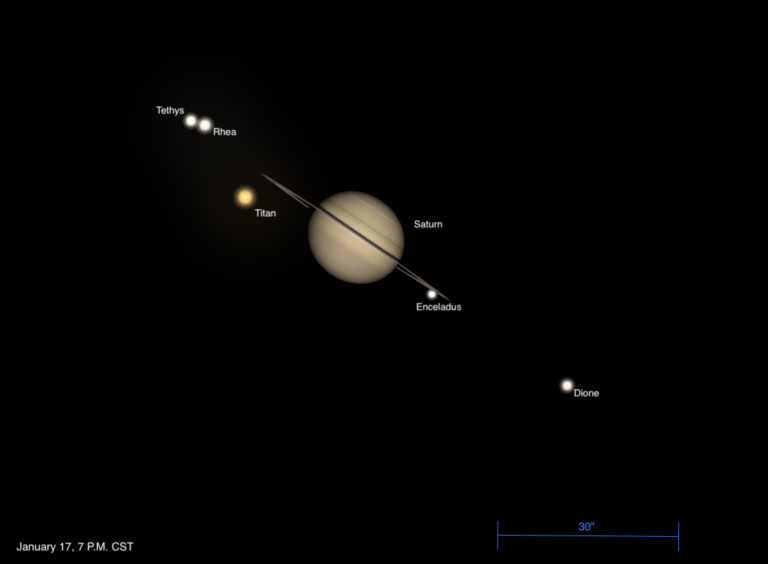
Through a telescope, take some time to admire the planet’s thin rings, now tilted by roughly 1.5° to our line of sight. While Saturn’s disk stretches an impressive 15” across, the rings are nearly 38” from end to end.
Bright Titan still lies due west of Saturn, now a little less than 2’ from the planet’s center. The inner moons have changed locations significantly: 10th-magnitude Rhea is still west of the planet early in the evening, but disappears in an occultation behind the limb shortly before 7:30 P.M. EST. Similarly bright Dione and Tethys are now east of the planet, with the former closer to the rings than the latter. Twelfth-magnitude Enceladus, if it is visible in your scope, is also east of Saturn, but closing in on the ringed world’s eastern limb for a transit beginning shortly after 8 P.M. EST, as Saturn is starting to get low for those on the U.S. East Coast. The small moon will likely be lost to view against the brighter disk.
Around 8 P.M. CST, Dione passes south of Tethys to Saturn’s east, with the planet quite low in the Eastern time zone (though experienced observers can still attempt the view). The pair may appear to briefly merge in most scopes around this time. After this, Dione will appear farther east of Saturn, with Tethys closer to the planet.
Sunrise: 7:20 A.M.
Sunset: 4:59 P.M.
Moonrise: 5:11 A.M.
Moonset: 1:55 P.M.
Moon Phase: Waning crescent (7%)
*Times for sunrise, sunset, moonrise, and moonset are given in local time from 40° N 90° W. The Moon’s illumination is given at 10 P.M. local time from the same location.