Key Takeaways:
- The article details the observation of NGC 2264, designated as the Christmas Tree Cluster, on December 24.
- This celestial object is identified as a magnitude 3.9 combination open cluster and star-forming region situated within the constellation Monoceros, positioned between Orion and Gemini.
- For optimal viewing, observers are advised to wait until 9-10 P.M. local time when the cluster achieves an altitude of 40°, utilizing binoculars or telescopes to discern its roughly triangular star pattern spanning approximately 20 arcminutes.
- While stars are visible with standard equipment, the associated nebulosity and the adjacent Cone Nebula necessitate larger telescopes, specifically those with apertures of 12 inches or greater, for detection.
Looking for a sky event this week? Check out our full Sky This Week column.
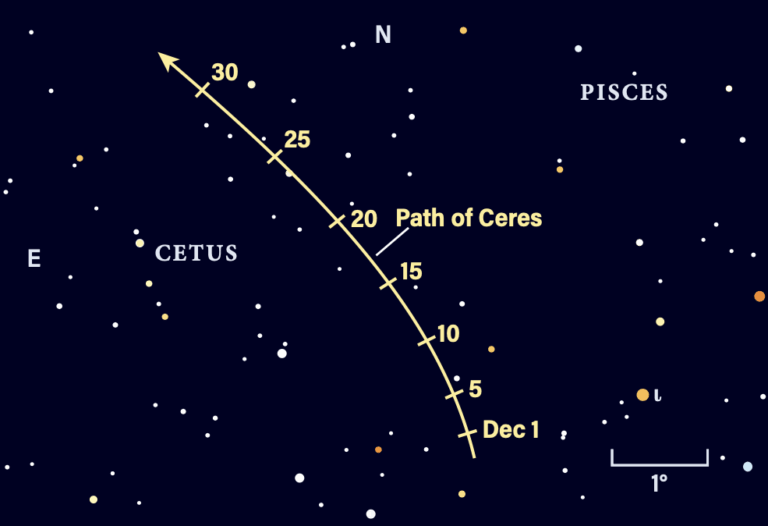
December 24: Ceres makes us see double
As Orion and Gemini rise in the east after dark, they carry between them the lesser-known constellation Monoceros. Within this star pattern is our target for tonight: the festive Christmas Tree Cluster.
Cataloged as NGC 2264, this pine tree-shaped group of stars is part of a combination open cluster and star-forming region. It lies near the Cone Nebula, which appears to reach toward the top of the tree as if to touch it.
To find the magnitude 3.9 cluster, wait until around 9 or 10 P.M. local time, when this region reaches 40° in altitude above the eastern horizon. Look with binoculars or a telescope toward the region between Orion and Gemini, about 6.5° south of 2nd-magnitude Gamma (γ) Geminorum or 11.5° east of magnitude 0.5 Betelgeuse in Orion. You’re looking for several bright stars in the rough shape of a triangle or arrowhead, pointing toward the south. (Note that this means the top of the tree might not be oriented up in your eyepiece.) The base of the tree, its trunk, is anchored by the cluster’s brightest star, magnitude 4.7 15 Monocerotis. Under magnifications of 50x, about a dozen stars will appear. Higher powers reveal more stars. The entire cluster stretches about 20’ on the sky.
Observers with larger scopes (on the order of 12 inches) will begin to pick up some of the nebulosity of the surrounding star-forming region. The adjacent Cone Nebula may start to appear as well, also visible only in large scopes.
Sunrise: 7:20 A.M.
Sunset: 4:40 P.M.
Moonrise: 10:53 A.M.
Moonset: 11:23 P.M.
Moon Phase: Waxing crescent (33%)
*Times for sunrise, sunset, moonrise, and moonset are given in local time from 40° N 90° W. The Moon’s illumination is given at 10 P.M. local time from the same location.